-
Tiruvoodal – the Divine Quarrel
As the name itself signifies, Tiruvoodal is the quarrel between Lord Shiva and Goddess
 Parvathi and it is celebrated particularly in Tiruvannamalai during the month of January, the 2nd day after Pongal. In fact there is a whole street close to the temple called ‘Tiruvoodal street’ where the main part of the festival, the quarrel itself, is enacted.
The Divine quarrel revolves around the time when one day Parvathi playfully closes the eyes of her august husband, Lord Shiva, with her hands. Utter chaos ensues. The whole universe is plunged in darkness and what was just a moment of play to Parvathi causes countless years of darkness and misery on the universe. Lord Shiva, enraged by this act of folly, punishes Parvathi which sends Her to Kanchipuram to do Tapas where She receives the assurance that after she kills the buffalo-demon Mahishasura on
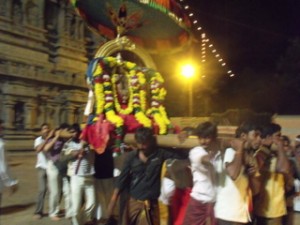 the slopes of Arunachala, She would subsequently regain the favour of her Lord and be united with Him in the left half of His body (Ardhanaariswara) and this is what is realised on the day of Karthigai Deepam.
It would seem that the Tiruvoodal festival is celebrated in Tiruvannamalai in order to commemorate the time when Shiva and Parvathi were in discordance. Nevertheless, it finishes with the divine union and brings them both back together in harmony. On the first day, there are three
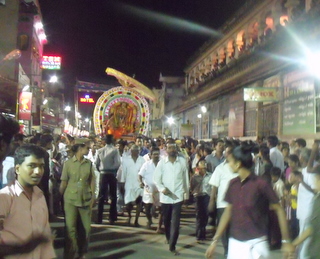
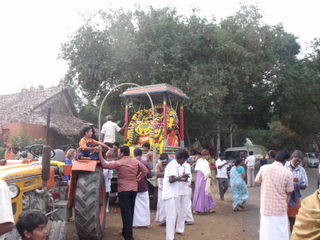
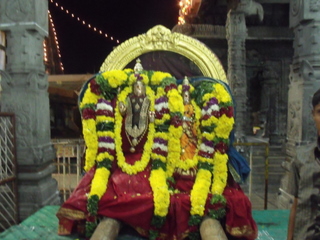
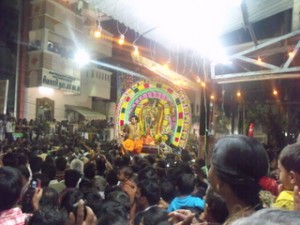 processions of the deities starting from the big temple and going on the four streets around the temple. The Utsava Murthis are Sri Mula Nayakar (Shiva in the form of Somaskanda), Tani Ambal (the independent goddess) and Sundaramurthi Nayanar (one of the main tamil saivaite saints).
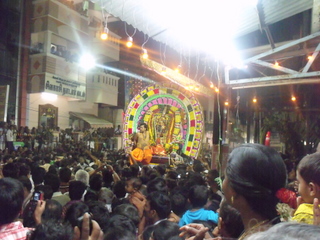
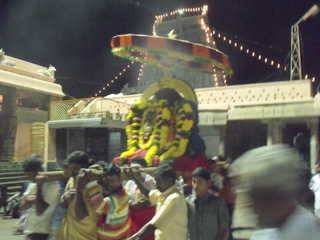
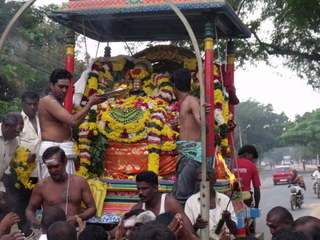
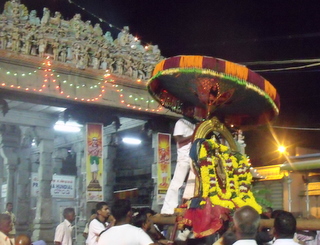
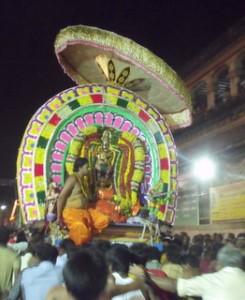
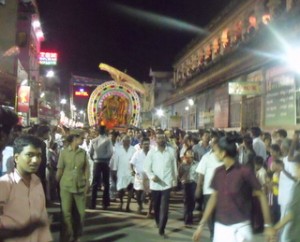 The most interesting part of the festival takes place in the evening on Tiruvoodal street. During this part, the quarrel between Shiva and His consort, Parvathi, is enacted in public on the streets and witnessed by a large gathering of devotees who are assembled there eagerly to watch the divine drama. The God and the Goddess are brought on palanquins from opposite ends of the street and then borne down to face each other. The narrative of the quarrel is chanted by an Oduvar (temple singer) in tamil lyrics. After this ensues a
 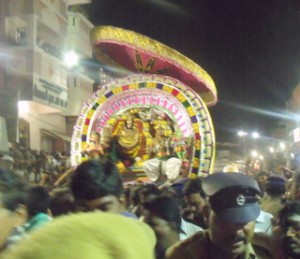 dramatic dancing procession. Six times the God and the Goddess are borne down at a great speed and then meet in the centre and
 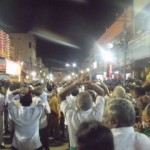 have their quarrel. This is played out by the palanquin bearrers jumping and shaking the palanquin up and down, which makes it appear as if the deity inside is jumping up and down in a fit of rage. The temple musicians play their drums in fitting accompaniment, adding to the frenzied rantings of the gods as they are shouting at each other. After each quarrel-dance, the deities change sides and each goes off in the opposite direction from which he or she came initially. The crowds of devotees are hysterical with excitement and after each dance-quarrel, the tension mounts and so do the loud cries of fervor and devotion which increase in volume and fury.
The next day, Shiva is up at dawn and leaves on Giripradakshina during which he makes
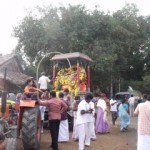 a halt at the Vedarpari mandapam where his jewels are supposedly stolen and later on he also grants salvation to his ardent devotee Kannappa. This is the reason for the Kannappa temple on that location. Shiva also grants darshan to another of his devotees the great rishi ‘Bhringi’ during this trip. Shiva eventually completes his giri pradakshina and returns to the temple in the afternoon where he enters, dancing the dance of the Swan (Hamsa Natanam). The bearers of the palanquins have a special technique to execute this dance and it causes a type of swaying, continuous oscillation of the deity without losing balance, quite a fascinating sight!
Now a ritual takes place in the southern area of the temple which covers directly the
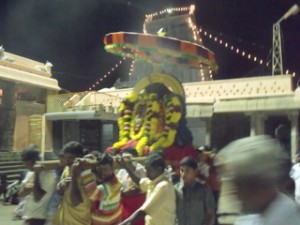 sanctum sanctorum. Sundaramurthi Nayanar first goes to warn the Goddess about the return of Shiva. Of course, She, being curious, leaves Her door open so that She can have a glimpse of the dancing arrival of Her Lord. On seeing this spectacle, however, She is so dazzled by her Lord’s beauty and splendour as He arrives
 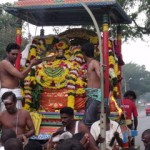 majestically doing His swan-dance, that She submits to Him and wishes to be re-united. Thus the reconciliation and reunion of the gods take place and to synchronise this, both the deities are brought together and placed on the same pedestal and the priests perform an Arathi puja waving and encircling one flame around both of the deities to signify the restoration of harmony.
continue reading
-
Pongal and Uttarayanam
 In India, the 15th of January is the day of the winter solstice (Uttarayanam) and this day is celebrated as the Pongal festival in Tamil Nadu. Pongal is essentially the harvest festival for the farmers but it is also a festival venerating the Sun God.The next day after Pongal is celebrated as the cow festival and all the cattle, both cows and bullocks are honoured on this day. In
 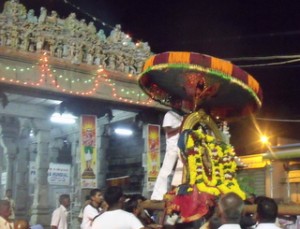 Tiruvannamalai, the Pongal festival has a special significance because Arunachala is believed to have subdued the Sun’s arrogance at one time. In lieu of this, the Sun God is believed to pay obeisance to Arunachala twice a year on the days of the winter and summer solistices. In the big temple of Arunachaleswara, there is a remarkable procession and abhishekam to commemorate this event, early in the morning of 16th January.
 In the Ramanashram, even from the days of Bhagavan, Pongal has
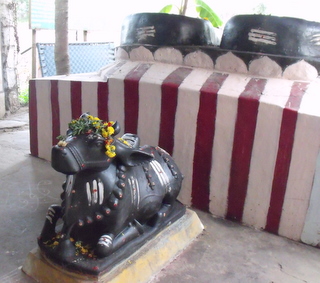
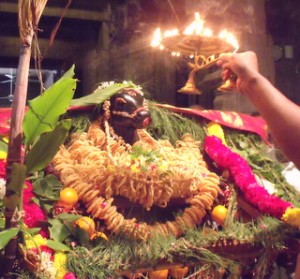
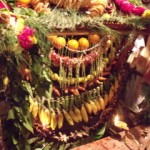
  always been celebrated well. Sri Ramana was very fond of the cow Lakshmi and He used to feed sweet pongal to Lakshmi with his own hands on Cow Pongal day. This year, on Cow Pongal day, there were three special events in the Ramanashram. First the Nandi (bull mount of Shiva) in the Mother’s shrine was decorated in a spectacular way. He was adorned with garlands of vegetables, fruits, sugarcane, grass, flowers. Vadais and other tasty sweetmeats. Then an elaborate Aarathi puja was performed by the priests with devotees looking on in rapt attention. The next event took place at the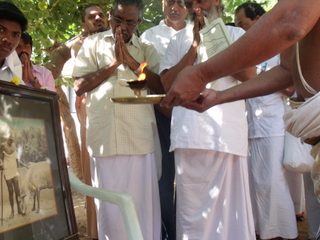
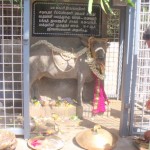
 Samadhi (tomb) of the cow Lakshmi which is located outside in the yard beside the dining hall. A group of devotees assembled here and the statue of Lakshmi was given abhishekam with milk and then a puja was performed with the photo of Bhagavan fondling Lakshmi looking on. The ashram ladies sang many beautiful hymns in praise of Lakshmi describing her devotion to Bhagavan and other touching episodes in her life like how she used to give birth to a calf every year right on Bhagavan’s birthday. Many devotees especially the older ones were moved to tears and all felt the benign presence of Ramana filling our hearts with grace.
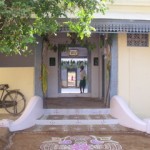 The third event happened in the cow shed of the ashram, called
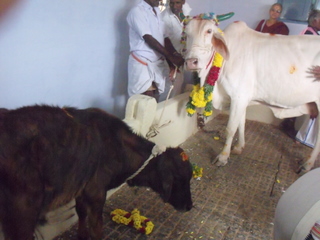
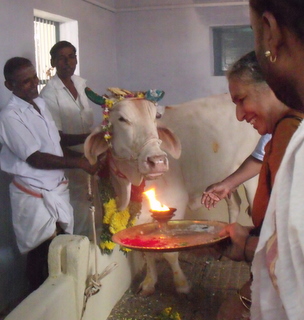
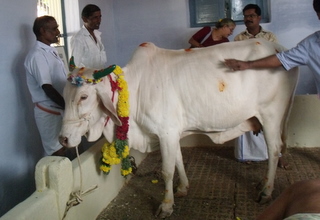
 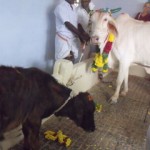 ‘Goshalai’. Inside, it was spotlessly clean and beautifully decorated with flower garlands and sugar cane and turmeric plants. In the centre, a lovely white cow (believed to be the descendant of Lakshmi) and her calf and another black cow were decorated and honoured. A puja was performed to them by the ashram priests with the same respect and energy as they would to a deity in the temple. The white cow was fed with sweet pongal from the president’s own hands and seemed to be quite content
 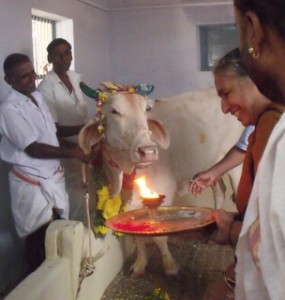 eating it. It was an enchanting scene and one felt
 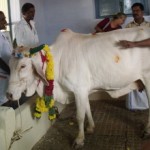 transported to times of yore when cows were treated like godly beings and people were more compassionate and respectful towards them. Let us follow the example of Sri Ramana and recognize and respect the Divine Being in every fellow creature on this earth, as in ourselves.
continue reading
-
Ashtalingams – Agnilingam – South-East
Agni is the hindu god of fire and is revered as the acceptor of sacrifices. He thus serves as the envoy from and to the other gods and as well as the envoy from humans to the gods. Because the fires of agni are lit everyday, he is ever rejuvenated and thus remains ever youthful and immortal.
 Even though Agni is the god of fire who presides over the earth, he still has a strong foothold in the hindu realm of gods. Along with Vayu and Indra who rule over the air and sky, he is one of the supreme gods in the Rig Veda. Serving as the link between heaven and earth, he plays a primary role in all Homas and Havans (vedic sacrificial worship with fire in order to gain special benefits from the gods).
Among the Ashta lingams, Agni lingam governs the south-eastern direction. The shrine of Agni lingam can be found while walking on the outer girivalam on Seshadri street which is a few metres before Seshadri ashram. There is huge theertham called Agni theertham which can be seen from the Chengam road itself and this usually overflows during the monsoon making the road into a lake.
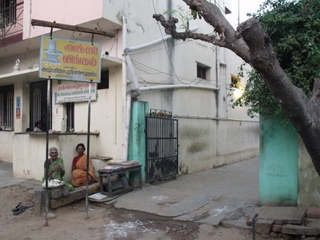
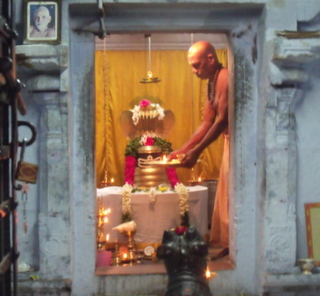
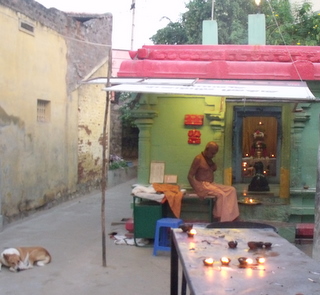 Today, the Agnilingam shrine presents a derelict appearance and attracts very few devotees on regular days. A sad-faced priest does puja in a subdued manner probably because he has not much audience. The special benefits that Agni lingam worship is believed to confer on devotees are protection from evil and reduction of harmful effects from past karmas.
continue reading
-
Girivalam shrines – Sri Ramapadam
 Legend has it that even the great Lord Rama came to Arunachala and performed giri pradakshina. Devotees probably know the story of Ramayana. In the Ramayana, Rama goes on war against Ravana in order to save and bring back his wife, Sita, who had been abducted by Ravana and placed in captivity in the Ashokavanam, a garden in Sri Lanka. After a long drawn battle in which Rama is helped by Hanuman and the monkey warriors, they succeed in winning back Sita. However in the process of the battle, Rama commits some sins due to his bad karma like killing Sugreeva from behind
  and sending Sita away to the forest.
Rama therefore incurred doshas (impurities) and underwent lot of suffering. He then went to Nandi, the divine bull and holy mount of Lord Shiva and asked what should be done in order to expiate his sins and be rid of suffering. Nandi in a thundering voice tells Rama to go to Arunachala, the holy hill, embodiment of Lord Shiva and do tapas there and circumambulate the Hill with devotion and he adds, moreover, that this was the only penance which would expiate all his doshas and purify him again. And thus Rama himself comes to Arunachala and performs giri pradakshina.
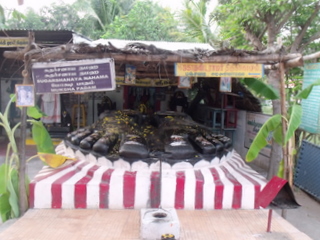
 Today, as a way of commemorating this momentous event, a shrine has been built on the outer girivalam path just a few metres after the
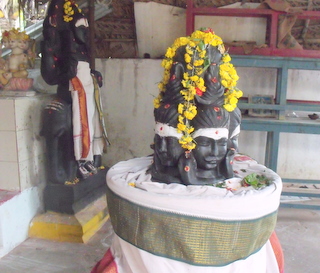
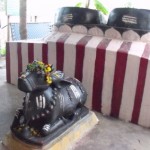
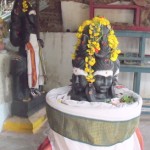
 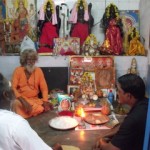 Surya lingam shrine. It presents an enormous sculpture of the feet of Sri Rama and behind is a statue of Vishnu in the form of Muralidharan. Not to be outdone, there is also a Nandi and five faced Shiva in the same courtyard. In a little room at the back covered with hindu religious images and idols sits an impish faced Swami who has made this shrine and also officiates as the temple priest. Called ‘Kaattu Swami’ he grins broadly at people and assures them that taking darshan of the Holy Feet and then going around the Hill would grant one Moksha (Liberation)…
continue reading
-
Bhagavan’s Jayanthi
Bhagavan Sri Ramana’s birth anniversary is called Jayanthi day and it is celebrated
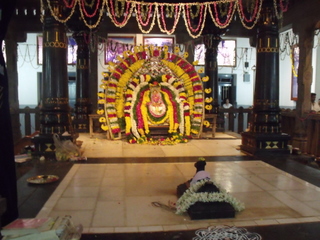 every year in the Ramanashram in a very splendid way. This year it fell on 22nd December. Early in the morning after the Dhanur Maasa puja there was special chanting of Arunachala Shiva followed by chanting of Tiruvempavai and Vishnu Sahasranaamam. Then there came the breakfast interlude. After this, the grand puja celebrating the special event was begun on the shrine of Sri Ramana’s Samadhi. This Ekadasa MahaRudra puja was performed on an elaborate scale by the priests and went on for a few hours. After the finishing Arathi, devotees were invited to partake of the sumptuous lunch Prasad meal and there was quite a scramble to get in front of the food queue. In the evening, there was a music concert by the Amritavarshini troupe from Bangalore singing their same collection of Ramana songs as they do every year.
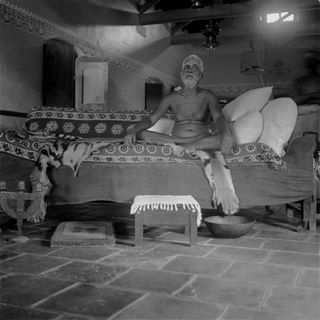 In Letters from Ramanasramam on 24th February 1947, Bhagavan is supposed to have narrated the following incident in connection with celebrating his birthday: “On one of my birthdays while I was in Virupaksha cave, probably in 1912, those around me insisted on cooking food and eating it there as a celebration of the occasion. I tried to dissuade them but they rebelled saying. ‘what harm does it do to Swamiji, if we cook our food and eat it here?. I therefore left it at that. Immediately after that they purchased some vessels. Those vessels are still here. What began as a small function has resulted in all this paraphernalia and pomp. Everything must take its own course and will not stop at our request. I told them at great length, but they did not listen. When the cooking and eating were over, Iswaraswamy who used to be with me in those days, said, ‘Swamiji ! this is your birthday. Please compose two verses and I too will compose two.’ It was then that I composed these two verses which I find in the notebook here. They run as follows :
- You who intend to celebrate the birthday, first ascertain as to whence you were born. The day that we attain a place in that everlasting life which is beyond the reach of births and deaths is our real birthday.
- Even on these birthdays, that occur once a year, we ought to lament that we have got this body and fallen into this world. Instead we celebrate the event with a feast. To rejoice over it is like decorating a corpse. Wisdom consists in realizing the Self and in getting absorbed therein.
This is the purport of those verses. It appears that it is a custom amongst a certain
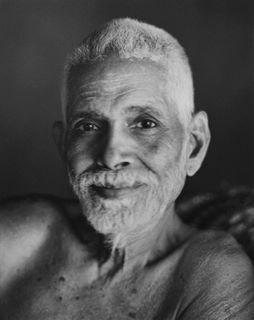 section of people in Malabar to weep when a child is born in the house and celebrate a death with pomp. Really one should lament having left one’s real state, and taken birth again in this world, and not celebrate it as a festive occasion.”
continue reading
-
Arudhra Darshanam
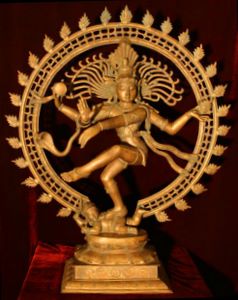
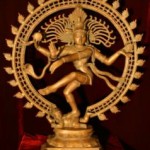 Arudhra Darshan is a very important festival dedicated to Lord Shiva Nataraja. It falls in the tamil month of Margazhi which begins in mid December and goes upto mid January. It is on the full moon night of the Arudhra (Orion) constellation that Lord Nataraja is believed to perform his cosmic dance and thus He upholds the five-fold activities of the universe. Arudhra signifies the red flame and Shiva performs his dance in this red-flamed light.
The cosmic dance of Lord Shiva represents five activities – Creation, Protection,
 Destruction, Embodiment and Release. In essence, it represents the continuous cycle of creation and destruction. This cosmic dance takes place in every particle and is the source of all energy. The Arudhra Darshan festival celebrates this ecstatic dance of Lord Shiva-Nataraja, the Cosmic Dancer.
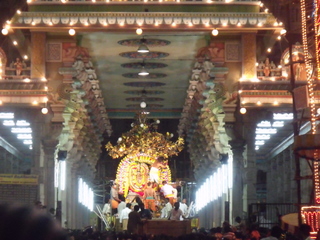
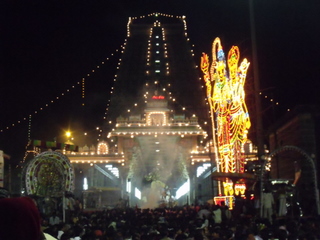 This year Arudhra Darshanam in Tiruvannamalai takes place on the full moon night falling on 22nd December. Millions of people will walk around the holy hill of Arunachala. In the big temple of Lord Arunachaleeswara, Arudhra is celebrated as a Nataraja Utsavam and there will be many special pujas and rituals involving sacrificial fires and grand abhishekams to the deities of Lord Nataraja and his consort Goddess Shivakami.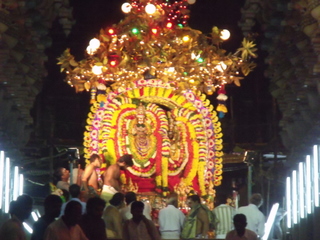
For Ramana devotees it will also be a special day because it marks the preceding night of Sri Ramanas birth anniversary which one may remember, happens on the next day.
continue reading
-
Sama Veda chanting
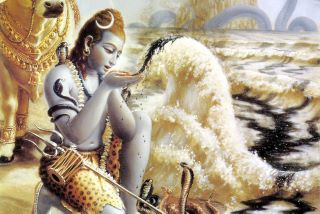 The Sāmaveda, (in sanskrit sāman means melody and veda means knowledge), is the second of the four Vedas. Its earliest parts are believed to date from 1700 BC and it ranks next in sanctity and liturgical importance to the Rig veda. It consists of a collection of hymns, portions of hymns, and detached verses, all but 75 taken from the Sakala Sakha of the Rigveda, the other 75 belong to the Bashkala Sakha, which are to be sung, using specifically indicated melodies called Samagana, by Udgatar priests at special Homas and Yagnas, in which the juice of the Soma plant, clarified and mixed with milk and other ingredients, is offered as propitiation to various deities.
The Sama Veda is the Yoga of Song. It consists of various hymns of the Rig Veda put to
 a different and more musical chant. Its secret lies in its musical annotation and rendering. The Sama Veda represents the ecstasy of spiritual knowledge and the power of devotion. If the Rig Veda is the knowledge, then the Sama Veda is its realization.
 Lord Shiva is believed to be a great fan of the Sama Veda chanting and in the epic Ramayana, Ravana gains the special favour of Lord Shiva by singing the Samaveda ganas to him while playing on his veena. This is how he was able to have so much power and create havoc in the life of Lord Rama.
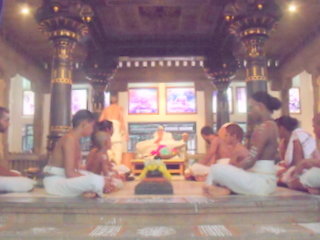
During the recent Karthigai Brahmotsavam, the Ramanashram hosted a group of Samaveda Udgatar priests from Kerala who rendered an excellent chanting of selections from the Samaveda, every afternoon,
 for all the ten days of the Utsavam. Devotees both indian and western listened to this chanting and found that the sounds were most conducive to their mediative practices.
continue reading
-
Deepam in Ramanashram
 People may wonder how Deepam was celebrated when Bhagavan was alive. Here is an account of it by Suri Nagamma in Letters from Ramanasramam:
In the afternoon from 3 o clock onwards the devotees started making preparations for the festival. At the Asramam the floor was decorated with lime and rice powder, floral designs and mango leaf festoons. On such occasions the crowds which come to town for this festival usually visit the
 asramam in the morning as they go round the Hill, whereas in the evening it is mostly the Asramites who are present at the Asramam celebrations…
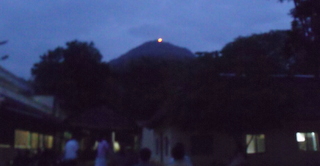
On this evening when Bhagavan went out the attendant placed his couch in the open space facing the summit. Opposite the couch a large shallow iron pan was placed on a high stool, ghee poured into it and a wick placed in the centre. We then sat in rows, the men on Bhagavan’s right and the women on His left. The space in front of Bhagavan was filled not only with baskets of flowers but also with vessels of all sorts of sweetmeats and other preparations. When the ghee brought by the devotees was poured into the pan for
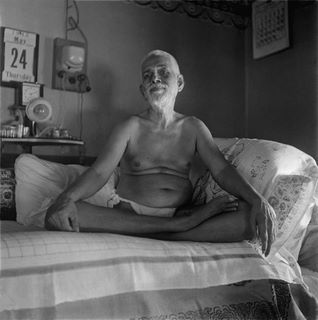 kindling the light, the pan was overflowing. Camphor was then placed on the wick. The fragrance from the lighted incense sticks spread on all sides and created a holy atmosphere. Bhagavan sat lovingly looking at all the devotees and related to those near Him the significance of the festival of Light. He also pointed out the exact place where the light was to be kindled at the top. Everyone was eagerly awaiting the lighting of the sacred beacon on the Hill top. While His gaze was concentrated on the summit of the hill, ours was concentrated on His divine face, for it was just a reflection of Arunachala. With the firing of crackers at the temple, the light on the Hill top appeared. Immediately the Akhanda Jyothi (perennial light) opposite Bhagavan was lit. The brahmins rose and chanted the mantra, “Na karmana na prajaya dhanena” and lit the camphor. After Bhagavan had partaken of a little fruit and some sweetmeats, the rest were distributed amongst the devotees. Immediately after that the devotees divided themselves into
 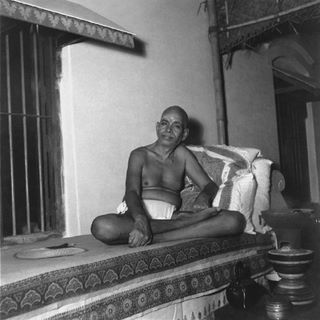 two groups, singing the hymn Aksharamanamalai. After that, the five stanzas beginning with “Karunapurana Sudhaabhde” in Sanskrit and its equivalent in Tamil were recited. Bhagavan sat resting His cheek on His hand, His characteristic pose. His face appeared as though mirroring His Self-Illumination, what with His silence and His profound thought reflected on it. The moon rose in the East and cast its light on Him as though seeking its light from Him…
continue reading
-
The Maha Deepam of Karthigai
 The glorious festival of Karthigai Deepam came to its culmination on Sunday 21st November. On this day the flame or the holy beacon is lit on the summit of Arunachala hill. The prelude to the Lighting of the Great Flame started inside the big temple at 2 o clock in the morning. At this time, a Yagna or sacred fire Homa is kindled in the Mahamantapam while the Abhishekam to Lord Arunachaleswara is performed in the inner sanctum.
 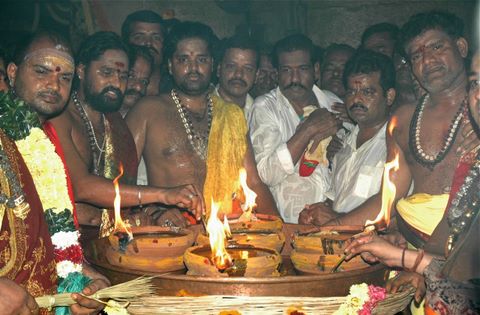 After the puja, Arathi is done by the priests by lighting a huge chunk of camphor on a golden plate and waving it around the Lord. The temple bells start clanging and the musicians beat on their drums. Amidst all these sounds, the temple walls resound with loud cries of devotion. The Arathi is brought outside and
 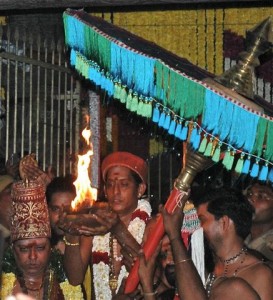 shown to the five lamps lit on earthen plates for which the Yagna has been going on. This is Bharani Deepam, the prelude to Karthigai Deepam. Its significance is that the universal Lord manifests as the five elements during the day and in the evening He again becomes the One Absolute Being and shines as Tejolinga when the Deepam is lit on the Hill. (Bharani is one of the 27 stellar constellations through which the moon is believed to pass through successively each day and according to the hindu almanac, Bharani precedes Krithika which is the constellation of Karthigai Deepam).
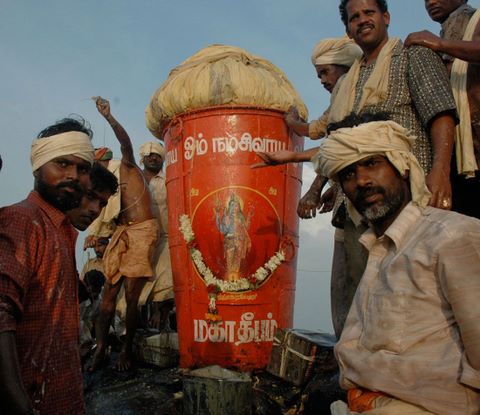
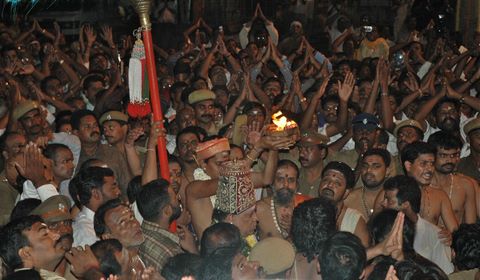 The earthenware lamps of Bharani Deepam are taken in procession around the temple. A fire torch is lit from these lamps and taken to the Hill top. Here on the summit there is a huge copper cauldron filled with ghee (poured in by devotees) and a wick made from many metres of cotton cloth rubbed
 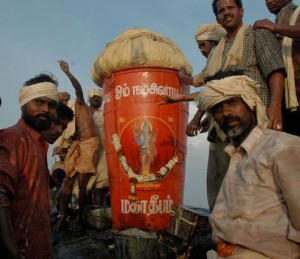 with camphor after being steeped in the ghee. Millions of people have already arrived since morning and start walking giripradakshina around the Hill. The roads are packed with an ocean of people still increasing as the day goes by.
 Around sunset, at 6 p.m. to be exact, the deity of Lord Ardhanaareeswara is brought out
 ceremoniously and installed in the DeepaMantapam in the big temple, facing the Hill. After Arathi is shown to the Lord, a thundering blast of fire crackers gives the signal to the men on the summit of the Hill to light the Flame. It is a Full Moon night and as the sun sets in the western sky and the beautiful full moon rises in the east, the flames of the Maha Karthigai Deepam spring forth into
 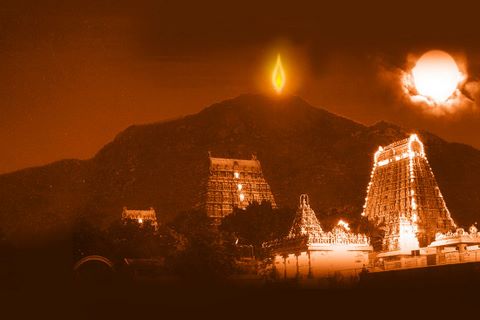 the sky on top of Arunachala, creating a wave of ecstatic devotion among all the people. A tremendous roar of “Annaamalaiyurukku Haro Haraa” is heard from all directions. The Deepam burns brightly and fills our hearts with the powerful and vibrant presence of the Lord. Everyone
 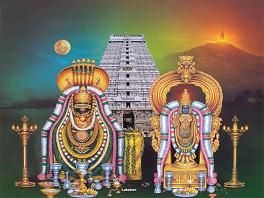 stands awe-stricken in front of this splendid sight and thousands fall down on their hands and knees doing Pranaam to the Great Lord. And thus the great festival of Deepam is completed. True Completion happens when it is not only outside with the Lighting of the Flame but also inside when the Flame of Jnana is lit correspondingly in the heart of each being.
continue reading
-
Maha Ratham – The Great Chariot
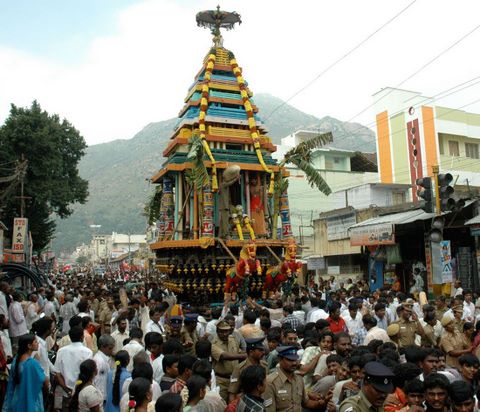 Thursday 18th November is the day of the Maha Ratham or the Great Chariot in the Karthigai Deepam Brahmotsavam. Today, the great wooden chariot which is supposed to be the largest temple chariot in Asia was taken on procession around the four streets of the temple. The main great chariot carried the stately figures of Lord Arunachaleswara and his consort Goddess Unnamulai whereas the smaller chariots carried the deities of Lord Muruga, Lord Ganesha and Goddes Durga respectively.
Early in the morning, thousands of men and women
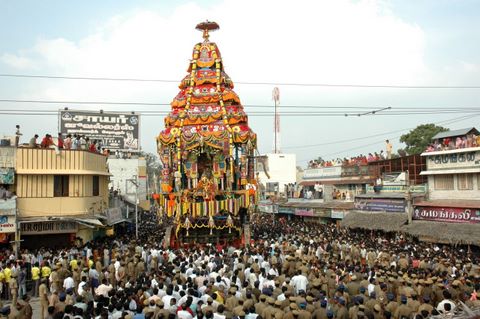 flocked the venue of departure in front of the Raja Gopuram, eager to pull the chains of the chariot thus having the honour of drawing their Lord’s vehicle.When the signal was given, men and women with great enthusiasm and crying loudly “Hail to Annamalaiyar” started to draw the great chariot with all their might. Slowly, inch by inch, the huge chariot moves and as the pull force increases it gains momentum and moves faster.
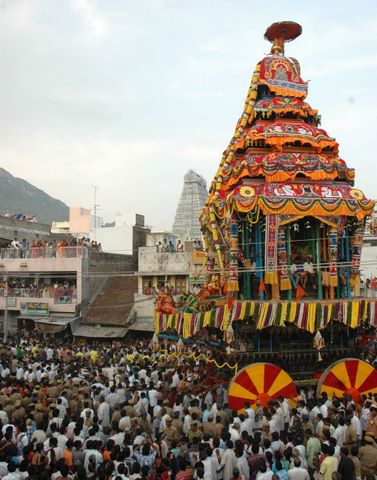 It is indeed impressive to see the gigantesque enormous wooden chariot move forth slowly and majestically, drawn entirely by man power. The chariot is made of rose wood and has beautiful carvings of divinities on its sides. The top is decorated attractively with silk canopies, banana and coconut fronds and flower garlands. The Temple Sivacharyas in royal attire are seated on either side like footmen to the Gods and they wave lovely peacock feathered fans to keep the Gods cool and airy during their procession.
And thus the great chariot winds its way down the
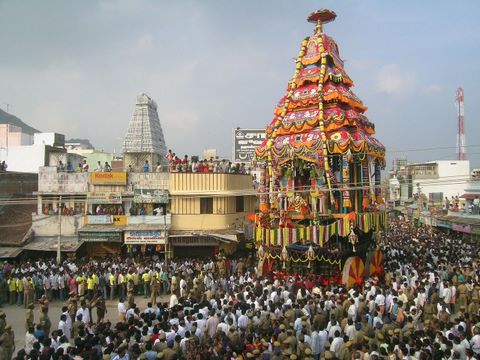 temple streets. By the time it has reached the western street, it is evening and the sun has started to set. The golden rays of the sinking sun shine through the peaks of the Hill. With the Hill view, the golden sunset, the soaring temple towers and the Lord majestically riding on his great chariot in the centre, it makes a spectacular sight and one feels that the gods themselves are down there admiring the show!
continue reading