-
Krishna Jayanthi
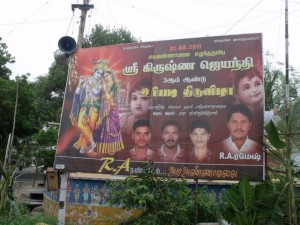 The birth anniversary of Lord Krishna is celebrated as Krishna
  Jayanthi. Krishna was born on the Rohini star on Ashtami day. The celebrations in the households consist mainly of ritual fasting during the day, spending the whole night in the worship of Krishna, chanting hymns in praise of Krishna and reciting prayers from the Bhagavatham. After the puja ceremony in which the idol of Krishna is venerated with flowers and lamps, sweets and butter are offered up as Prasad and then eaten by the whole family.
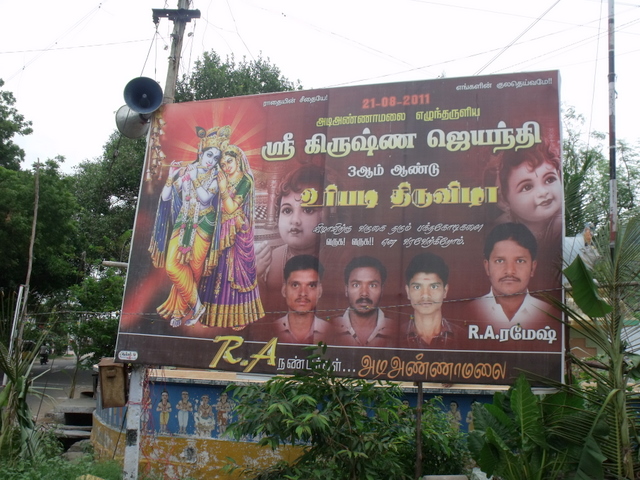
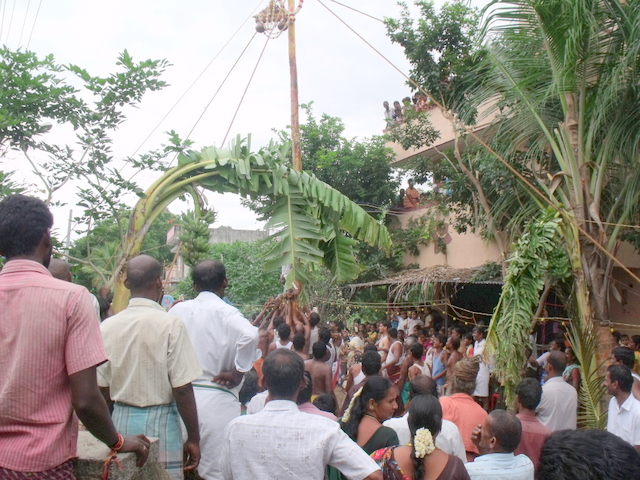
 In the village of Adi Annamalai, Krishna Jayanthi is celebrated by
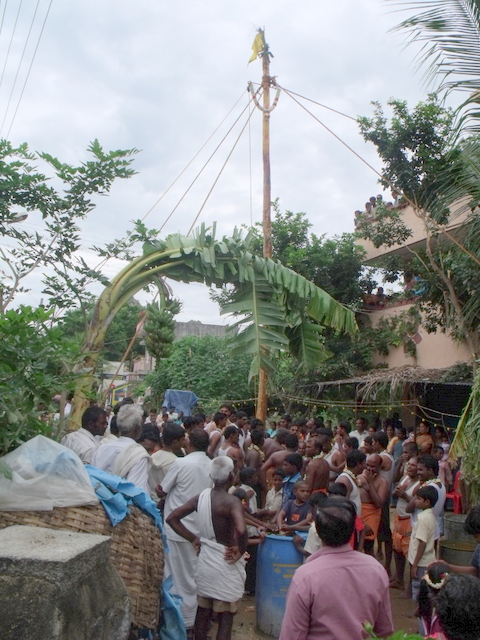
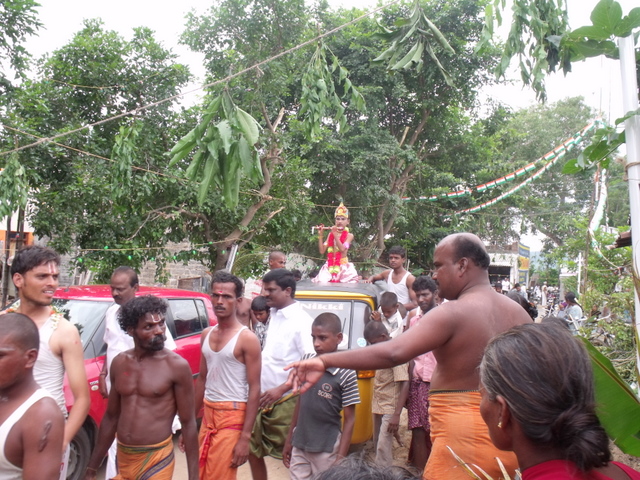
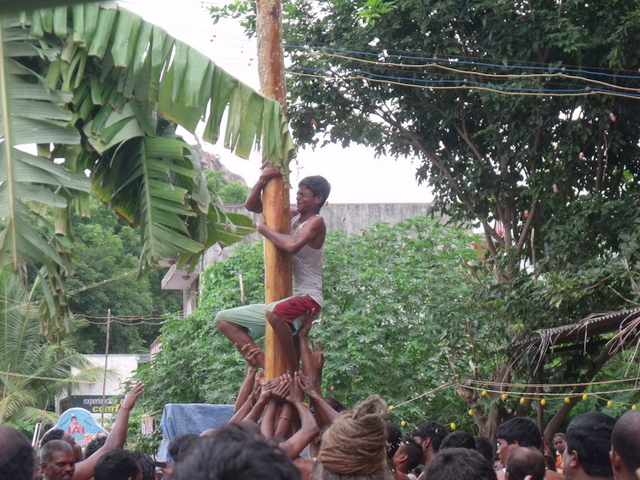
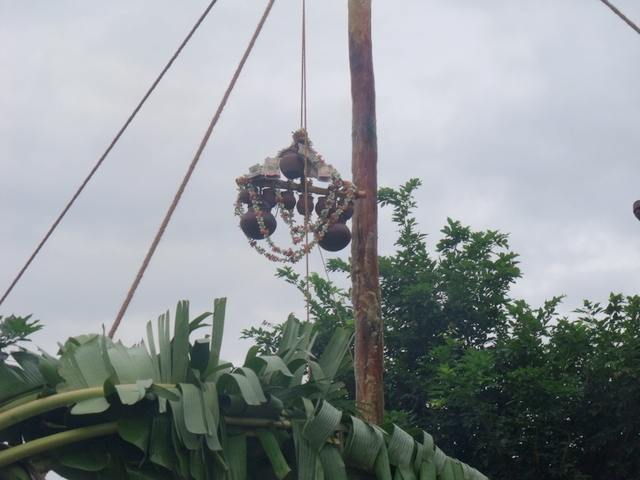
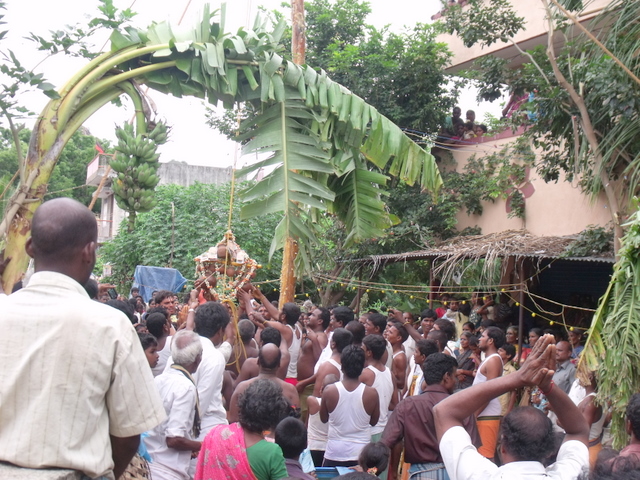
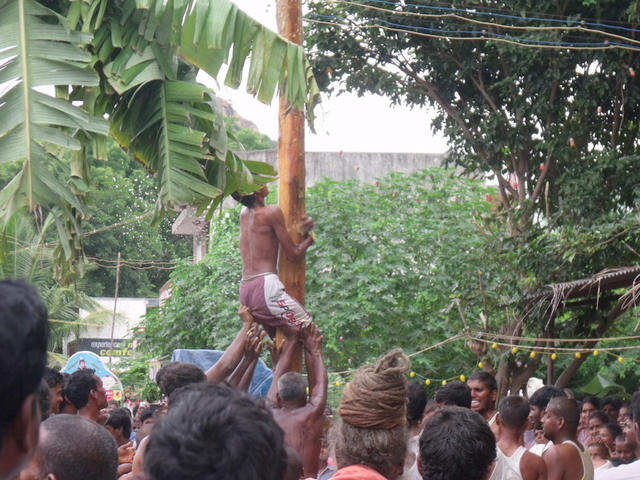
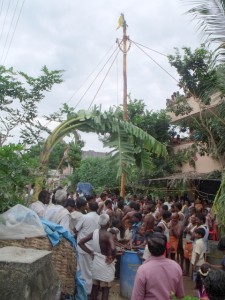
 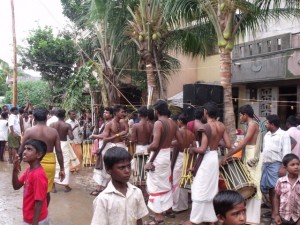 the village people under the name of “Uri Yadi Vizha” literally meaning ‘Beating the pot festival’. A high pole is erected in the centre of the village square. On the high end of the pole hangs the booty, many earthenware pots with money and sweets stashed inside. The sides of the pole are rubbed down with butter making it difficult to climb. The celebration takes the form of a contest. All the able bodied young men of the village, especially those of the Yadava community, vie with each other to climb up the slippery pole and hit the pots with a stick and break them, thus winning the prize of money and sweets that is contained inside.
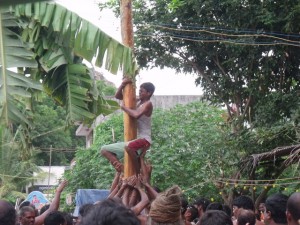 It is quite an entertaining spectacle. While each man tries with
 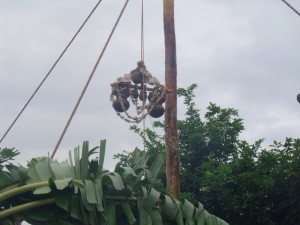 great hardship to climb up the butter smeared pole and hit the pots, his task is made even harder by the crowd who throw buckets of water at him during his arduous ascent. Many of them get deterred and slip down the pole without being able to hit the pots with the stick. Then another tries and
 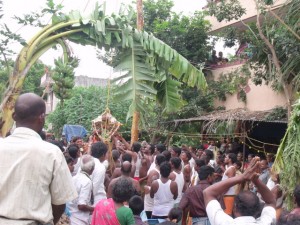 yet another and it goes on. Finally towards nightfall, a tough, undaunted lad reaches the top in spite of the slippery slide and the water drenching him and manages to hit
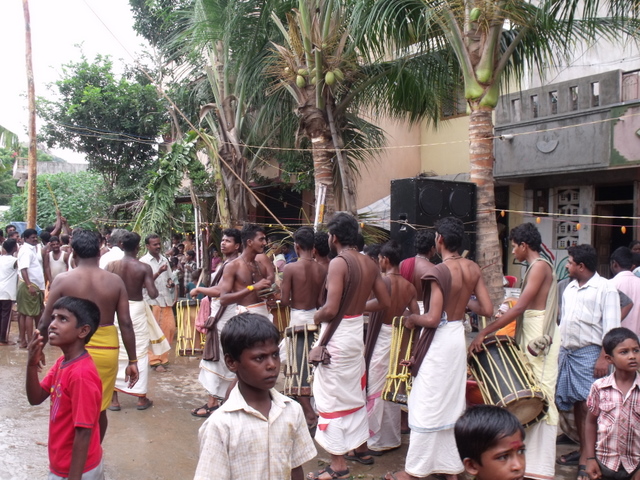
 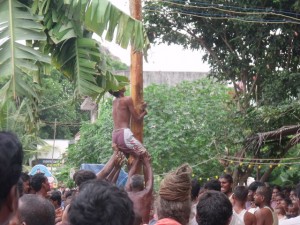 one of the pots with a resounding thwack. The pot breaks and sweets come cascading down on the crowd. Children laugh and rush gleefully to grab the sweets. Loud cries of Govinda! Govinda! rent the air. The
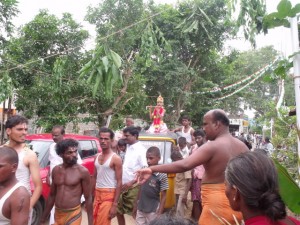
 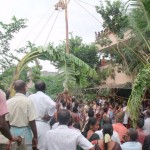 drummers play with frenzied energy. Then more men feel encouraged by this hit and are able to climb up and break other pots. In the end all the pots are broken. Three of four men have been declared winners and the prize money is equally distributed between them. The crowd disperses slowly. Later on, an abhishekam is done to a small idol of Krishna in the same place and the prasad is shared by all.
continue reading
-
Arunachala, a geological view
 According to a geological study of the Continents, it seemed that the continents were once a huge mass of land, part of an ancient super continent Pangea. In course of time this huge mass of land broke up into fragments which began to drift, forming the present continents. Certain continents (S.America and Africa, Africa and India with Madagascar in between; India and Australia; and Antartica) now far apart seem to fit together if joined. A study of positions of magnetic poles measured from rocks in two of the continents likewise indicated relative
  movement between the two continents. Also the geological structures and formation of rocks particularly charnockite seem to perfectly fit as one single mass when these continents are put together. The distribution of certain flora and fauna belonging to Gondwana Land – supercontinent Pangaea, which is the convergence of the movements of continents about 350 million years ago.
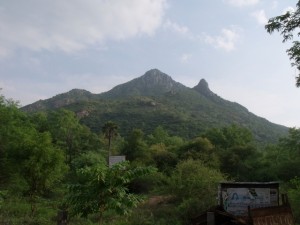 The section of land from Tiruvannamalai towards Villupuram contains various stages of migmatisation of charnockite (of Tiruvannamalai it is 2.55 billion years) and the associated members culminating in the formation of Gingee pluton (2.5 billion years). The evidence gathered from geological studies made in Tiruvannamalai during the 1970’s throws light on the formation of the charnockite and related assemblages of rocks older than 3000-3500 million years. The rock formation in this section as explained in the process of migmatisation of charnockite and associated rocks in phases culminated in the evolvement of Gingee Pluton consisting of granite composition.
A detailed study of the world mountains, with particular reference to India, reveals the
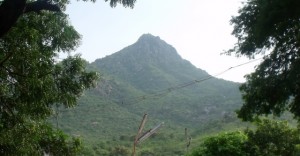 following features : The world’s famous mountain ranges like the Alps, the Rockies, the Andes, the Himalayan and Applatian ranges contain high peaks at very high altitudes, but geo-chronologically they do not come under the Archaeon period and belong to younger ages. The upheaval of the Himalayas was not a continuous process but took place in four phases. Himalayan ranges are less than 50 million years old, whereas the upheaval was in one single phase for the holy hill of Arunachala.
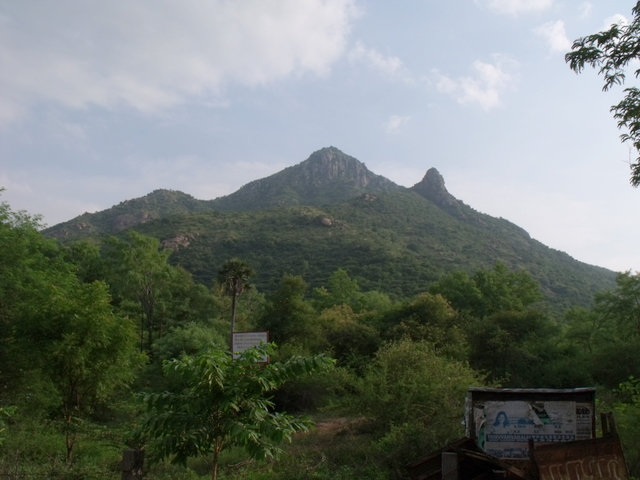
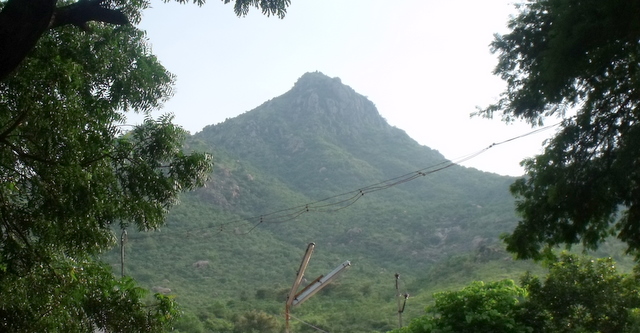
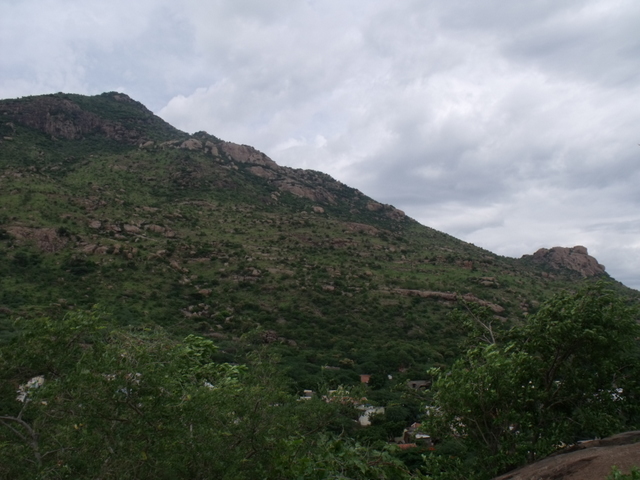
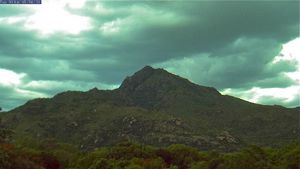
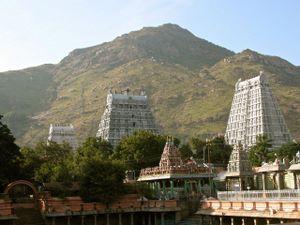
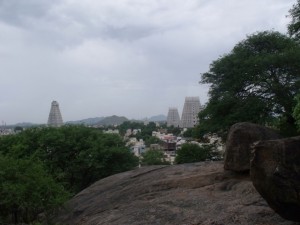 The Tiruvannamalai hill is an imposing landmark with an elevation of 2634 feet and is the highest peak in the hill ranges found conspicuously in the western and southwestern directions of Tiruvannamalai; the eastern and southeastern parts of Tiruvannamalai on the other hand are gently undulating plains dotted with few knolls and mounds. Also it would appear that
 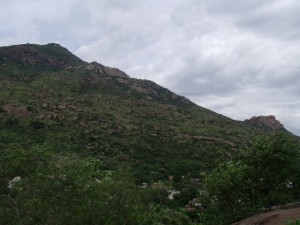 among other mounainous belts, the Deccan plateau in Southern India including Tiruvannamalai is one of the areas of little or no tectonic activity i.e. seismologically these belts have not changed their characterisitics drastically over a long period of time. In recorded history the origin and flow of rivers, homosapiens, flora and fauna are geo-chronologically far later developments.
From the above inferences, it is clear that the holy hill of Arunachala is older than the Himalayas (mount Everest or Kailash) and hence the oldest natural shrine in the world. And so, Manickavasagar, one of the ancient 63 Tamil saivaite saints hails Lord Arunachala as ‘older than the oldest’ and ‘later than the latest’.
(courtesy: French Institute Research studies on Tiruvannamalai and Ramana’s Arunachala by Devotees)
continue reading
-
Aadi Padhinettam Perukku
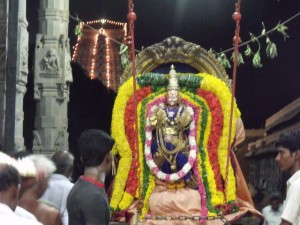 Aadiperukku is a festival celebrated on the 18th day of the Tamil
  month of Aadi (Mid july -August). This year it happened on the third of August. This festival is also called as “Padinettam perukku” – Padinettu -means 18 and Perukku signifies a great rising. The Aadi month falls during the south-west monsoon period and during this month all the south Indian rivers would normally get flooded by the rains. Aadi Perukku is celebrated in Tamilnadu and it is a time of rejoicing for the farming community who live on the banks of the main rivers and their tributaries. People perform special pujas to the river on this day. Hundreds of devotees, especially newly married couples celebrate this festival and worship the Mother Goddess on the banks of the river.
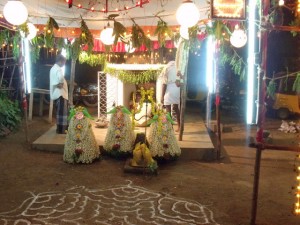
 In Tiruvannamalai, due to the absence of a river in the town, Aadi Perukku is celebrated within the precincts of the big Temple. The Mulaipari ritual in which 9 types of grain
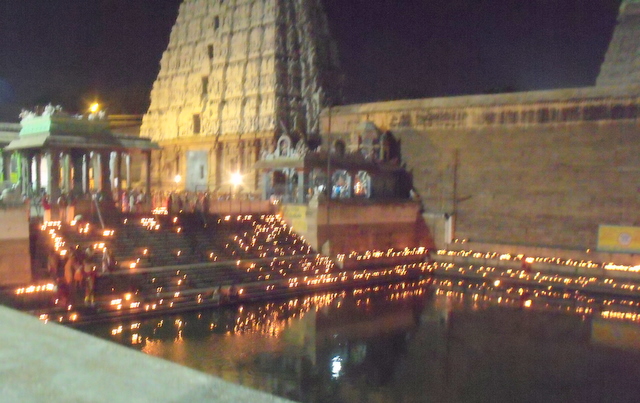
  are sown in earthenware pots and then brought as offering to the Goddess, takes place outside the Pidari Amman shrine. This ritual is performed as a prayer to the Goddess to provide a plentiful monsoon and for fertility of the land and to have a bountiful yield from the crops. Women also float clay lamps on the Brahma Theertham of the temple and this is quite a lovely sight at night.
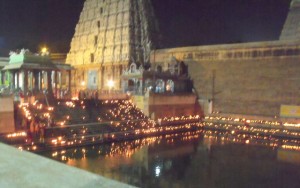 Subsequently, there is also the Aadi Puram festival which is
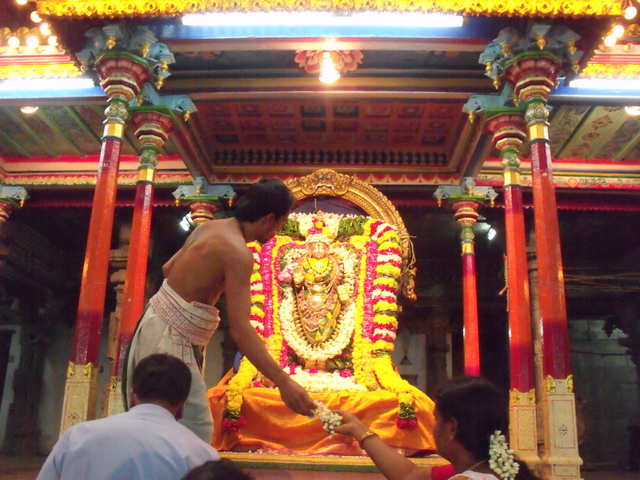
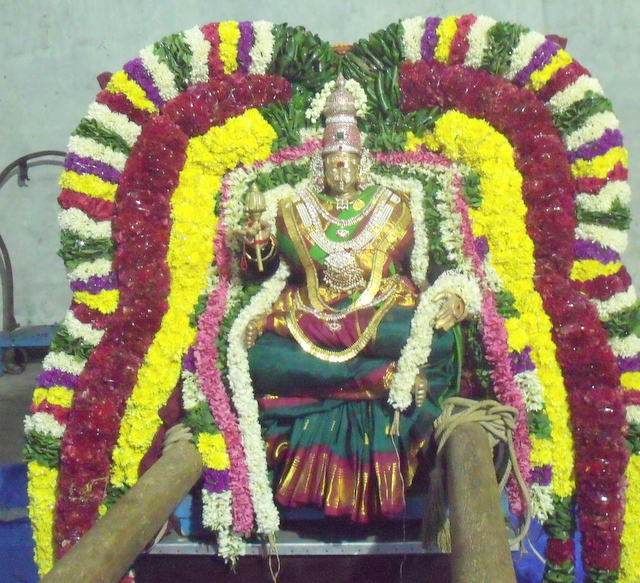
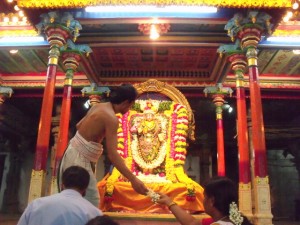
 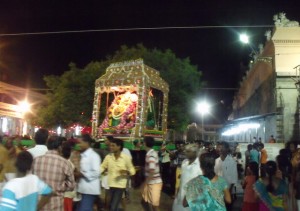 celebrated in the big temple. During the celebrations, the Goddess Parashakthi is brought to the ‘valaiyal kappu mandapam’ in the 5th courtyard. Here, first the Goddess is worshipped with a grand abhishekam. Then
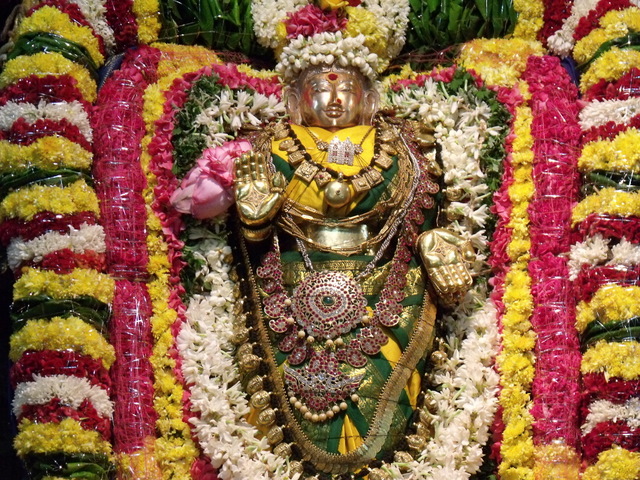
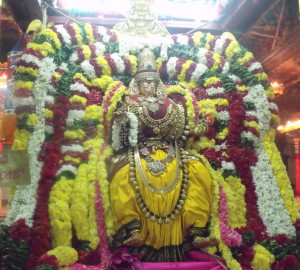
 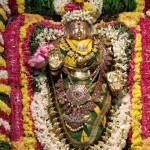 She is beautifully adorned in a silk sari and decked with golden ornaments and flowers. After this a long queue of women devotees offer bracelets and
 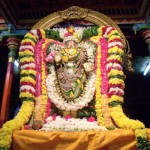 bangles (valaiyal) to the Goddess. The priest places the bracelets on Her arms and then returns them to the women as prasad. Rudram is chanted by the Vaidikas (brahmin vedic scholars) all the while. And thus the festive month of Aadi draws to a close and with these final two festivals it is believed the Mother Goddess to whom this month is consecrated, would have been ideally propitiated and Her blessings would be abundantly showered.
continue reading
-
the Living and the Dead
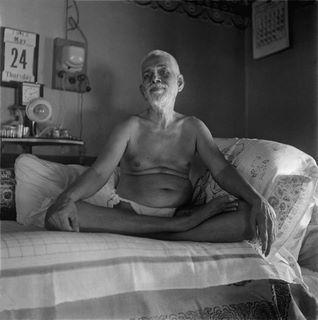
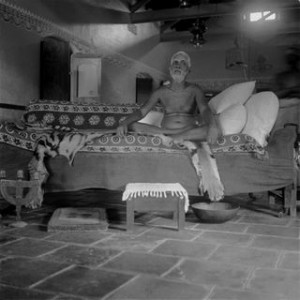 During the time when Sri Ramana used to sit in the old Hall of the ashram, one day there arrived a sadhu among the gathering. He approached Bhagavan and said, “Bhagavan! It is said that the Self (Atman) is present in everything. Does that mean that the Self is to be found, even in a dead body?” Bhagavan replied, “Oh! This is what you want to know, is it? Is it the dead body who wants to know, or is it you? Who is asking the question?. The Sadhu replied, “it is I who want to know, Bhagavan.”
Then Bhagavan explained: While you are asleep, do you wonder,
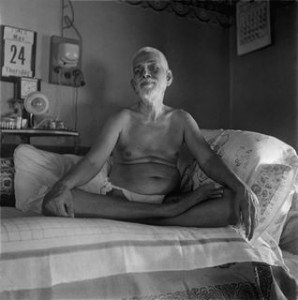 Am I here or not?. It is only in the wakeful state that you say, ‘I am’. Similarly, the Self is definitely present even in a dead body. But if you enquire further, you will realise that both the dead body and the living body are equally illusory. That which moves, we label as being ‘alive’, and that which is motionless, we say is ‘dead’. The differentiation is only in our minds. In our dreams, we see both the living and the dead. As soon as we wake up, we realise that both the living and the dead of our dreams are but illusions. In the same way, this entire universe is nothing more than a grand illusion. The birth of the I thought is referred to as birth and the disappearance of the I thought is death. Both birth and death are for the ego alone. Neither birth nor death can touch the I which forms the essence of your being. When the awareness of the Self is strong, you are there; you are equally there when the self-awareness fades. It is ‘you’ that is the source of the ‘I-thought”. But the ‘I-thought’ is not you.
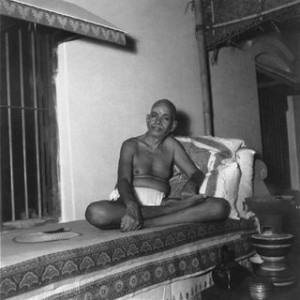 Realisation is nothing but perceiving the source of the cycle of birth and death, and uprooting the ego and destroying it completely. That is, you must ‘die’ and still remain aware. He who dies with awareness is transformed into pure Self. That is, when the ego dies, the Self is born. When this happens, all doubts vanish immediately. The veil of illusion is lifted and everything is perceived properly. All confusion is removed. The differentiation between birth and death, living and dead, everything disappears. The Self is all-knowing. The Self has no doubts. It is only the ego that is plagued by doubts.
 – (from Cherished Memories by T.R.Kanakammal)
continue reading
-
Aadi Velli in Pachaiyamman kovil
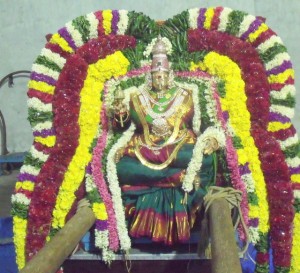 The Tamil month of Aadi (mid July to mid August) has begun and
 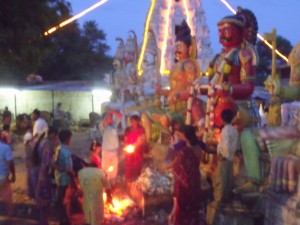 with it a plethora of religious events related to the Mother Goddess to whom this month is consecrated, have also begun. The Fridays of this month are most auspicious for married women and they perform various rituals and religious customs like fasts and vows for the well-being of their spouses on these Fridays known in Tamil as Aadi Velli.
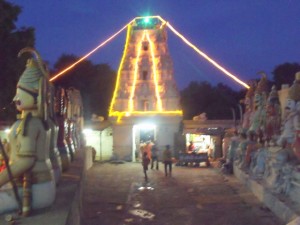 The Pachaiyamman Kovil, home to the Green Goddess, nestles in
  the heart of the Arunachala foothills and beckons benevolently to women devotees to come and take her abundant blessings. Goddess Pachaiyamman is a form of Shakthi or Parvathi. Legend has it that Parvathi came to Arunachala to perform tapas during puranic times and settled down in this area. In the
  beautiful energy created by her devoted tapas, everything around turned green including her body and thus She was given the name of Pachaiyamman, the Green Mother. In later days, a shrine was built here to venerate the Green Goddess at this spot. It is here that Bhagavan Ramana resided during the plague epidemic and tigers and leopards used to visit him here and pay their respects to the Divine Incarnate.
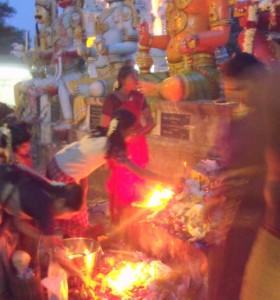
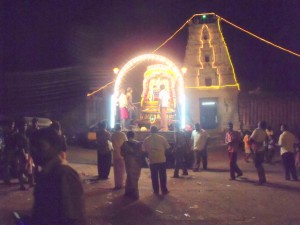 Every Aadi Velli day, women throng to this temple
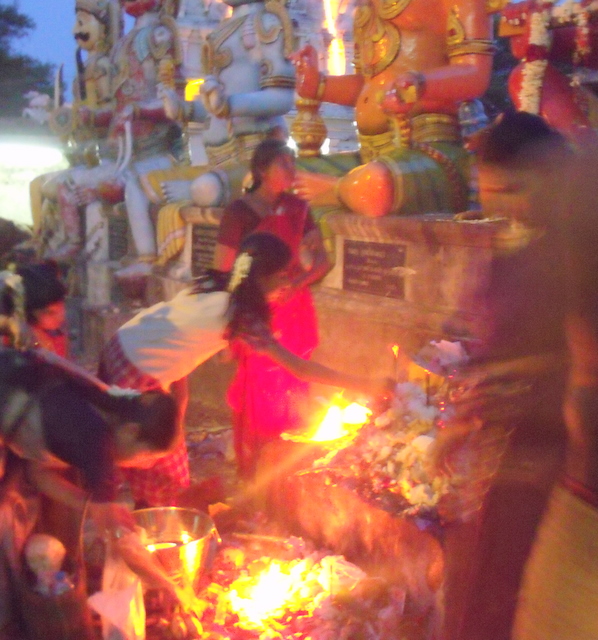
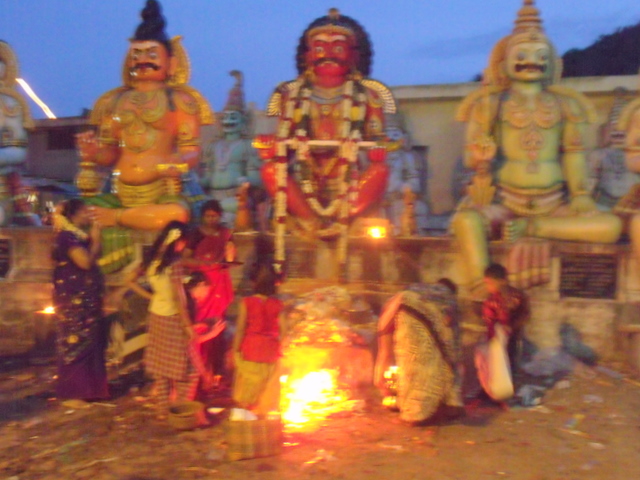
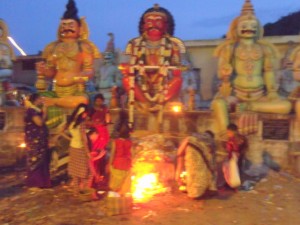
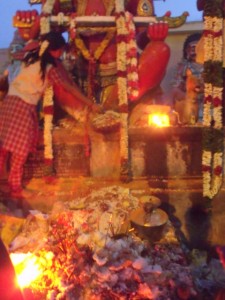
  to light lamps to the Goddess and to offer turmeric and vermillon as a homage to her eternal Sumangali-hood. The women also burn lamps and offer rice puddings and fruits to the huge guardian deity idols who stand in array and form quite a majestic arena in the outer courtyard of the temple. After
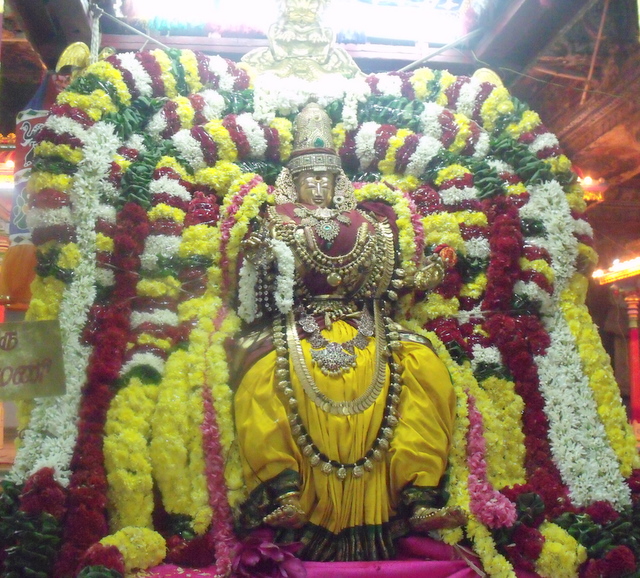
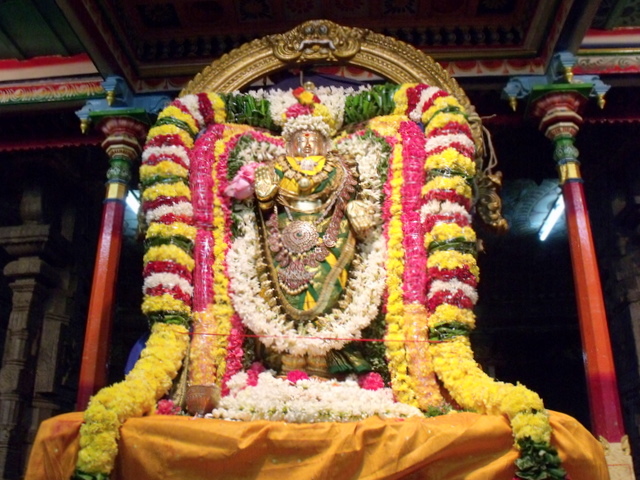
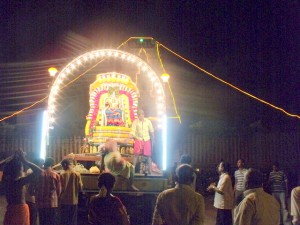
  nightfall, the deity of the Goddess is installed in a mantapam and decorated beautifully in silk and gold. Then She is
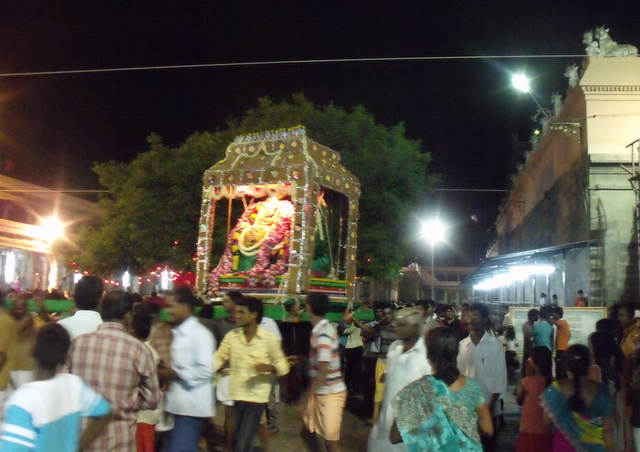
  worshipped with camphor Aarthi and borne outside and mounted on a chariot which takes a different form each day (elephant, lion, 5 headed serpent, peacock etc). Finally, She goes on procession right upto the outer girivalam path near the town bus stand and Here She stands for a while granting darshan to all passers by.
continue reading
-
The Southern Journey of the Sun – Dakshinayanam
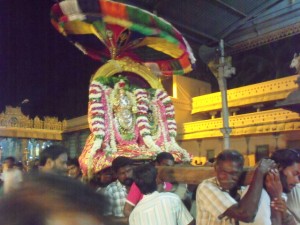 In Sanskrit, the term Dakshinayanam literally means southern
  journey. In this case, it refers to the Indian Summer solistice, for in hindu puranic yore the Sun is believed to move towards the South at this time. It seems to accentuate the idea that we are entering the darker part of the year – less sun, more rain, longer nights… As Arunachala is also revered as the Sun mountain, events involving the Sun are celebrated here as a festival.
 The Dakshinayanam festival begins in the big temple of Arunachaleswara exactly 10 days before the summer solistice
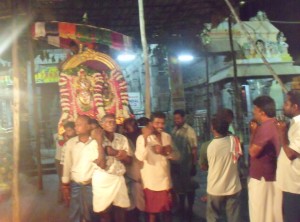
 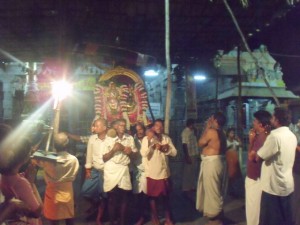 which, in India, falls on the 17th of July. It follows the traditional course of an Utsavam (temple festival). Each day in the morning at sunrise and in the evening at sunset, the different gods of the hindu pantheon are taken out on procession. The yagasala is opened since the
 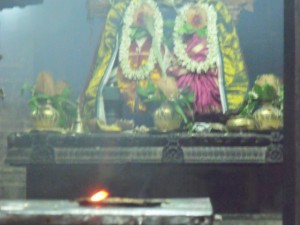 first day and two kalasams representing the Sun (Surya) and his wife, Chaya (the Shadow) are venerated according to vedic rituals during the first nine days. On the tenth day, at the culmination of the festival, the kalasams are brought outside on procession with the gods and taken inside the main shrine. The waters from the kalasams are then utilised to perform a grand abhishekam for the principal deities, Lord Arunachaleswara and His consort, Goddess Apeethakuchambal.
 Even though the meaning of the festival is not very explicit, one can eventually glean
 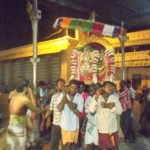 the cosmic dimension it represents, for at this time of year this festival apparently tries to define the auspicious period around which the idea of death leading to ascension is highlighted in a most subtle way.
continue reading
-
Aani Thirumanjanam
 In the tamil month of Aani (june-july) there takes place the first of the two important festivals dedicated to Lord Nataraja, the second one
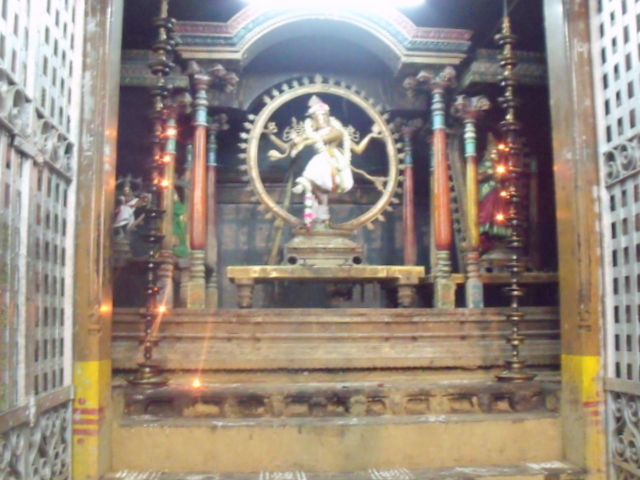
 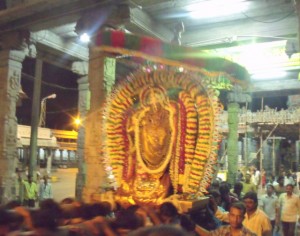 being in December. The Aani Thirumanjanam festival is believed to correspond to the period of ‘between two’ which highlights the transition from day to night, the moment called ‘pradosha’. From this point of view, it would mean to herald the coming of a period of longer nights. Nataraja, the Lord of Dancers is the cosmic form of Lord Shiva (In Sanskrit, Nata means dance and raja means Lord). The ring of fire and light, which circumscribes the entire figure, identifies the field of the Lord’s cosmic dance encompassing the whole universe. The lotus pedestal on which the Lord rests, locates the universe in the heart or consciousness of each person.
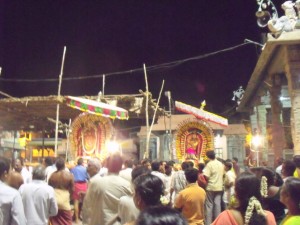 In the big temple of Lord Arunachaleswara, the celebration of the Aani Thirumanjanam festival comprises of the following
 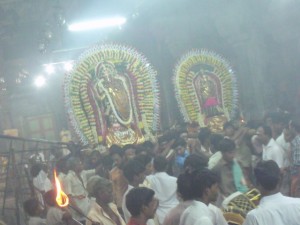 ceremonies: The deities of Lord Nataraja and his consort Goddess Shivakami are worshipped and brought outside of their altar in the main shrine, they are then borne in procession around the firs courtyard and then installed amidst great fanfare in another temporary altar inside the thousand-pillared of the temple. Here the deities are venerated, over a course of a week, with a series of elaborate abhishekams or sacred ablutions followed by karpoora aarathi (waving of camphor flames) and deepaaradhana (waving of lighted lamps).
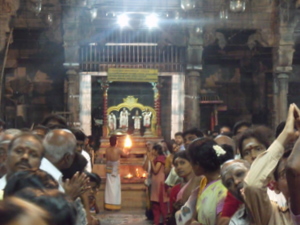 Simultaneously, there takes place another ritual which is called
 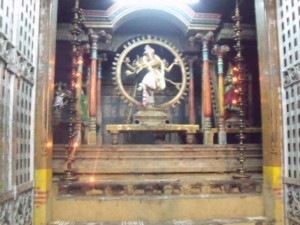 the Arakattu Utsavam. During this ceremony, the three great tamil Saivaite saints are worshipped in their altar which is the one directly opposite the altar of Lord Nataraja in the main shrine. Devotees crane their necks back and forth in order to get darshan of both the ceremonies as they take place and the priest rush from one altar to the other to do the honours correctly to all the deities. It is quite an amusing sight ! The end of the festival is celebrated at night with a grand Abhishekam and Aarathi to the deities after which they are borne back in procession to their altar inside the main shrine.
continue reading
-
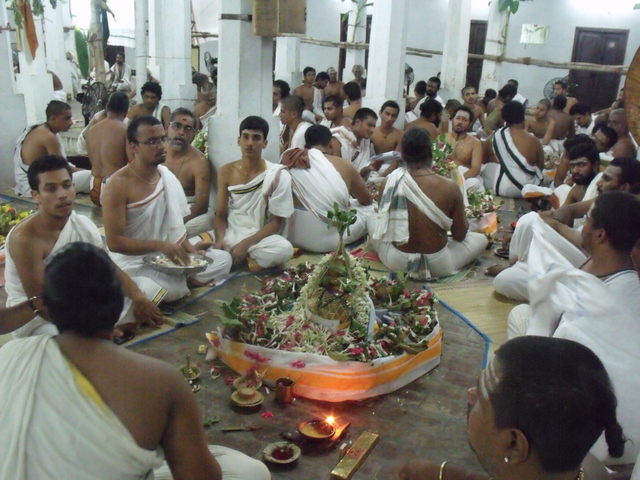
Athi Rudra Maha Yagnam 2011
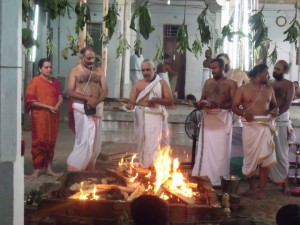 This month, an eminent devotee of Ramanashram
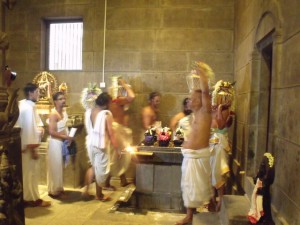
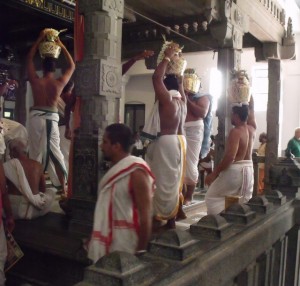
 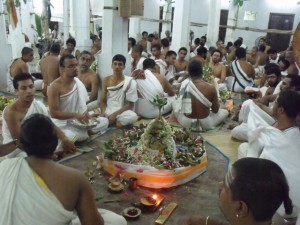 conducted the Athi Rudra Maha Yagnam in Tiruvannamalai. The venue of the Yagnam was the Oye Mantapam on Tiruvoodal street. Hundreds of talented brahmin priests well versed in vedic procedures and rituals took part in and performed this Athi Rudra yagnam with great devotion and power. A tremendous wave of sacred energy was created resultantly and the Mountain Arunachala and Lord Shiva himself seemed to be present at the chantings and listening to the Rudrams with intense pleasure.
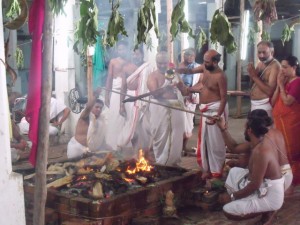 As one is told, the Lord himself is a great fan of the Rudram
  chantings and this is one sure way to draw his interest and attention. Sage Satapatha in his treatise “Maharnava Karma Vipaka” listed four types of Abhisheka procedures compatible with Vedic and scriptural lore. They are Rudram, Ekadasa Rudram, Maha Rudram and Athi Rudram – each being more
  potent than the preceding one. Of these, the most potent form of Athi Rudram. It involves 14641 Rudrams
  (Rudram is a combination of Namakam and Chamakam given in Rudradhyayam in the 5th Prapathakam of the 4th Kanda of Krishna Yajur Veda Samhita). Namaka recited once along with recital of Chamaka once constitutes one Rudram. Recital of 11 Namakas along with one Anuvaka of Chamaka at the end of each Namaka, thus completing one Chamaka constitutes Ekadasa Rudram. Recital of 11 Ekadasa Rudrams is Laghu Rudram or Rudraikadasini. Recital of 11 Laghu Rudrams is one Maha Rudram. Recital of 11 Maha Rudrams is one Athi Rudram. Therefore, in Athi Rudram 14641 Rudrams include 14641 Namakams and 1331 Chamakams.
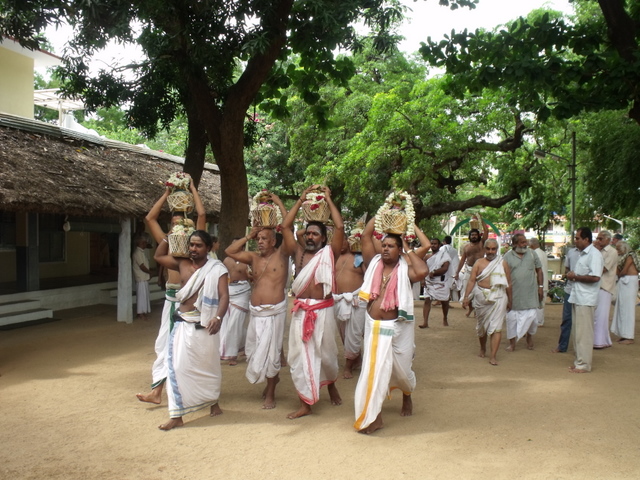
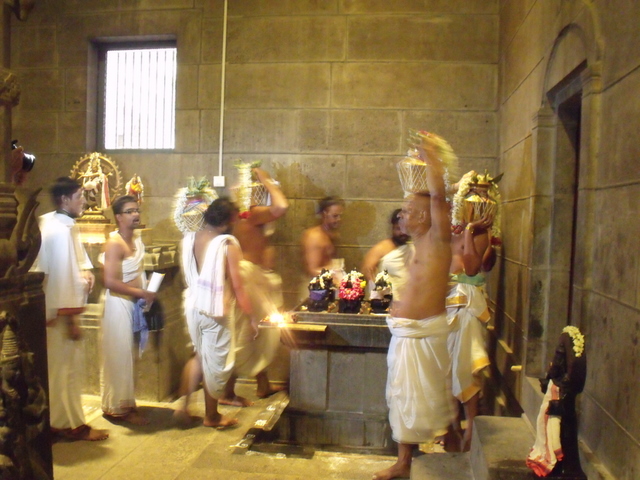
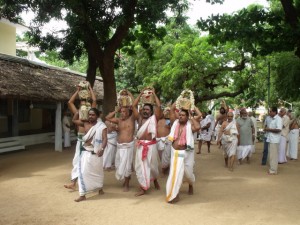
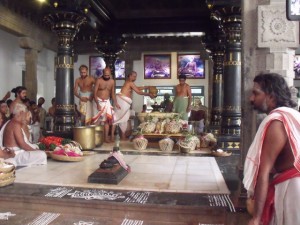 On the final day, at the culmination of the yagnam, the
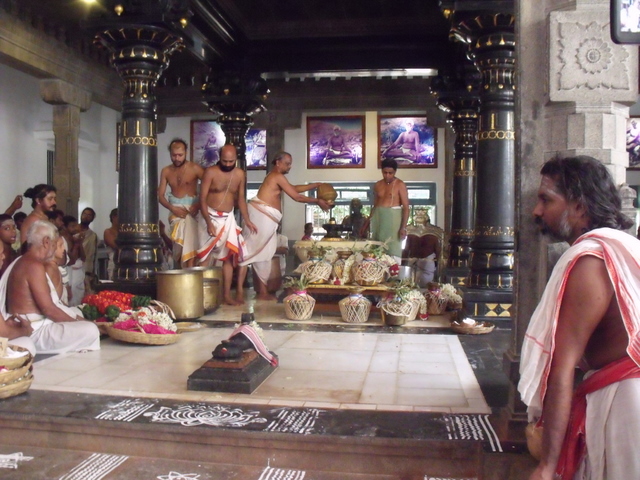
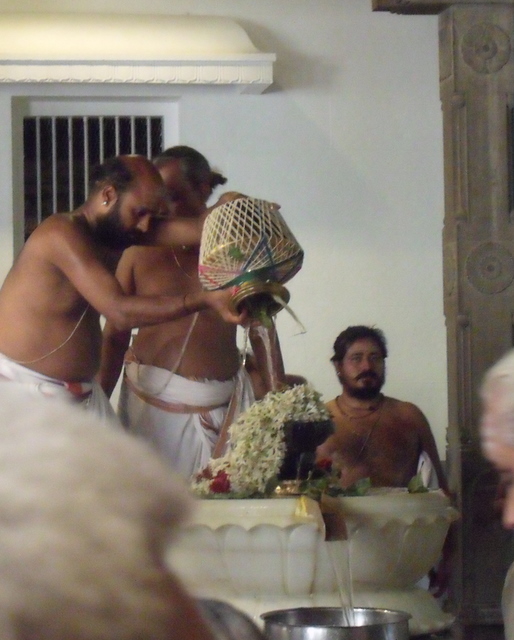
 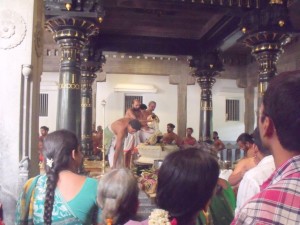 Pooranahruthi was performed and the sacred waters from the yagnam were transported in pots to the Ramanashram premises. Here an elaborate Abhishekam was performed over the Samadhis of Sri Ramana and his mother with the sacred waters. Devotees were caught in a surge of spiritual energy as the
 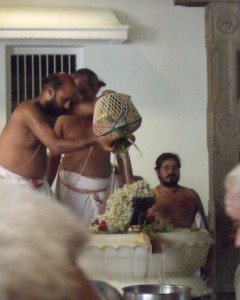 waters came cascading down the Lingams to the accompaniment of the resounding chantings of the Rudrams. This is indeed a rare spectacle and we are fortunate to live in Tiruvannamalai and witness such an ancient and sacred ritual being performed so beautifully according to the vedic tradition and in the holy presence of the Divine Mountain and Bhagavan Ramana.
continue reading
-
Bhagavan Ramana and Giri Pradakshina
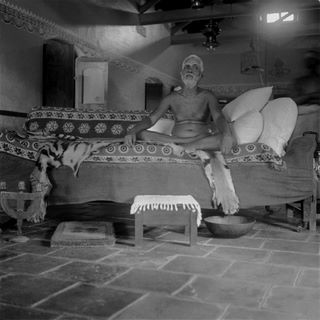
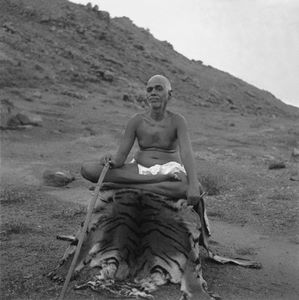 Sri Ramana used to go around the Hill on pradakshina quite often during his time. In this connection, He once said to a devotee: “The greatness of the giripradakshina has been described at length in Arunachala Purana. To go round this hill is good. The word pradakshina has a very precise meaning. The letter pra stands for removal of all kinds of sins, da stands for fulfilling desires, the syllable ksha stands for freedom from future births, na stands for giving delivrance through jnana.” B.V.Narasimha Swami in his book, Self-Realisation, says, “Almost from the time the young Maharshi came to Tiruvannamala and until 1926, he used to perform pradakshina of the hill several times a year.”
Once Muruganar, a great devotee of Bhagavan Ramana, asked him to elucidate on the
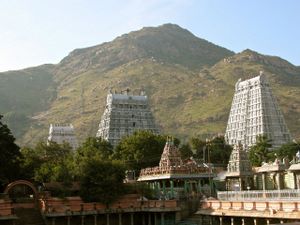 spiritual benefit of going round the hill. Bhagavan asked him to go round it first and then come to him. Sri Muruganar followed his advice and told Bhagavan that he lost his dehatma buddhi (body consciousness) after a while and regained it only after reaching Adi Annamalai. He reported to Bhagavan that the experience was unexpected and unique. Sri Bhagavan smiled and asked, “Do you now understand?”
Sadhu Bramiam a physician who was a devotee of Sri Ramana writes: “on one of my early visits I went on giripradakshina with some friends. When I returned my feet were blistered and I entered the hall limping. Bhagavan asked me the cause of the limp and then said that I should bathe the feet in warm water for a few minutes and repeat the pradakshina the next day and the day after. I did so and the feet gave no more trouble.”
 When a devotee thought that giripradakshina was meant only for novices and not for advanced sadhakas, Bhagavan made him understand that this was not so and the devotee changed his notion and started going round the hill regularly and was helped immensely in his sadhana. On another occasion a sadhu going regularly round the hill, requested Bhagavan for a vedantic text. To this another devotee casually remarked “He only goes round the hill, what will he do with any vedantic text”. Bhagavan immediately retorted, “What better sadhana can there be than going round the Hill?” There are thus many anecdotes which show the great importance Bhagavan gave to Giripradakshina.
continue reading
-
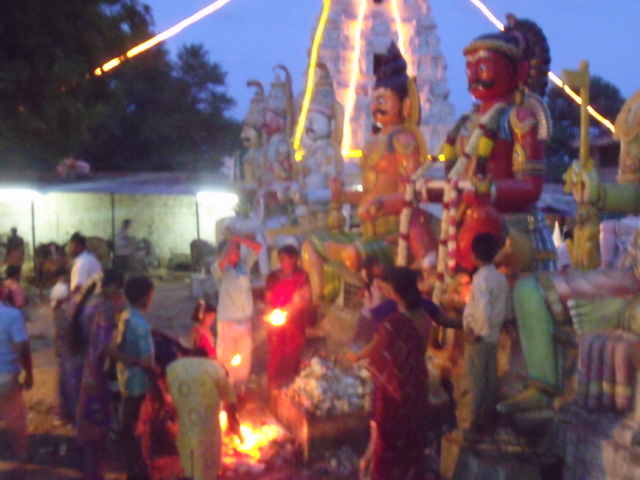
Mariamman festival in Adi Annamalai
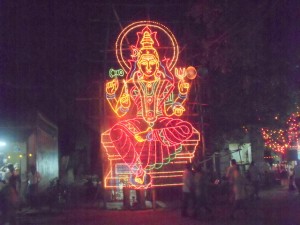 After the one hundred thousand lamp festival a few weeks ago,
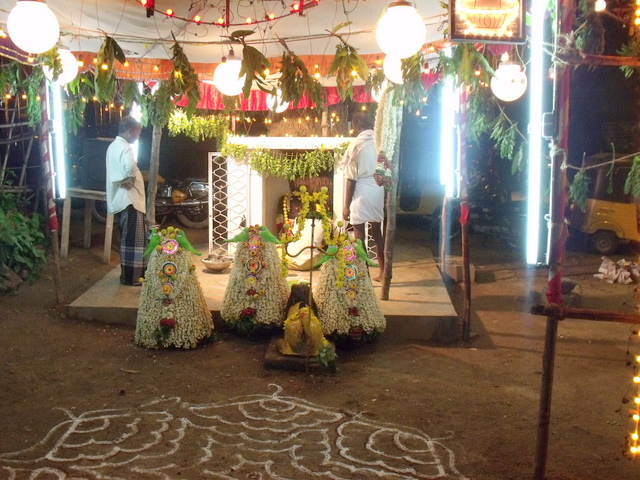
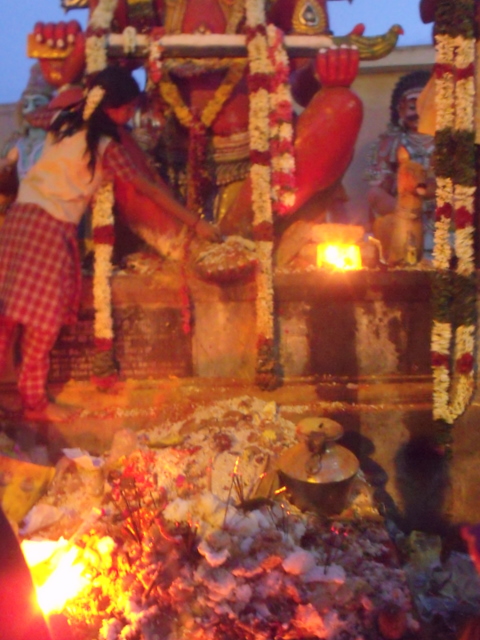
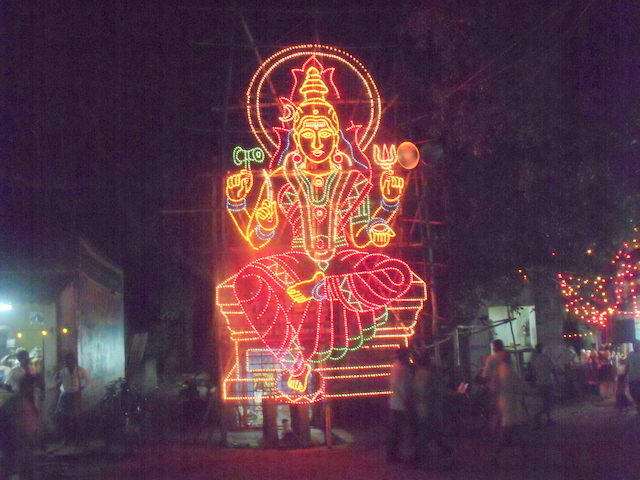
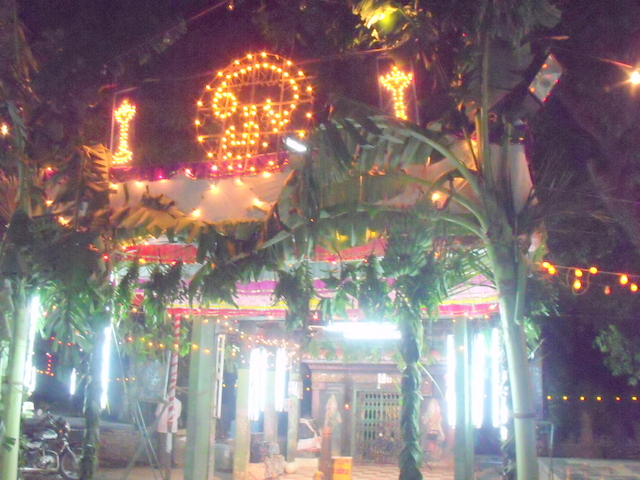
 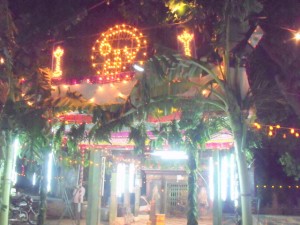 the village of Adi Annamalai on the Girivalam road is once again a venue for yet another festival dedicated to the resident Mother Goddess of the region. The first day of the festival dawns with the ceremony of the Kooluthal meaning distribuition of porridge. Kool or Ragi porridge is prepared in every house and then poured inside the huge temple cauldron and left to ferment overnight. The next morning it is distributed to one and all as prasad.
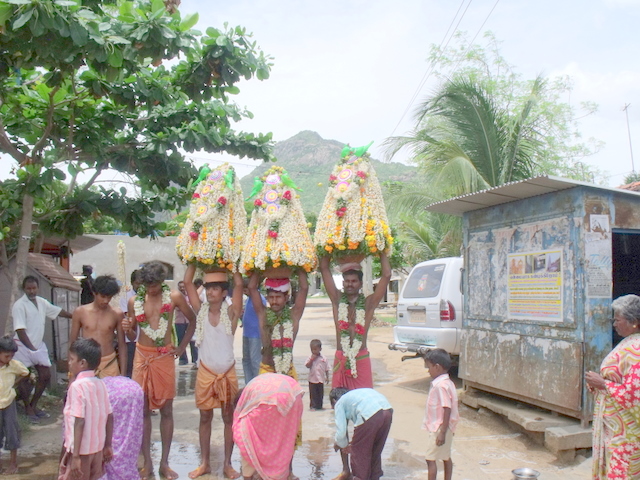
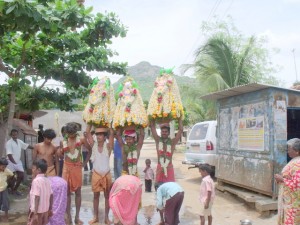
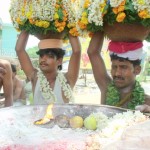
 During the day, there takes place a dance ritual known as Karagattam. In this, a group
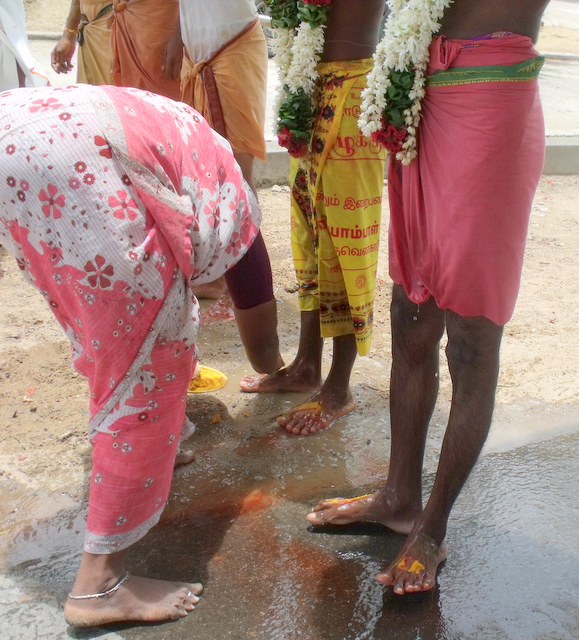
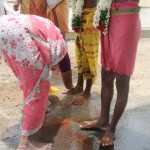
  of male dancers with bells tied around their feet and huge decorated pots balanced on their heads go dancing around the streets of the village accompanied by a band of folk musicians. These dancers on this day are believed to be embodiments of the Goddess and they are honoured in each house with women coming out and washing their feet with turmeric water and prostrating themselves on the ground. Camphor arathi is also performed as is the custom for any temple deity.
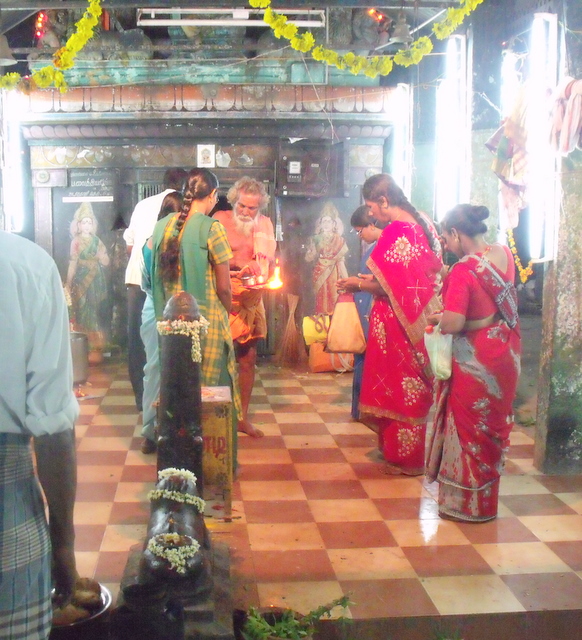
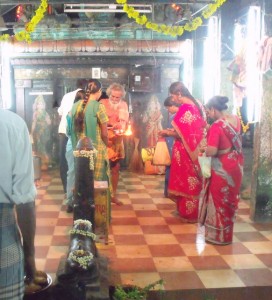
 In the evening there is a huge abhishekam ceremony performed to
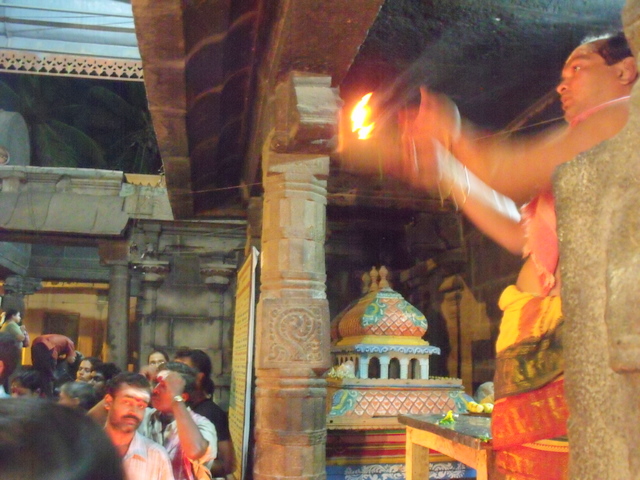
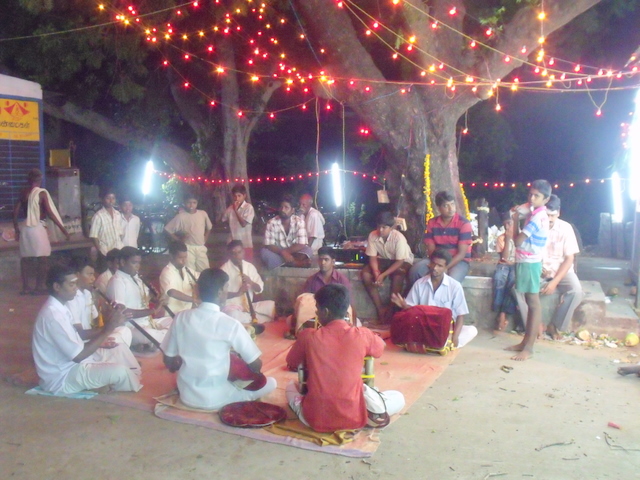
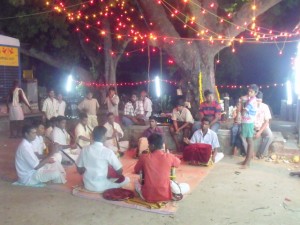
 the Mariamman deity of the local temple. Here the traditional temple musicians with their beautiful nadaswarams and mridangam instruments, sit in a circle on the temple courtyard and play with great devotion throughout the evening, adding to the religious fervour and energy. Devotees throng in large
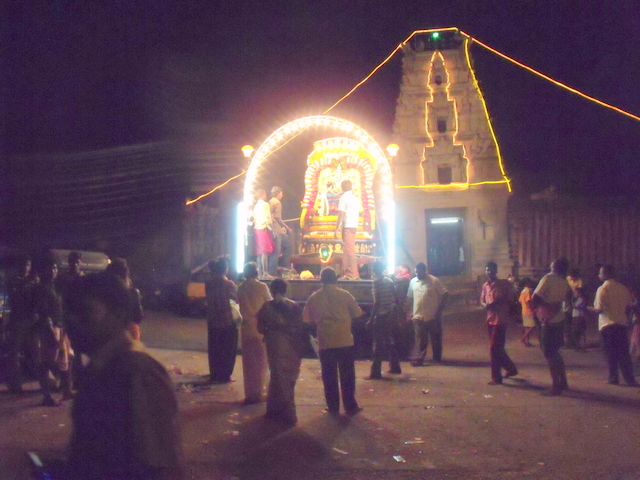
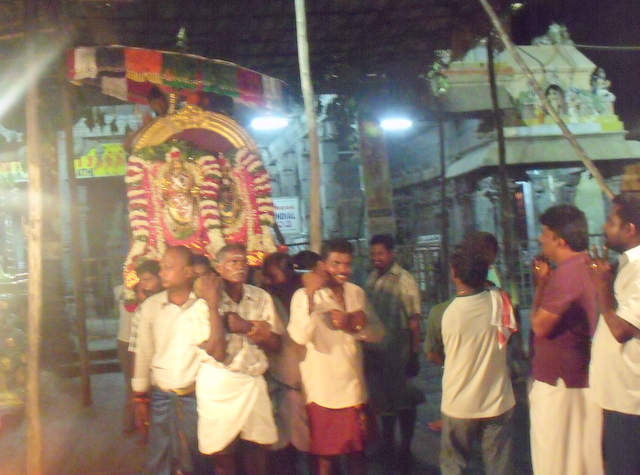
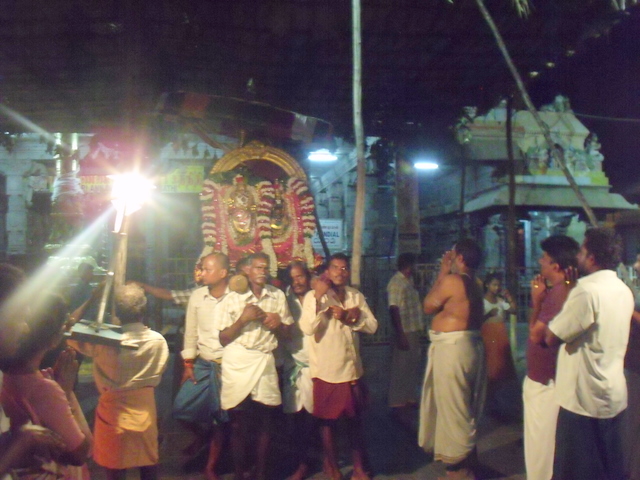
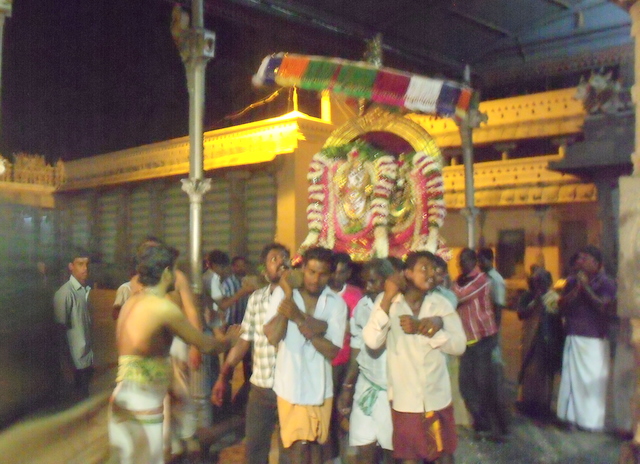
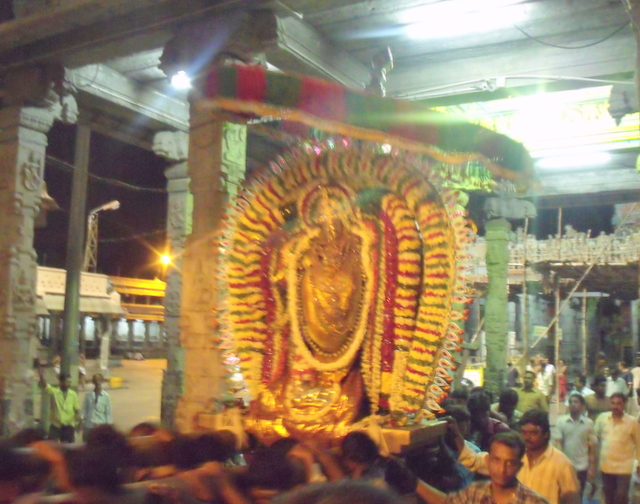
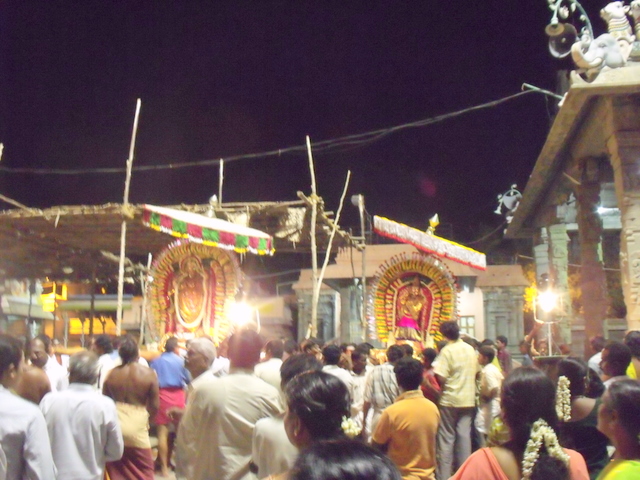
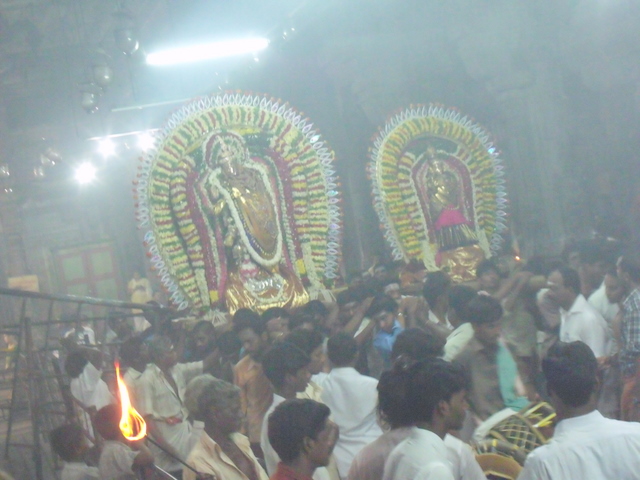
  numbers to take darshan and also to enjoy the music. Late at night, the Goddess is borne outside in procession and taken through all the streets of the village. The villagers come out, enthralled, to worship Her even at that late hour for it is indeed a rare occasion to receive the Goddess right in front of their houses.
continue reading