-
Rishi Durvasa shrine on Girivalam
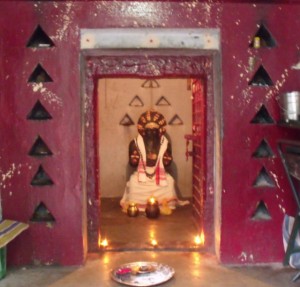 Rishi Durvasa is particularly known for his terrible temper due to which he would give dreadful curses upon the offender. Rishis are
 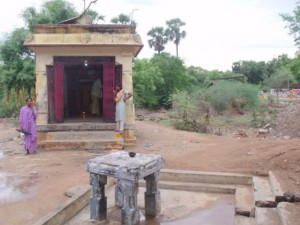 great sages. Durvasa is considered to be an incarnation of Shiva. To truly understand Rishi Durvasa, it is important to know about the power of the penance done by his parents. The father of Rishi Durvasa is Rishi Atri who is one of the three Brahma Rishis along with Rishi Gautama, and Rishi Bharadwaja. These three Rishis are known as the givers of AUM due to which they are called the Brahma Rishis. All creative process is believed to have begun with A-U-M and is therefore threefold having A which is Brahma (Rishi Gautama); U which is Vishnu (Rishi Atri) and M which is Shiva (Rishi Bharadwaja).
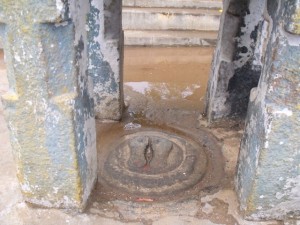 The three deities of the Drekkana Varga are Narada, Agastya and Durvasa. All three were Rishis, holders of divine knowledge.
 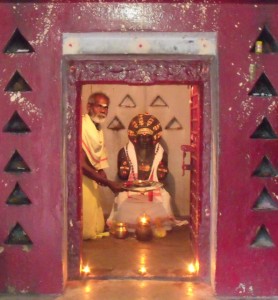 Narada was the son of Brahma. He received the knowledge of Bhakti, devotion to the Supreme. In mythology, he is portrayed as a mischief-monger creating problems and disturbing people in order to make them think on higher planes. He represents karma and the soul. He also deals with creation as we are only created if we have karma to reconcile. Agastya Muni was a great thinker and is linked to the mind. He is connected to sattva, preservation and Vishnu. Durvasa is a more difficult Rishi. He made effort to control his senses and therefore he represents the desires and their abilities to lead us astray. Durvasa is linked to Shiva, tamas and destruction. Narada works on the karmic level, Agastya on the mental plane and Durvasa on the physical desires. As Drekkana represents free will or courage, these deities represent the influence of these Rishis on our actions and behaviour.
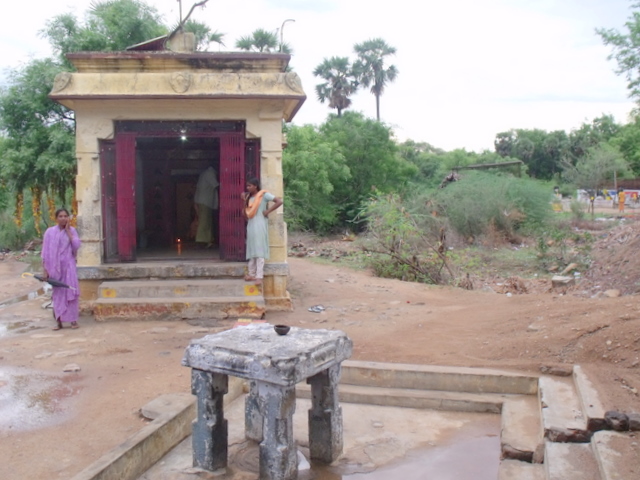
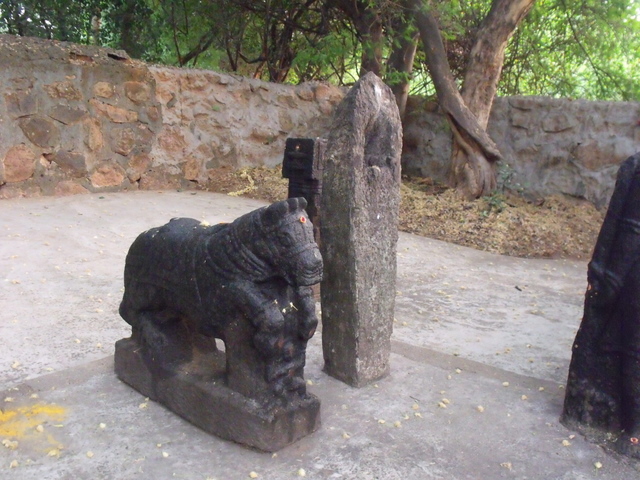
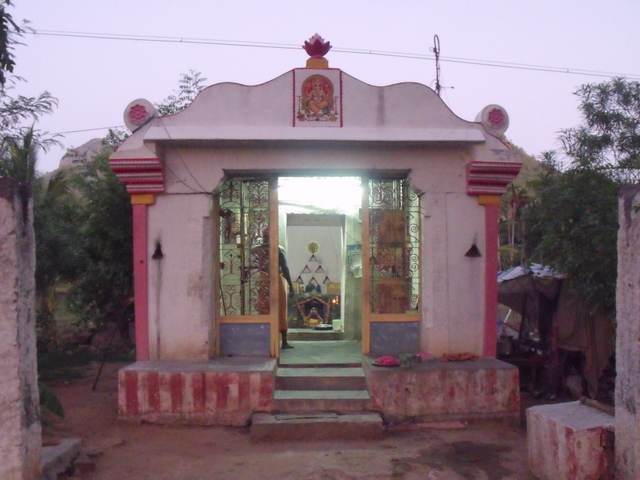
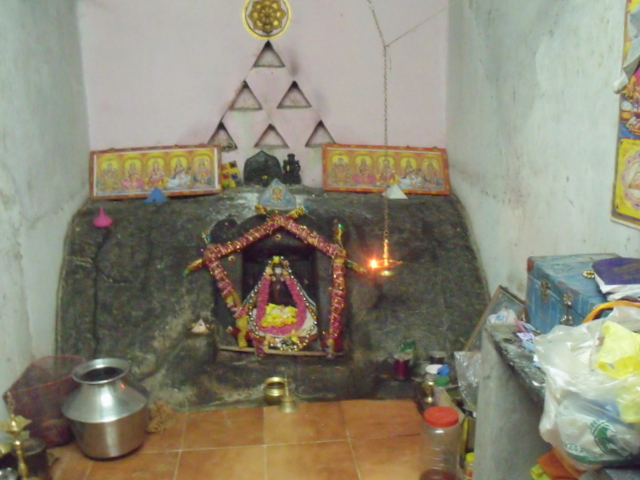
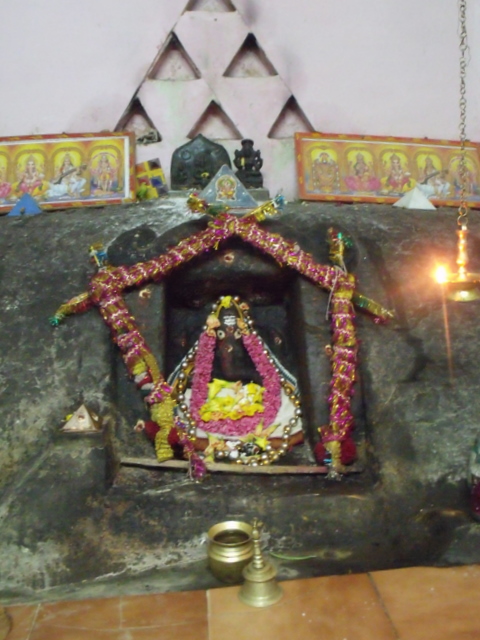
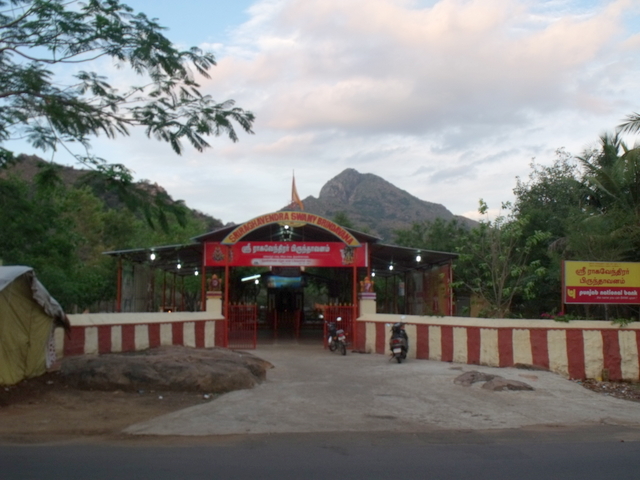
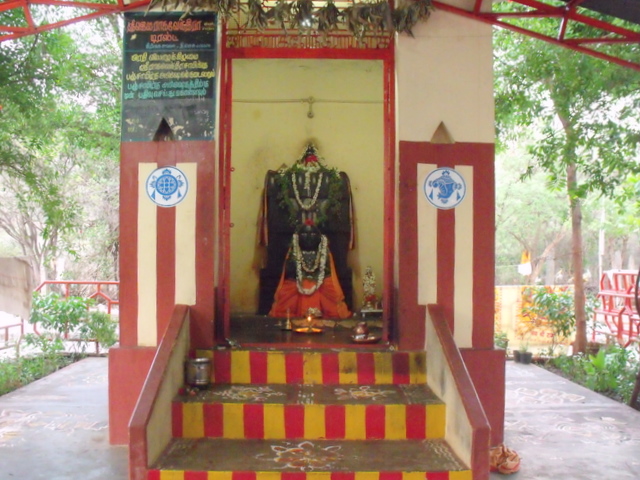
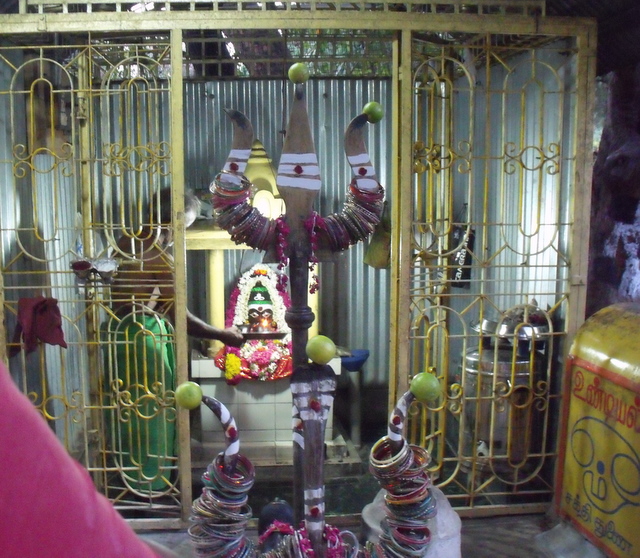
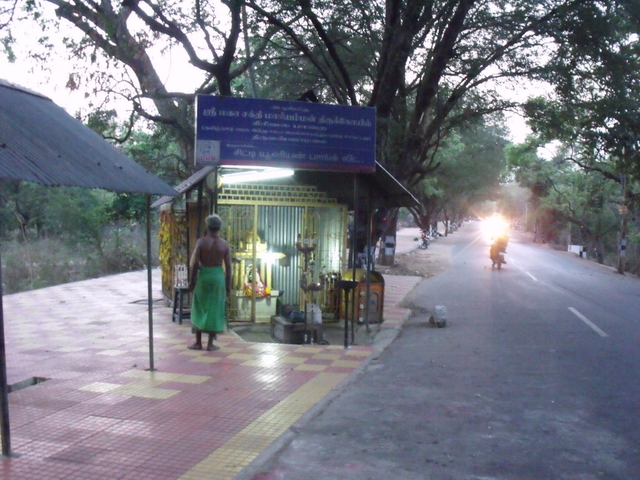
The shrine of Sri Durvasa Rishi on the Arunachala girivalam can be found on the outer path a few hundred metres before Sona theertham. Though it looks insignificant from
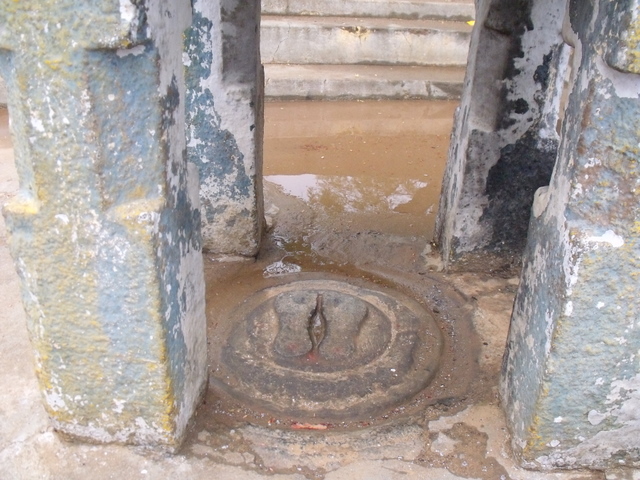
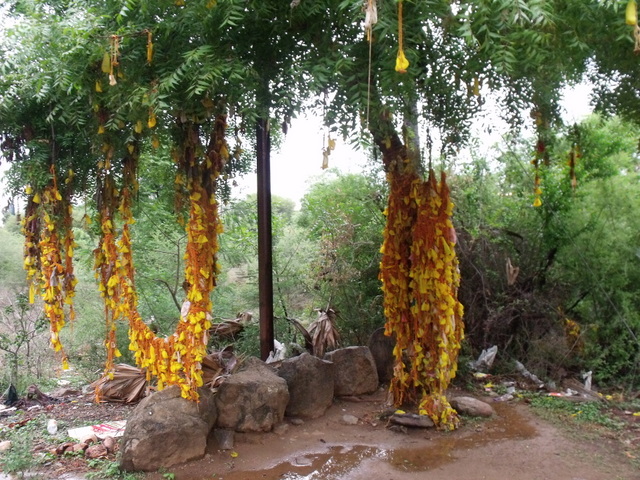
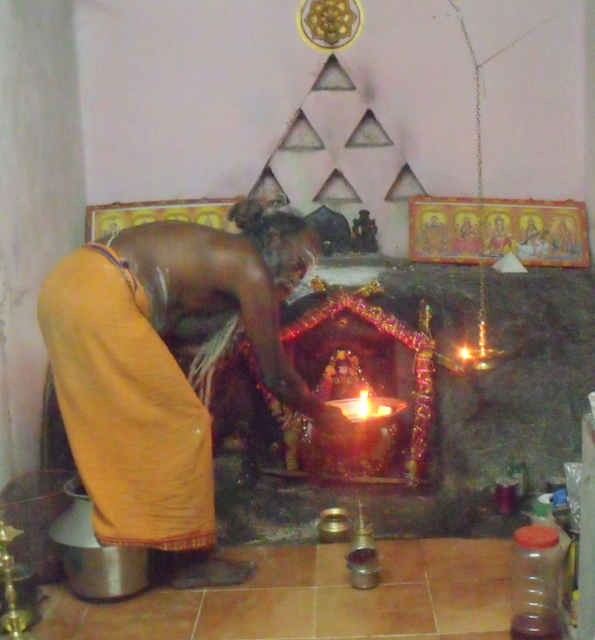
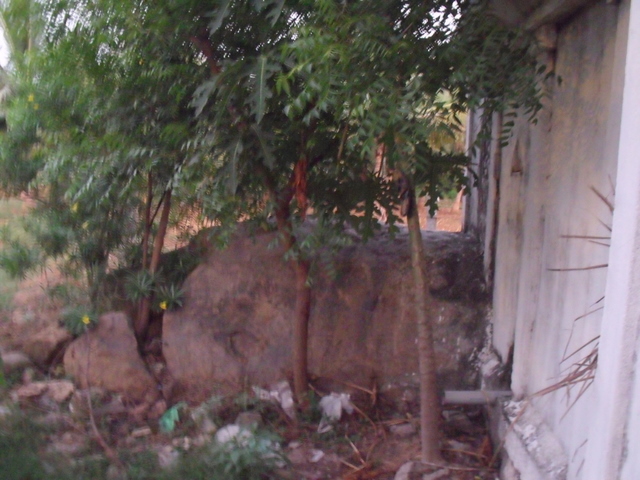
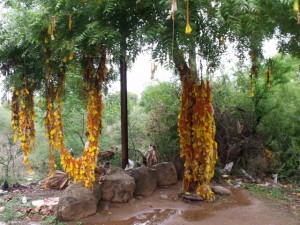 the outside, this shrine seems to attract a number of devotees who come here mainly for two reasons: married couples who have been unable to get children come here and tie a yellow thread on
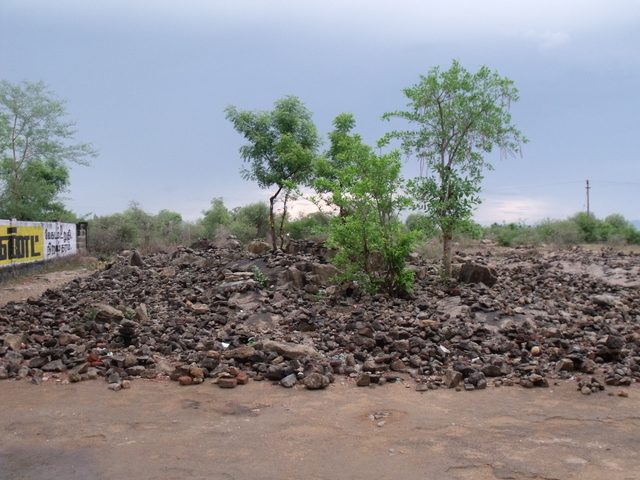
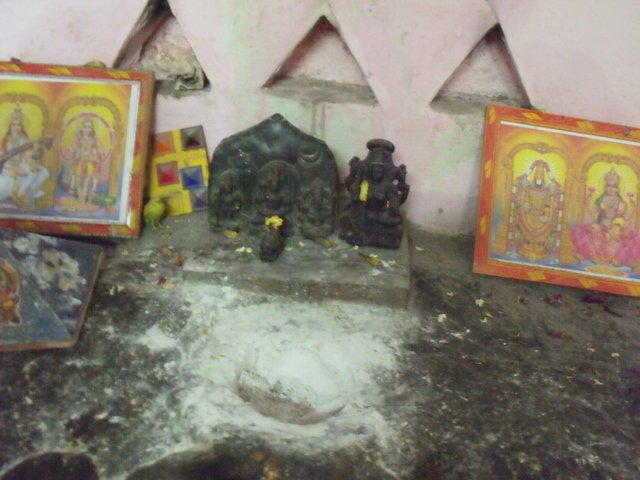
 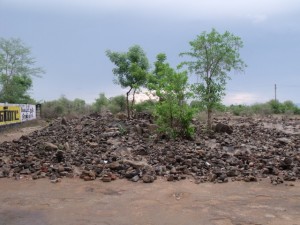 the neem tree behind the shrine and then offer three oil lamps to the deity of the Rishi inside the shrine; householders who are trying to buy their own land come here on full moon nights and arrange four stones to form a niche and place a burning oil lamp inside. Apparently this practice is quite beneficial and often results in the wishes of the devotees getting fulfilled. It is strange indeed that such a wish seeking cult should be developed around this Rishi in today’s times whereas he was known for quite opposite powers in ancient times !
continue reading
-
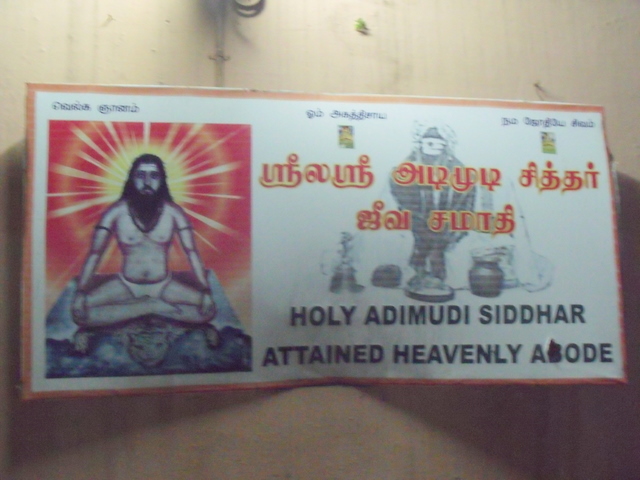
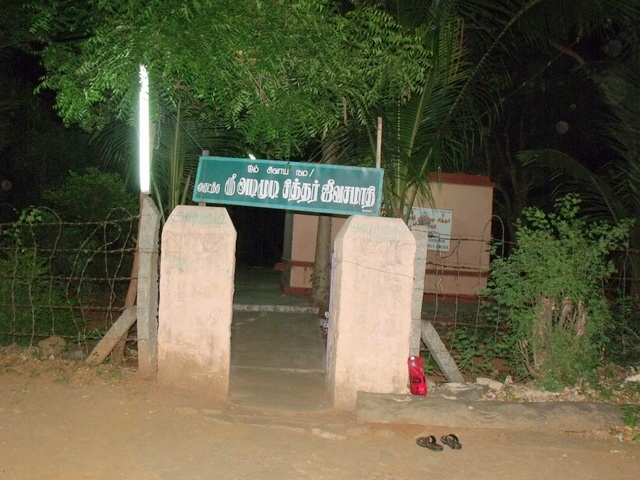
Adi Mudi Siddhar Jiva Samadhi
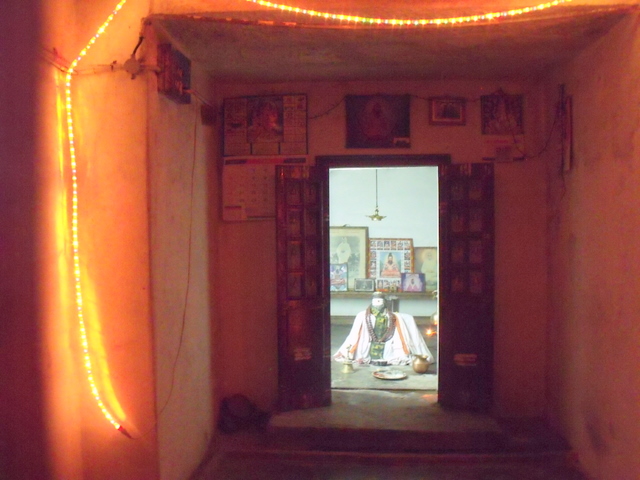
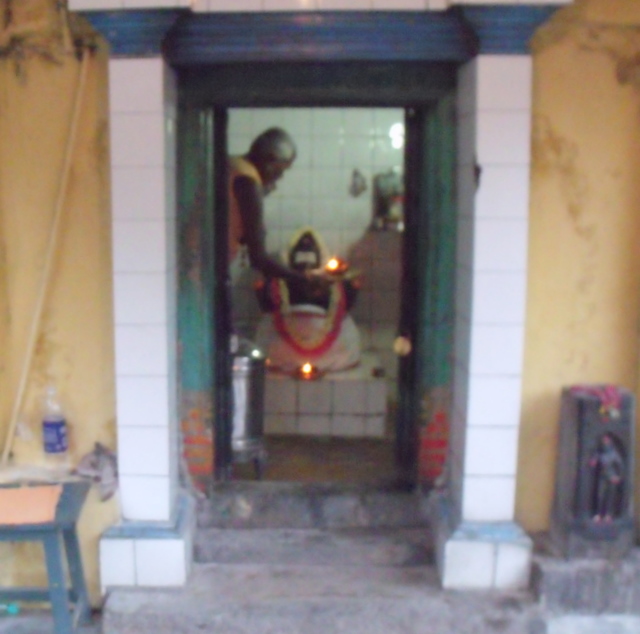
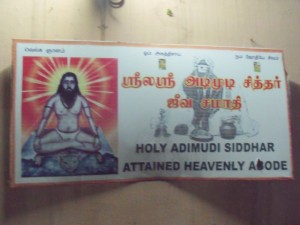 On the outer girivalam road just after the Vediyappan kovil (which was described in an earlier post) is the Samadhi shrine of Sri Adi Mudi Siddhar. He is supposed to have lived here in the beginning of the 20th century and attained heavenly abode towards the middle of the century.
Different legends revolve around this saint and one of them being that he was a very advanced siddha purusha who could take the guise of wild animals and roam around the forest on the hill at night in this form. The
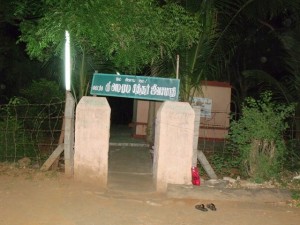 samadhi where he is interred is in a little shrine with a votive Shiva lingam where puja is performed daily by a few sadhus of this area. It is not really visible from the main road and attracts few devotees.
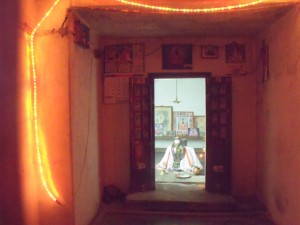 The speciality attributed to this saint is that he has the power to grant relief to people suffering from ‘Othai Thalaivali” or one-sided migraine headaches. One suffering from this ailment is supposed to make three turns around the samadhi and beat his head on the walls of the inner chamber after each turn and after this to proceed on giri pradakshina. Such an act is believed to grant a permanent cure from migraine to the suffering person.
continue reading
-
Shirdhi Sai Baba temple on Girivalam
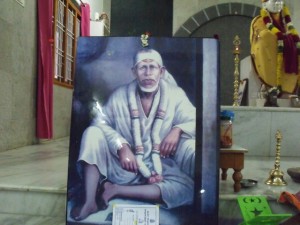 The Sai Baba of Shirdi lived in the early part of the 20th century
 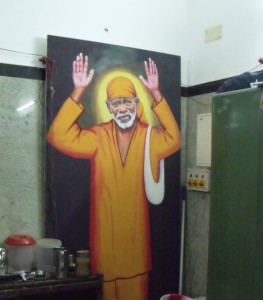 and was a great guru, yogi and fakir. Hindu devotees consider him as an incarnation of Lord Dattatreya. Many believed that he was a Satguru and an enlightened Sufi Pir or a Qutub. His real name is unknown. The name Sai was given to his upon his arrival at Shirdi. No information is available regarding his birth and place of birth.
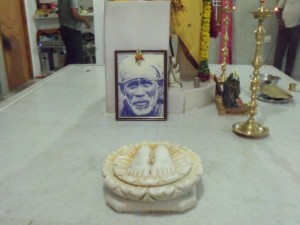 Sai Baba had no love for perishable things and his sole concern
  was self realization. He taught a moral code of love, forgiveness, charity, contentment, inner peace and devotion to God and guru. Sai Baba’s teachings combined elements of Hinduism and Islam. He gave the hindu name Dwarakamayi to the mosque where he lived, practiced both hindu and muslim rituals, taught using words and figures that drew from both traditions, and was buried in a hindu temple in Shirdhi.
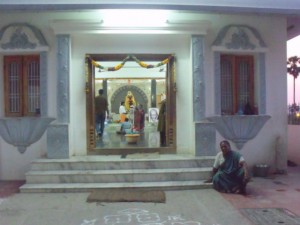 There is now a Shridhi Sai Baba temple on the Arunachala outer
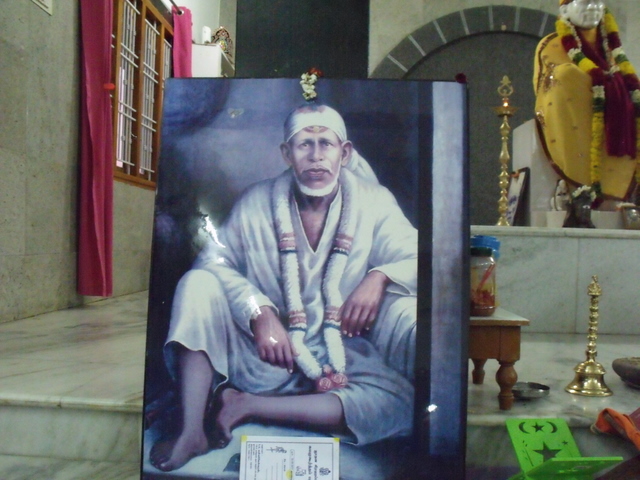
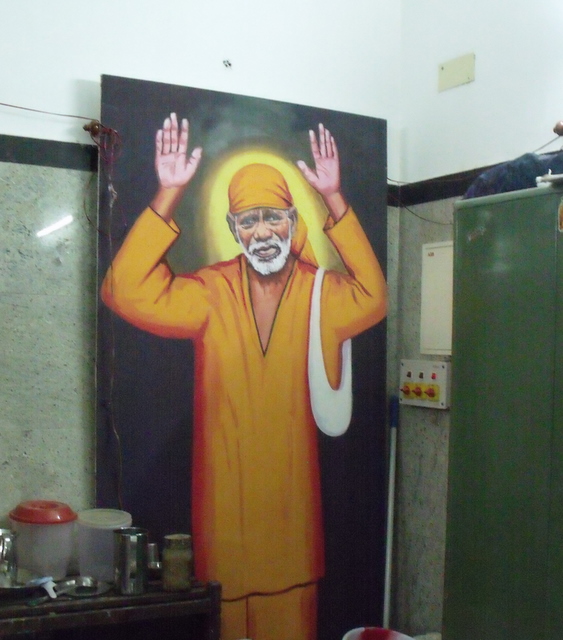
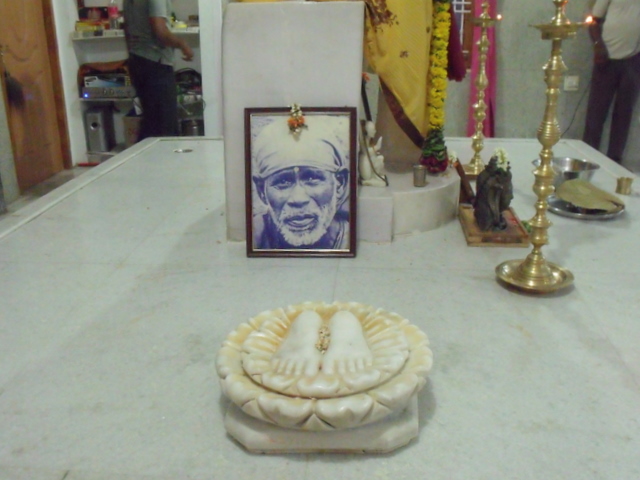
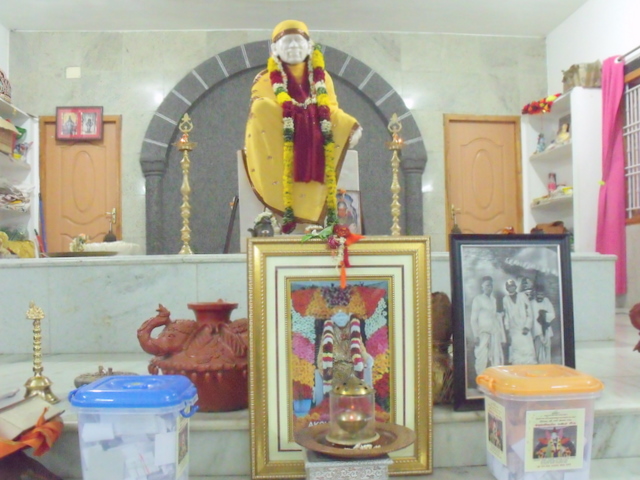
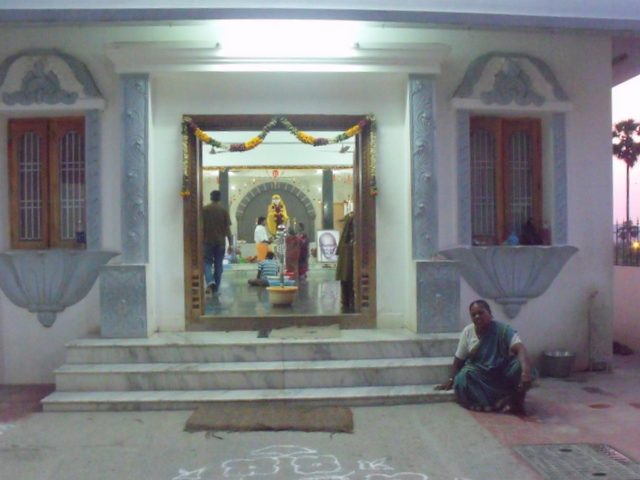
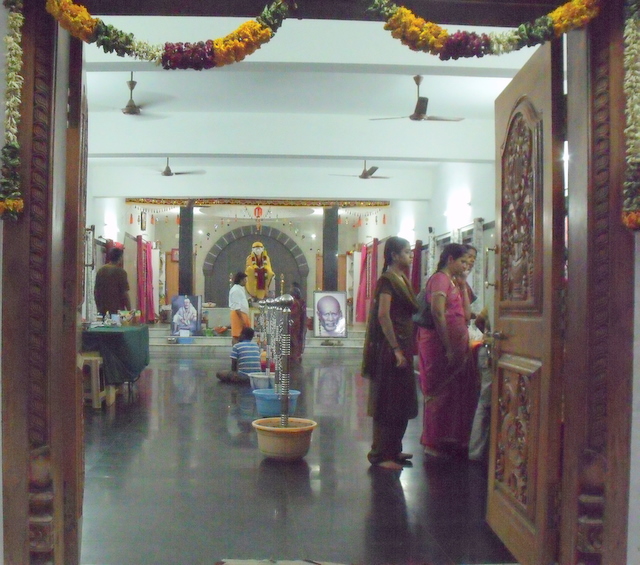
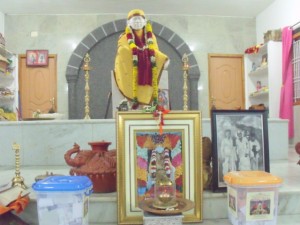
 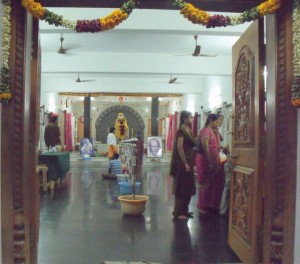 girivalam path. It can be found a few hundred metres after the village of Adi Annamalai just opposite the Sudhananada ashram. The temple is housed in a modern concrete structure with a north indian style hindu minaret on the roof. Inside is a vast room with a dazzling white marble floor and many painted pictures of the Baba in various attitudes of compassion
 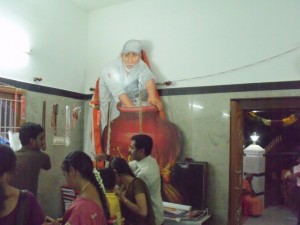 and grace. The altar itself is quite lovely with a beautiful marble statue of Baba and little votive pedestals depicting his holy feet. The only aspect that strikes a garish note is the commercial sale of religious commodities like amulets and pictures being done inside the shrine itself which effectively prevents devotees from sitting quietly in the shrine and meditating or worshipping the Baba in silence. Maybe it would be better if this activity alone were shifted to a little room outside the shrine.
continue reading
-
Girivalam shrines – Vediyappan kovil
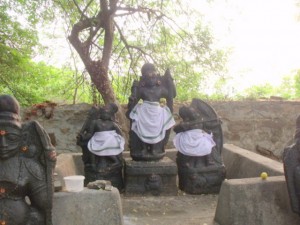 Vediyappan or the Lord of the Forest is an ancient dravidian deity,
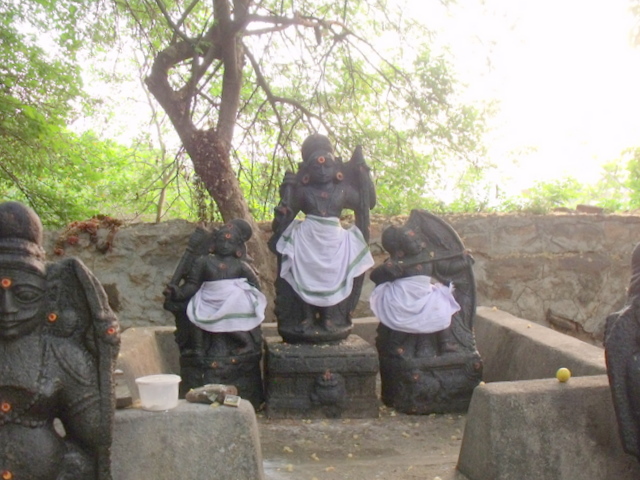
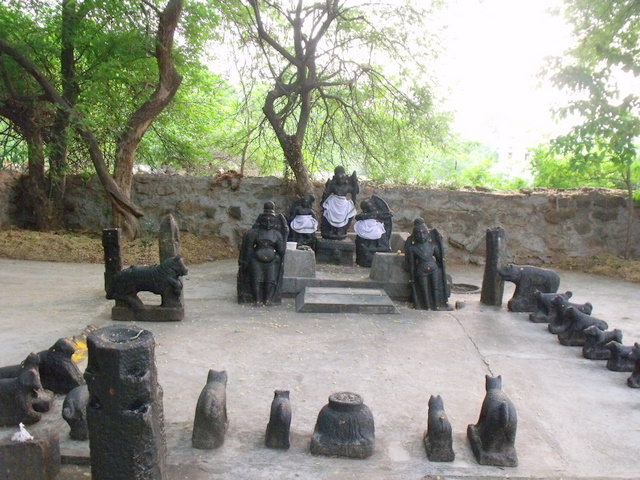
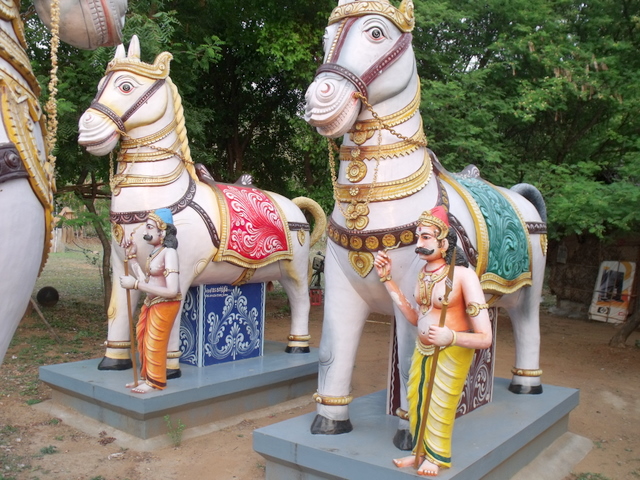
 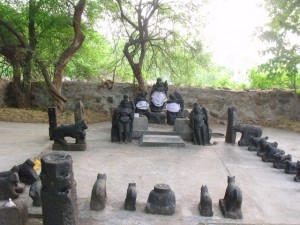 said to be a manifestation of Lord Shiva and worshipped under this title by tribals and jungle dwellers. He is a guardian deity and his temples are usually found in the woods and other forest areas. He is often worshipped inside a natural glen of trees surrounded by rocks and all around him are stone sculptures of many wild animals who form his faithful band of followers. And of course, as is the tradition for guardian dieties, one or two stone horses are kept close by in readiness for him to mount and ride like the wind on any rescue mission for his devotees when they need his protection.
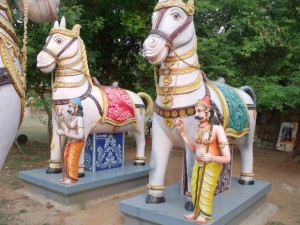 A really authentic Vediyappan shrine can be found if one takes a
 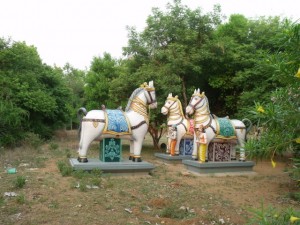 little forest trail right opposite the Seenuvasa school on the outer girivalam. Here in the midst of a lovely green forest enclave, stands a very ancient and imposing deity of Vediyappan surrounded by his coterie of wild animals and other woodland creatures like sprites and driads. And there
  are also three magnificent horses with their guards ready to take the god on their backs and flee to the help of any devotee in trouble. It is very impressive to just walk up this seemingly innocuous path and then suddenly stumble upon these surprising horses with their brilliant colours, forming a stark contrast to the surrounding landscape.
continue reading
-
Girivalam shrines – Thalaithiruga Dhanam Tharum Vinayagar
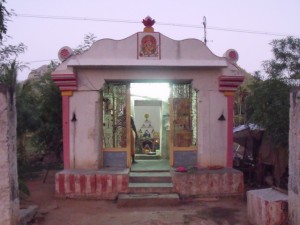 This is a very old shrine to Lord Ganesh and can be found on the right side of the outer girivalam road, a few metres after the Surya theertham. It
 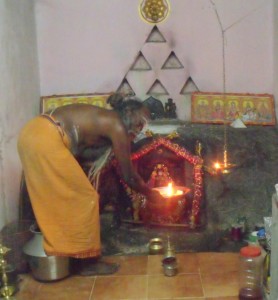 had fallen into disuse for some years and has now been renovated by a kind Sadhu who performs the daily puja at his own expense. The name itself is quite intriguing and ‘Thalaithiruga dhanam tharum’ a tamil term literally means ‘he who bestows riches on
 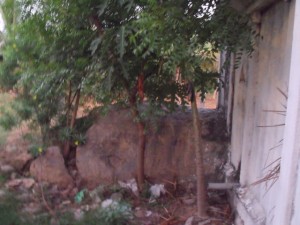 head being twisted’. Ouch! how painful that this poor Ganesh had to have his head twisted each time a devotee approached him with a desire for riches! Mercifully this practice has been stopped due to the twistable head of the deity itself having been removed by some Raja in his greed for wealth. Apparently he met with a sorry end after this act. Another example of killing the goose which laid golden eggs?
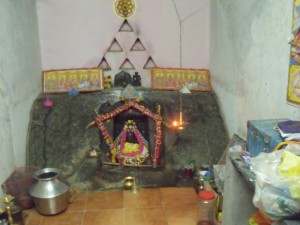 Today the deity presents itself as a full-fledged Ganesh (with figure intact and firm
 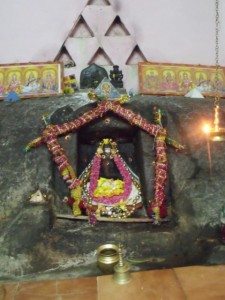 non-twistable head) carved on the front surface of a fairly long natural rock formation. The rock itself is so long that the two ends can be seen extending outside of the concrete structure housing the shrine. The Sadhu priest is earnest to show us the place on the rock where the earlier twisting-removable head used to be. This is now a depression in the rock on the top surface and is
 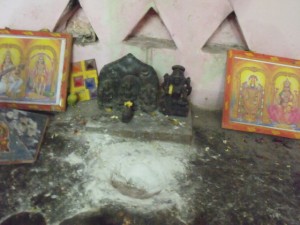 covered with vibhuthi. and a little glass prism. The priest also explains the legendary practice where-in the head used to be removed and a few brass coins placed in the hole underneath and the next day if the head was again unscrewed and removed, the hole underneath used to be full of gold and silver coins ! The devotee who placed the brass coins would then recover the gold and silver coins after giving one or two back as offering to the priest.
continue reading
-
Aaradhana of Sri Ramana
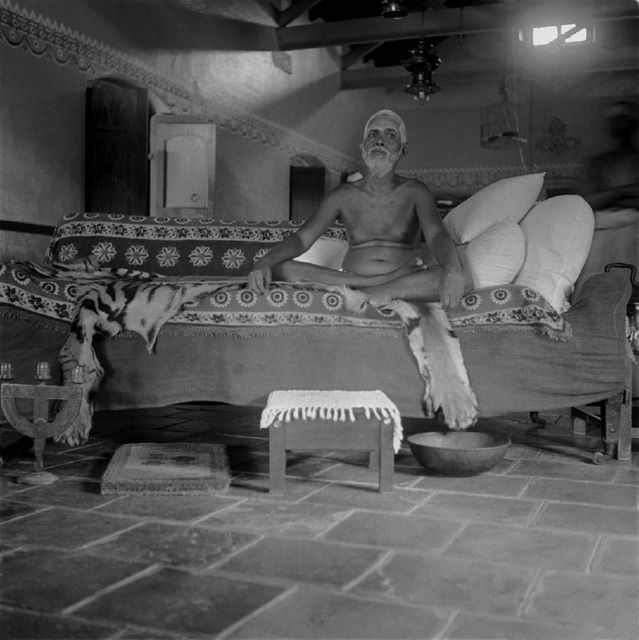
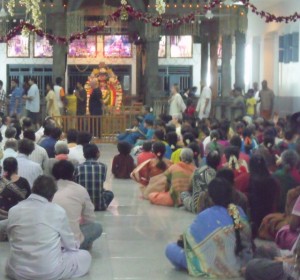
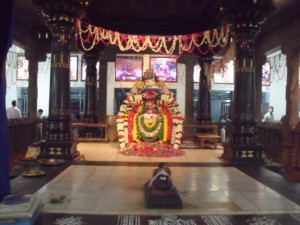 The death anniversary of Sri Ramana Maharshi when he attained Brahma Nirvana is celebrated as Aaradhana festival in Ramanasramam. This year this day fell on Saturday, 30th April and it was celebrated with many beautiful rituals and ceremonies and music programmes in the Ashram. In the morning there took place the grand puja called the ‘Ekadasa Mahanyasa Maha Rudrabhishekam’ performed over the Samadhi of Bhagavan which the brahmin priests did with utmost devotion and expertise. In the evening, Smt.Ambika Kameshwar rendered a vocal music concert, singing her usual repertoire of Ramana songs. Hundreds of devotees participated in all the events and partook of all the free meals with great enthusiasm.
Sri Bhagavan Himself considered both life and death in this body as mere thought
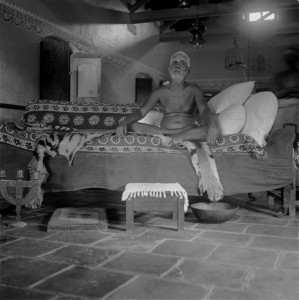 forms. In this regard, an old devotee S.S. Cohen recalls this from the master’s teaching in his book Guru Ramana: “Life is miserable because it consists of nothing but thoughts. When death strikes down the body, the dreamless, thought-free state prevails for a brief period, but soon thinking starts again in the dream – ‘astral’ – world, and continues till a full ‘waking’ takes place in a new body, after another dreamless lull. This daily cycle of waking and sleeping is a miniature of the cycle of life and death in man and the universe, of alternation of activity and rest. The substance of the former is thoughts and sensations, and of the latter the
  peaceful being from which these arise. To transcend birth and death we have, therefore, to transcend the processes of thought and abide in the Eternal Being… But the Jnani, the Self-Realised man, whose mind has already ceased to act, remains unaffected by death; it has dropped never to rise again to cause births and deaths. The chain of illusion has snapped forever for him… It is now clear that there is neither real birth nor real death. It is the mind which creates and maintains the illusion of reality in this process, till it is destroyed by Self-Realisation.”
continue reading
-
Girivalam shrines – Sri Raghavendra Swamy Brindavanam
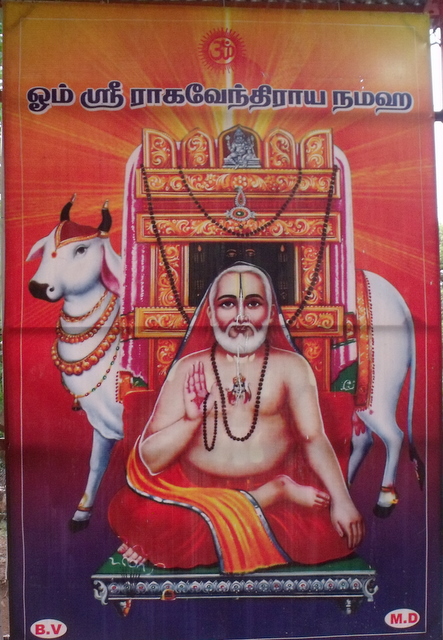
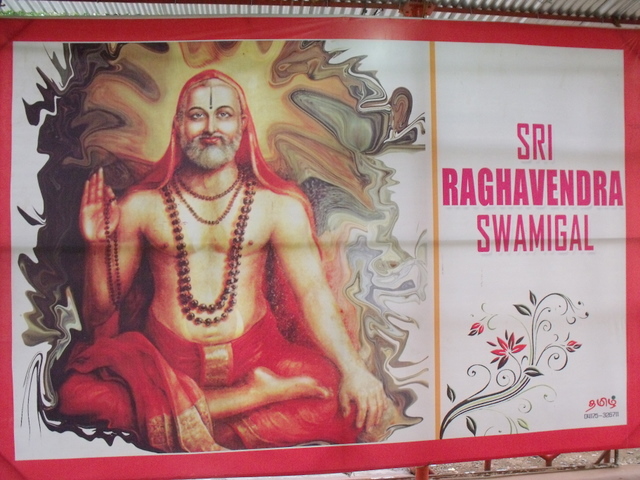
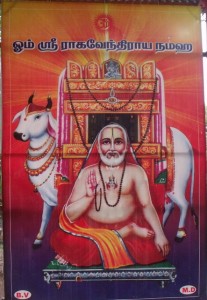 Sri Raghavendra Swami was one of the great proponents of the Madhva philosophy (Dvaita or Duality believing that God and Man are different entities and that Man should approach God through devoted worship). He lived in South India during the 16th century. For nearly 50 years, he was
 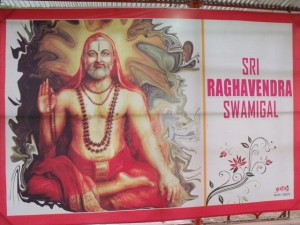 the revered head of one of the great peethams (hindu religious authority). He excelled in many fields such as logistics, Mimamsa, music, yoga, dharmashastra and all the 64 vedic arts. He was believed to be an avatar of Prahlada, a famous child devotee of Lord Vishnu and so he chose his Brindavanam or divine abode (Mantralaya) on the banks of the river Tungabadhra, where Prahlada had performed his yajna in Krita yuga. It is said that the stone used for the Brindavan was sanctified by the touch of Sri Rama and Sita in the Treta yuga.
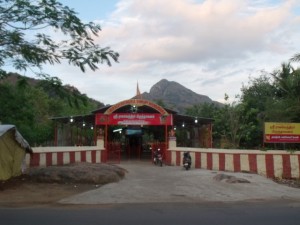 The Raghavendra Swamigal shrine can be found on the outer girivalam road right beside the Hanuman or Anjaneya temple. It is situated on a large courtyard with the backdrop of Arunachala. The
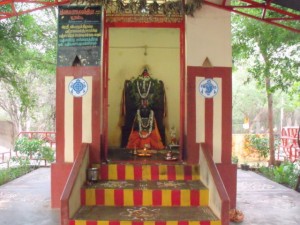 shrine consists of a stone statue of Sri Raghavendra depicted against a stone scultpure of Kamadhenu, the celestial wish fulfilling cow. The maintenance and running of the temple are funded by a local private group of Raghavendra devotees who come daily in the evening to participate in the pujas. There is also a daily feeding of Sadhus at this time. On festival days this temple is often a venue for carnatic music concerts with the participation of good musicians from Chennai. And so this has become a regular halt for traditional music lovers in the area.
continue reading
-
One Hundred Thousand Deepam festival
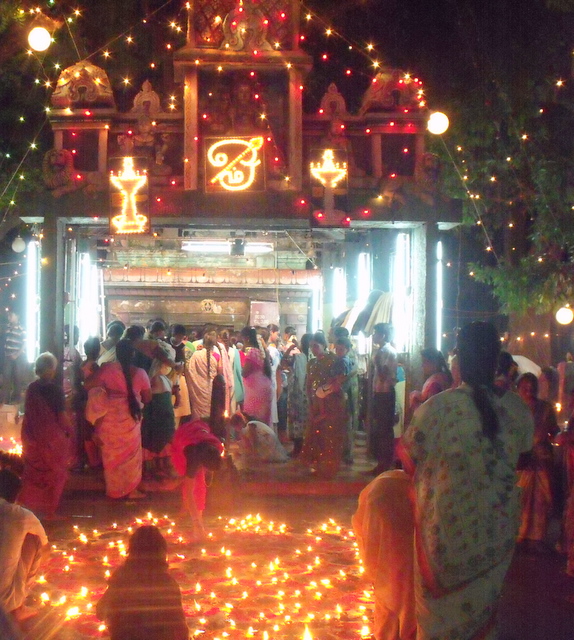
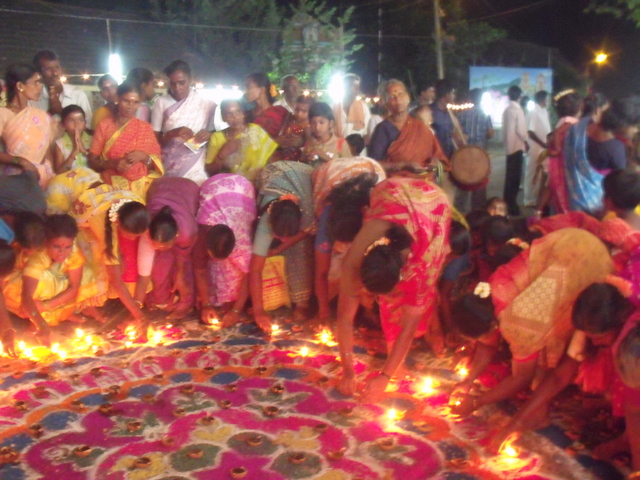
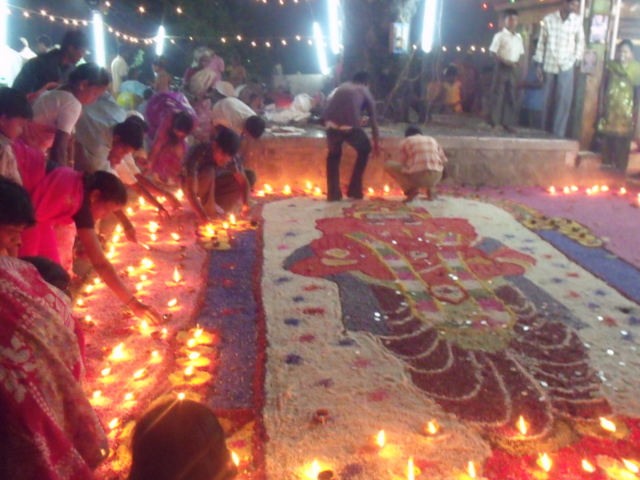
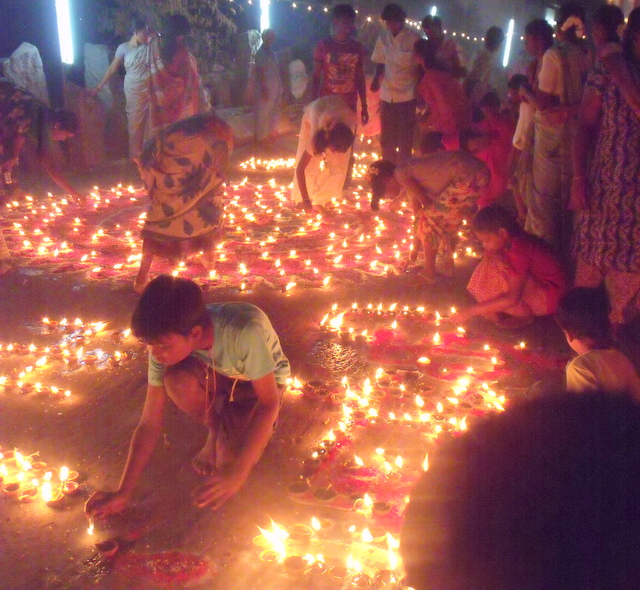
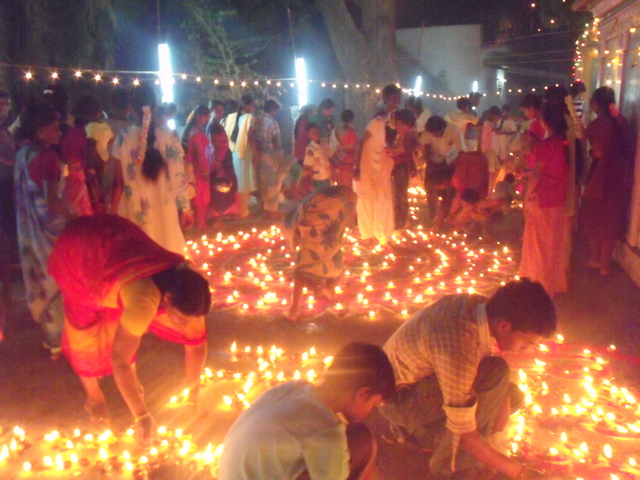
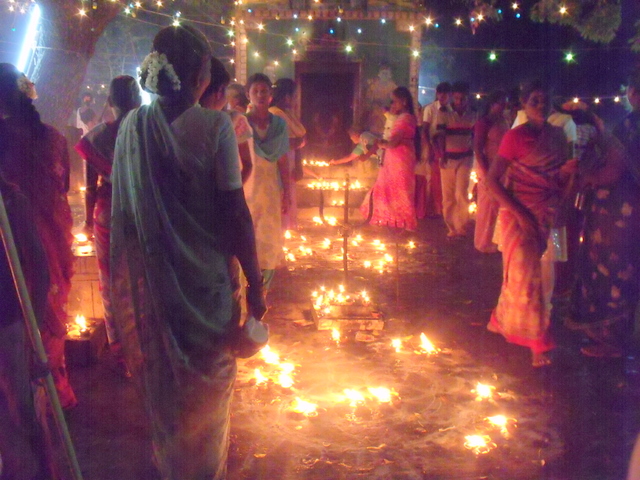
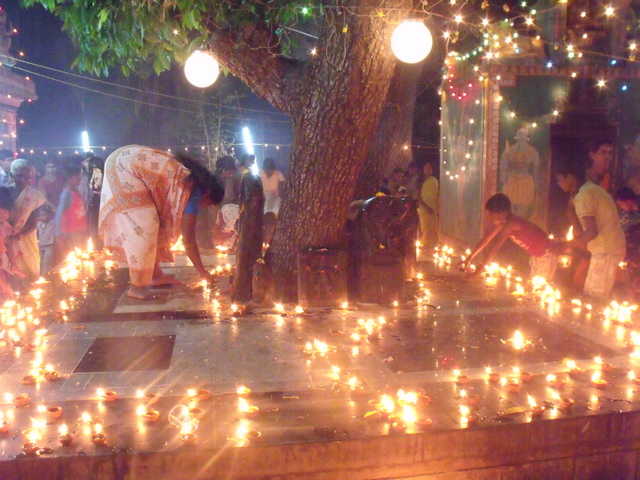
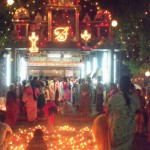 Recently the Renuka Amman temple in Adi Annamalai was the
 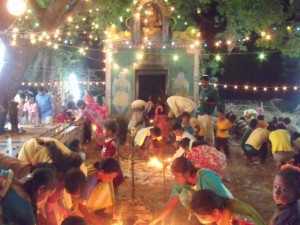 venue for a most spectacular and beautiful festival called the Laksha Deepam festival or the festival of One Hundred Thousand Lamps. This temple can be seen on the left side of the outer girivalam path right as one crosses the village of Adi Annamalai.
 The festival took place on Thursday, April 14th which also happens to be the Tamil New Year. Around
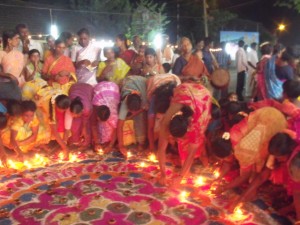
  sunset, the temple courtyard was already filled with village people who had come to start drawing the Kolams or sacred designs on the ground. Though not much is known about the antecedents of the festival, it seems to be a way of welcoming the new year and also a ritual to propitiate the Goddess so that the summer would not be too hot and that She would send rain from time to time to cool the parched earth and the people.
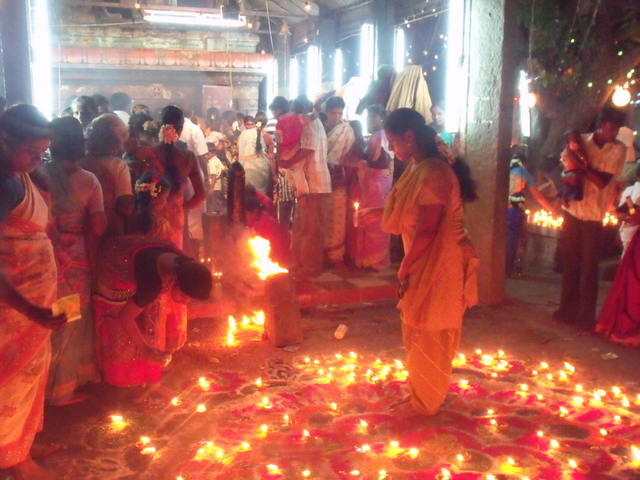
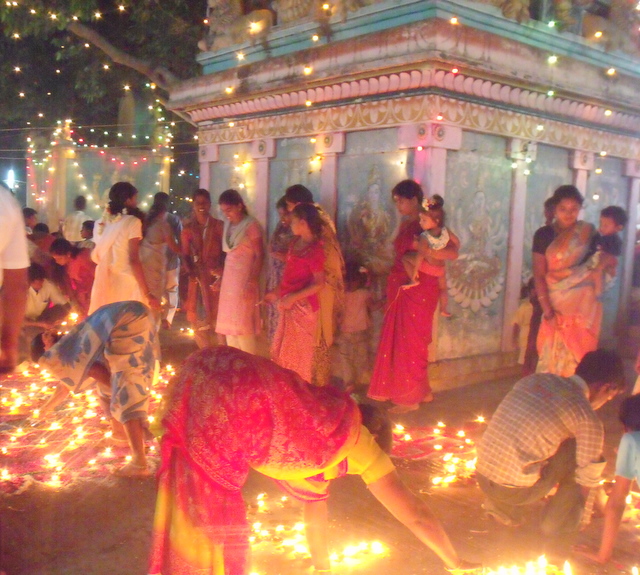
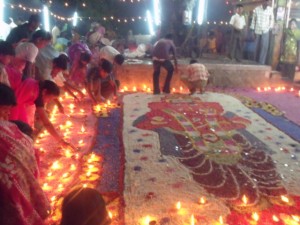
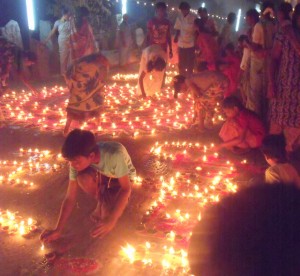 The festival happenings itself are quite simple. First many
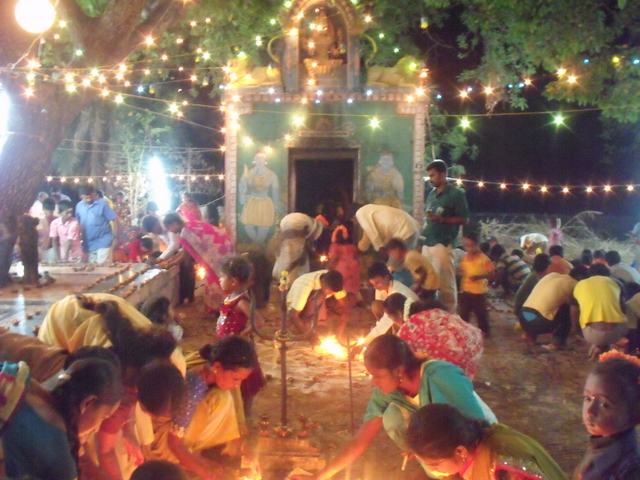
 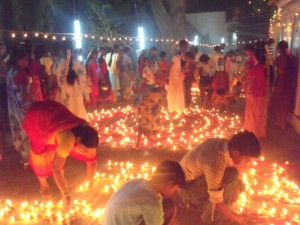 beautiful colourful Kolams are drawn all around the temple and then one hundred thousand clay-oil lamps are placed and lit all over the arena. After this, the Goddes is venerated with a huge abhishekam and then finally brought outside in procession through the streets of the village.
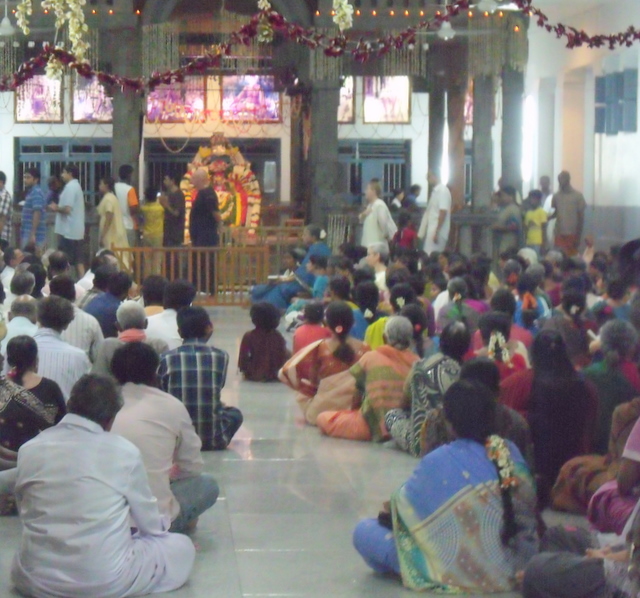
It was really moving to see the rural folk, both men and women,
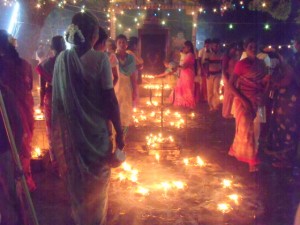
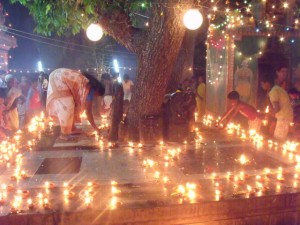 young and old, all dressed in their festive best and participating so enthusiastically in making the Kolams and arranging and lighting the one hundred thousand oil lamps. Many women devotees were singing hymns in praise of the Goddess asking Her for blessings and cool rain during the hot summer. An elaborate Aarthi puja was
 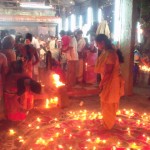 performed after the lighting of the lamps. Later that night, the
 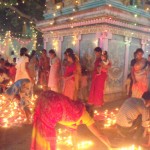 Goddess was beautifully decorated and then raised on a pedestal and placed on a wooden palanquin. She was then borne in procession by many men around the village of Adi Annamalai where the residents of the village honoured Her, made offerings and worshipped her with devotion.
continue reading
-
Girivalam shrines – around Sona theertham
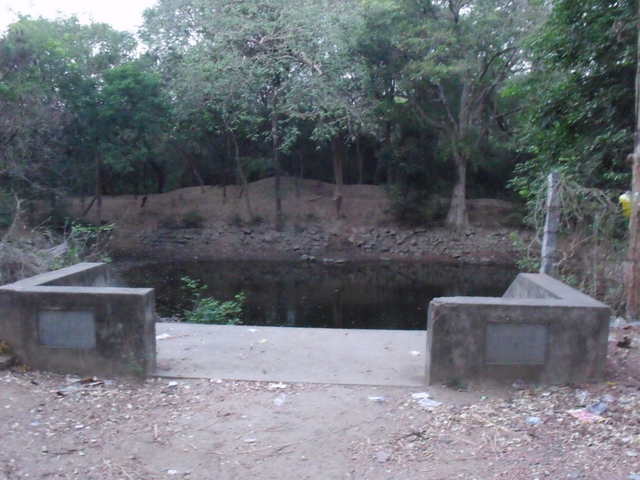
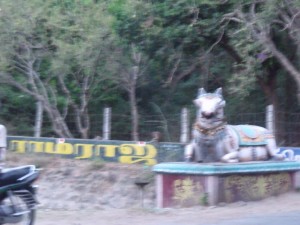
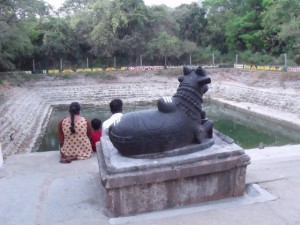 Sona Theertham is a sacred tank of water situated on the outer
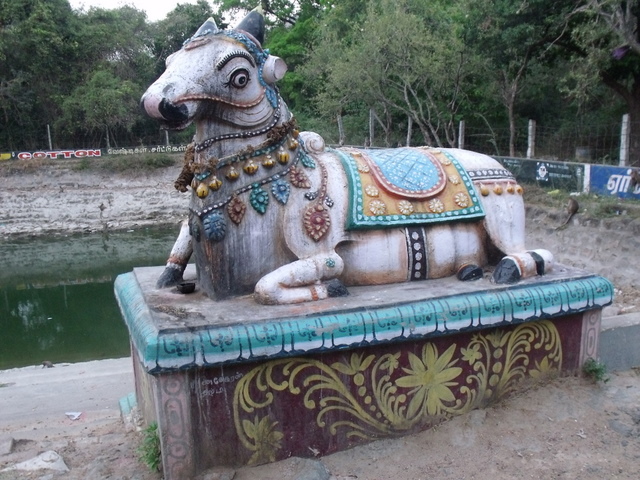
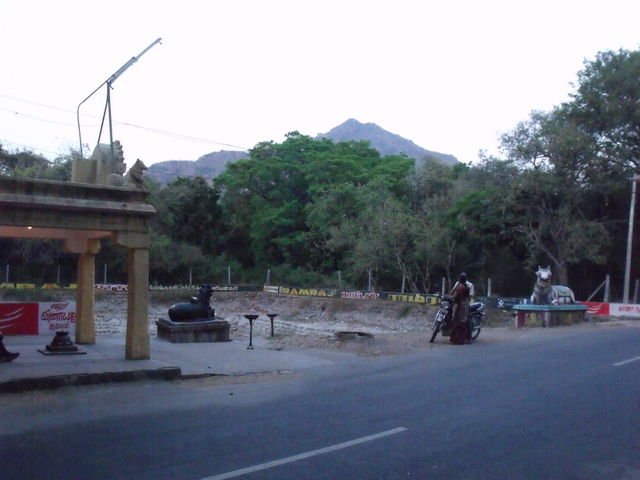
 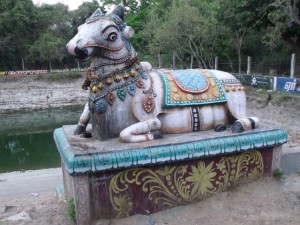 girivalam path. It is located in a very pictoresque spot on the border of the innerpath forest and thus has an abundance of lovely old trees all around. The theertham has two Nandi statues flagging the entrance steps which lead down to it and also a cute little Ganesh shrine with a smiling sadhu priest who looks like a sweet chimpanzee. This seems to be quite an idyllic place and often romantic couples come to sit here and enjoy the view.
On the opposite side there is a shrine to the
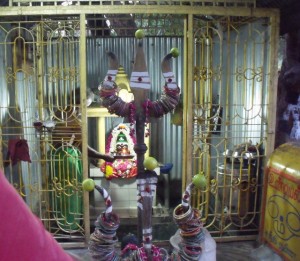 Divine Mother under
 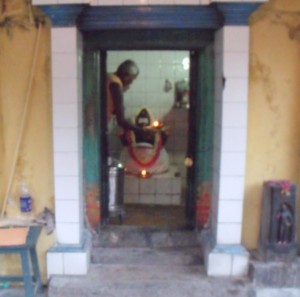 the title of Muthu Mariamman, a tamil name for goddess Parvathi. Of recent years this little shrine has become quite popular and on Sundays there is quite a crowd of devotees here especially vehicle owners who like to get their cars and trucks blessed with a little puja involving lemons and camphor flame.
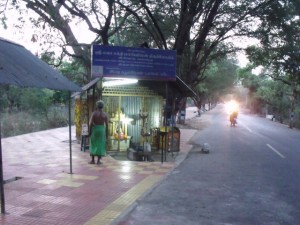 A few metres after Sona Theertham on the same side is another
 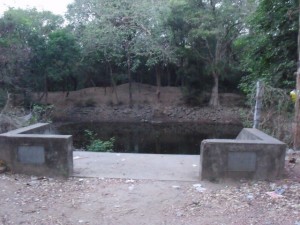 pond called Krishna theertham due to the little Krishna shrine which is found just in front of it. This pond has fallen into a state of disuse and needs to be cleaned up ideally, which would make it another good clean natural source of water for the animals and birds which flock here to drink the water and enjoy the cool shade from the trees.
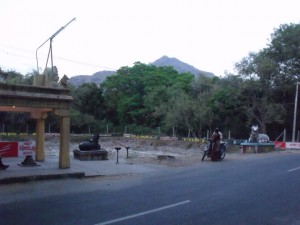 The remarkable feature about this spot is that even on a hot
  summer day it is always especially cool around here, probably due to the trees and also due to the plentiful water sources which are in concentration here. When one drives in here from elsewhere, one can feel the perceptible drop in temperature as soon as one enters the vicinity and due to this, often passersby stop here and relax to get relief from the summer heat.
continue reading
-
Now for Iphone and Ipad
Arunachala-live has now been configured for the iphone and ipad for the benefit of those wishing to see Arunachala on apple mobile devices. Previously this was not possible but our technical support staff has solved this problem in a very elegant manner. We are very grateful for their diligent efforts. The main page functionality has also been improved and you can notice some slight differences, especially when resizing your browser. Previously the camera image was a fixed size even if the rest of the browser was resized. It now resizes with the rest of the page allowing viewers to adjust the main page to their screen size. We hope our mobile users enjoy the possibility to view Arunachala on their devices
The Arunachala-live team
continue reading