Day 8:27 pm
-
Panguni Uttaram – the Divine Marriage
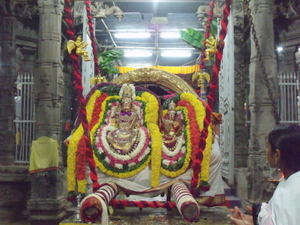 The full moon of the tamil month of Panguni in conjunction with the lunar constellation of Uttaram (meaning that which is superior, excellent) is presided by the ViswaDeva (meaning totality of the Gods). The fullness of the moon, the excellence of the constellation and the divine totality all give this day the qualities of completion and perfection.
In Tiruvannamalai, on this day, the marriage of Lord Shiva and Goddess Parvathi is celebrated. The marriage celebrations last for 6 days and the programme is as follows: 1st day – Panguni Uttaram, celebration of the bethrothal ceremony. 2nd day – Maru Unnal Utsavam, feast of taking meals in the in-laws house. 3rd, 4th and 5th days – Nalangu Unjal, ceremony of ritually rocking the Gods seated upon a wooden swing. 6th day – Manjal Nirattu vizha, ceremony of the ritual bath in turmeric water.
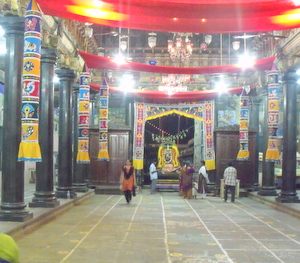 At the outset, the marriage invitation is printed and distributed to all the town folk. Curiously the marriage ceremony is performed twice. In the morning it happens inside the inner sanctum of the resident chief deity (Moolavar-lingam) and in the evening it is celebrated for the Utsava murthys (the ambulant Gods or the deities in procession).
Morning: the marriage ceremony is begun with the usual daily rituals performed to the lingam. During the course of the rituals, the gold-jewelled symbol of marriage (thali or mangalyam) is tied around the neck of the Goddess Bhogasakthi represented by a bronze statue who is always present in the ante-chamber of the sanctum.
Afternoon: Around 4 p.m. the Goddess Thani Amman is borne in procession to the Kumaran temple situated at the South of the big temple where She is installed on a pedestal.
Night: Around 10 p.m. after a very elaborate ritual of decoration, the Goddess adorned in her marriage sari is borne back in procession to the shrine in the 3rd courtyard of the big temple where Lord Shiva awaits her in the form of Somaskanda (Shiva as a husband). Now, to the delight of the spectators, a graceful ballet ritual ensues, during which the two deities (Thani Amman and Somaskanda) borne upon devotees’ shoulders are brought close thrice, one to the other, and the marital garlands are exchanged thereby. Then the bridal couple deities are carried to the marriage hall on the South of the 3rd courtyard where devotees are gathered already to witness the marriage celebration. Here the Gods are installed on a beautiful wooden old fashioned swing. At their feet, two kalasams representing the bridal couple have been consecrated and decorated. We also see various other symbols of marriage – germinated grains sprouting in 5 little earthen pots, mortar and pestle etc. The main ceremony begins around midnight. There takes place firstly a series of general marriage rituals:
– a protection braclelet (kappu or kanganam) is tied around the waist of each.
– after a divine chanting, a sacred cord (Yajnopavita) is offered to the god.
– the thali or mangalyam (the sacred cord of marriage with gold-jewelled ornament) is then tied around the neck of the Goddess.
– the priests perform a very elaborate fire sacrifice (agni homa). This sacrificial fire is conserved in a clay pot and is kept burning for 5 days.
The end of the marriage consists of a puja, with offering of naivedya (food offering) to the fire, to the kalasams and to the deities.
Very late at night around 2 a.m. the celebration continues with a very lighted procession around the 4 streets of the temple and this goes upto dawn. On their return, around 7 a.m. the bridal couple, Somaskanda and Thani Amman resume their places in the marriage hall and are worshipped with Abhishekams (sacred ritualistic baths for the deities).
 Thus the divine marriage serves as a reminder to men that the marriage of the gods is a model of that of men and that conjugal life is a source of happiness and prosperity.
continue reading