Day 8:15 pm
-
Amman Kooluthal festival
 In the month of Aadi (July-August), which is devoted to the Mother Goddess (Amman), there is a popular rural celebration in Tamil Nadu called the Kooluthal festival. Kool is a type of gruel made of fermented ragi batter and at this time, each family prepares a pot of Kool and offers it at the local Amman temple where it is poured into a huge cauldron and offered to the
  resident Goddess (usually MariAmman, a rural form of Parvathi). This is then distributed to one and all as Prasad. During the festival, the whole main street from the temple is
  decorated with banana and palm fronds and shiny coloured lights are strung everywhere. There are also enormous lighted cut-outs depicting the Goddess which blaze at night and strike the attention of every passer-by.
This week in the village of Adi Annamalai, the Kooluthal festival was celebrated on a
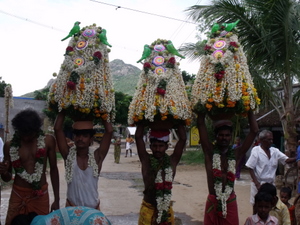 grand scale. The morning after the distribution of the Kool, the ritual with the karagam dancers was performed. This involves a group of male dancers, some with flower-decorated pots balanced on their heads, musicians of three sorts, a few with drums, some others with waving cymbals and more others with
 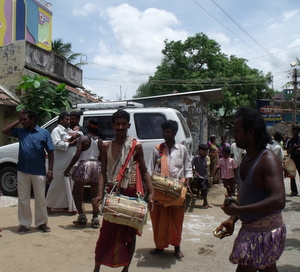 bells tied around their feet and brass rings in their hands. This group makes a tour of all the streets in the village. The ones with the pots on their heads are considered to be embodiments of the Goddess and are worshipped by each family with women washing their feet with pots of water, applying turmeric and vermilion on their feet and then prostrating on the ground in front of them.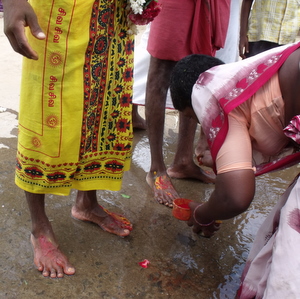
In the evening, the Goddess is brought out in procession and fireworks are set off. Later that night there is much fun and merry-making among all the people. Film shows, dramas and other entertainment shows take place in the ground outside the temple and the rural folk relax and enjoy themselves.
This is the time of year when summer is drawing to an end and the first rains have arrived. People are relieved that the great heat
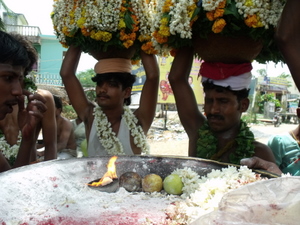 is over and that they can start the next season of cultivation soon. It is a time of hope. The Goddess is propitiated with the belief that the rains will be bountiful and that they would reap a good harvest and have prosperity in their lives with Her blessings.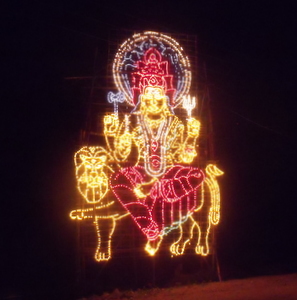
continue reading