Day 7:13 pm
-
Durgai Amman Kovil
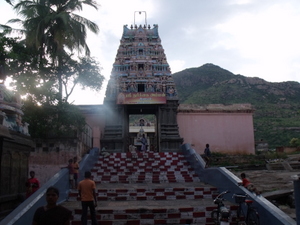 The Durgai Amman Kovil stands as a veritable landmark on the eastern portion of town. It is a fairly large temple dedicated to the Goddess Durga and is filled with women devotees almost every day. Durga is the Goddess of fertility and womanhood and She is revered as the female archetype. As one crosses the bus depot area and enters the temple quarter, one can find the entrance tower of this temple on the right and the street on which it stands is named after it – Durgai Amman kovil street.
The temple is situated in a vast area and has the
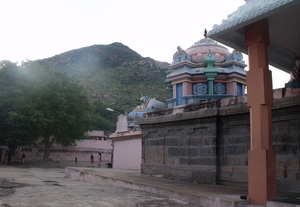 backdrop of the Mountain on three sides. There are two grand old peepul trees and one banyan tree around the courtyard. As well as the main shrine to the Goddess, there are many sub-shrines in honour of various forms of Shiva and Parvathi. The famous Kadga
  Theertham with its perennial waters fed by underground springs from the mountain is found here and serves for the abhishekams.
Apart from regular worship, there are three special cults which take place here. One is the Durga Rahu kala cult on Tuesdays and Fridays. During the inauspicious time of Rahu, many married women come here and burn oil lamps made of an inverted lemon peel and chant the Durga namavali and other
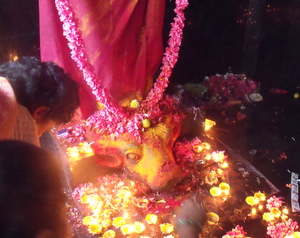 hymns in praise of Her. They believe that this will keep their husbands in well-being and long life and also protect them from the evil effects of the demon Rahu. It is a touching sight to see the devotion of these Sumangali women who queue up in large numbers to perform this ritual.
The second is the Sri Chakra cult where-in Sri Chakra puja is performed on certain auspicious days. Inside the temple precints, there is a beautiful stone-carved Sri Chakra Mehru installed in a special
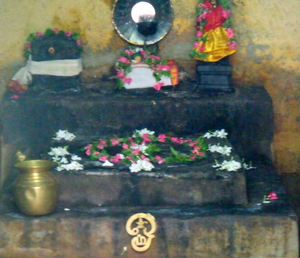 shrine. This Sri Chakra was consecrated by Bhagavan Sri Ramana himself and seems to emanate a very deep energy. Devotees are fortunate because this Sri Chakra can be seen and approached very close, unlike the one in Ramanashram which is deep inside the sanctum and can only be seen and approached by the priests.
The third cult is one of snake worship. In the temple
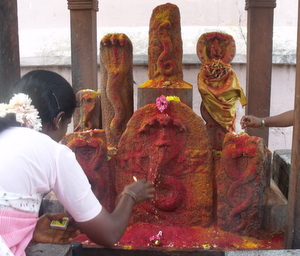 courtyard is an altar with a series of snake idols and women congregate here and perform puja with turmeric and vermillon to these idols, with their own hands. There is no intermediary of a priest in this case and this also speaks of the strong feminine aspect of this temple.
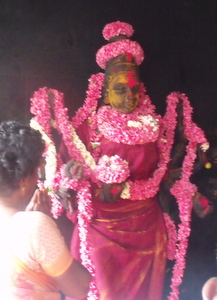 What is remarkable here is that in spite of the crowds that throng here all the time, the temple always has a tranquil and serene aura to it. This must probably be because the majority of the devotees here are usually women who come demurely and attend to their worship and other feminine rituals with quiet piety and grace.
continue reading