Vasantha Utsavam, the Spring festival – Part I – a curtain raiser
-
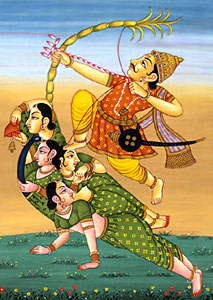
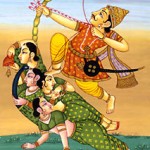 In Tiruvannamalai, the Vasantha Utsavam is celebrated to commemorate the momentous events that took place one fateful spring morning thousands of years ago, when Kama, the God of Love, decided to wield his Cupid´s bow and fire a flowery arrow into the heart of Lord Shiva himself who sat in deep meditation. Shiva, thus aroused, becomes furious and burns poor Kama to ashes with the flames of wrath leaping out of his third eye. Much later, Rathi the celestial consort of Kama appeals to Shiva in tearful agony and Shiva moved by her distress resurrects Kama out of the ashes.
This festival is celebrated alternately in the popular quarters of the town of Tiruvannamalai and inside the big temple of Arunachaleswara under the auspices of an Utsavam. In the town it is celebrated in 5 or 6 minor shrines dedicated to Devi or Subramanya. About two months prior to this, on the day of Masi Magam, a staff with a green standard is planted in the earth near the temple. To the bottom end of the staff is attached a pat of dried cow dung which bears the vaishnavite symbol of Kama. Although it is not used otherwise than in this ceremony, the pat of cow dung is the symbol representing the burning of Kama to ashes by the fire of Shiva. Following this incident, 10 days before the full moon of Chithirai, a little group of devotees from each temple march across the town in the evening bearing a tambour and a flag depicting Kama in the process of striking his arrows. They go from street to street singing the mournful strains of the Oppari (funeral) chant. Moreover, interspersed with the chanting, they recite the amorous exploits of Kama in coarse dialect. On the 10th day which is the full moon, an effigy of Kama made of lemon grass is dragged on the streets and burnt early in the morning in the presence of a character dressed up as Rathi and another dressed up as Shiva in meditation under the trees.
However, in the temple celebration, Kama is always resurrected, 3 or 5 days after his death. And with this idea, the ashes are collected in a little mound and in the midst of chanting Rathi pours milk on them as is wont in funerals. In some cases Shiva also gives a stick to Rathi with which to beat on the ashes thus showing that the Lord has accepted the appeal of the wife and that it is He who thus accords to Kama the right to live again.
In the temple also the festival is celebrated just after the vernal equinox which corresponds to midday of the gods day. It is notable that the 10th and final day of the festival coincides with the full moon of Chithirai in conjunction with the Chaithra constellation.
The preparations for the festival in the big temple consist of the following ceremonies:
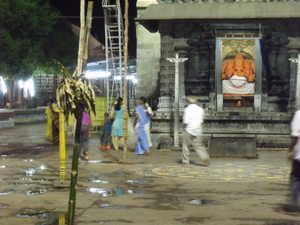
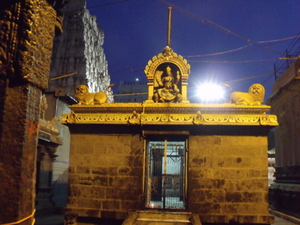
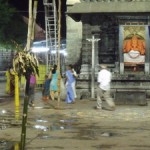 – the pandalkal muhurtam or the auspicious moment for defining the sacred space of the festival by the ritual of erecting the pandalkal or pandal pole. This is done in front of the shrine of the Sambandha Vinayagar who is freshly anointed with vermillion and showered with abhishekas for the occasion. Here on the ground the pandalkal decorated with mango leaves and flower garlands is firmly planted inside a pit which has been dug and consecrated earlier with bhumi puja ritual. After the pole is erected, diparadhana and arathi are performed.
– the Yagasalai or hall of sacrifice is opened on the first day in the evening after the sayarakshai ritual.
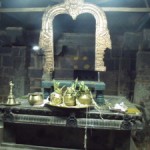
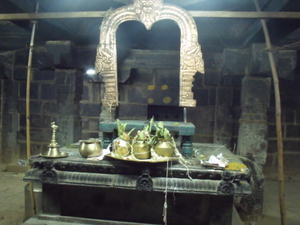
Here on the central platform, two kalasams, one representing Soma and the other Kama, have been placed on a mound of rice. The kalasams in this case are bronze pots filled with turmeric water and a coin, they are closed with a coconut surrounded by mango leaves crested by a knot of Dharba grass and decorated with a flower garland. Around the kalasam representing Soma, there are five palikai, little earthen pots in which the Navadhanya or the nine classic food grains have been germinated.
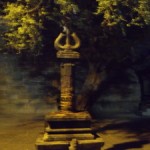 The soil in the pots comes from the ground beneath the Vilva tree which grows near the shrine of Goddess Pidari amman. Puja is performed to the kalasams twice daily during the 10 day period of the festival.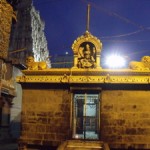
– A Kappu or protection bracelet is tied around the arm of god Somaskanda just after the first ritual in the yagasala.
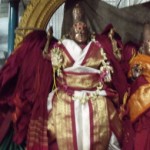
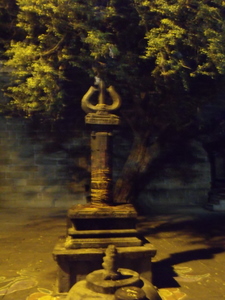
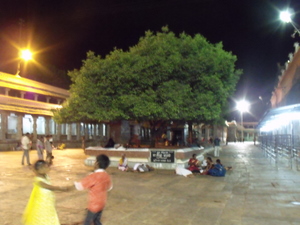
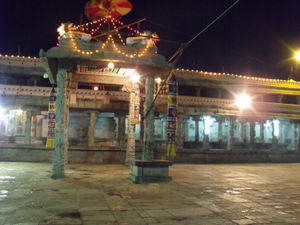
The specific rituals of the Vasantha festival: They are connected to the Southern area of the 3rd courtyard of the temple where there are the three Makila (mimusops elangi) trees, (the sthala viruksha or sacred/special tree of Arunachala), as well as to the divine marriage hall or kalyana mandapam.
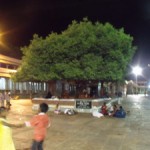
– the deities who are installed in shrines under the trees receive abhishekam and karpuratti puja daily twice during the 10 days.
 – inside the marriage hall right at the back, the Bhimaswera lingam is also venerated with abhishekam and puja during all the 10 days whereas this lingam is never venerated at any
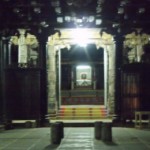 other time of the year. Interestingly the name of this lingam, Lord Bhima refers to the third brother of the Pandavas in the epic of Mahabharatham and it is he who gives Kama, the desire, the precedence over the three other goals of man (purusharthas)
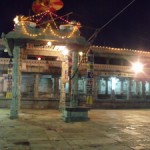 The principal and most attractive feature of the festival are the 10 splendid nightly tours of the god Somaskanda around the Makila trees with music and dance accompaniements and fanfare for the first 9 days of the festival. On the 10th day which falls on the full moon, the gods will go on a tirthavari procession to Ayyamkulam (ritual of the gods taking holy dip in a sacred pool) and on their return will take place the burning of Kama enacted in the form of an elaborate divine charade.
The celebration of the Vasantha festival dates back to very ancient times as learnt from the Bhavisyottara purana. Our next post will describe the actual proceedings of the festival with photos.