Vasantha Utsavam – Part II – the celebrations
-
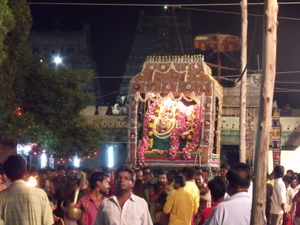
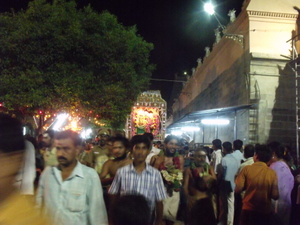
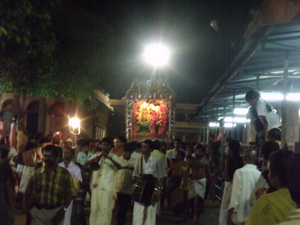
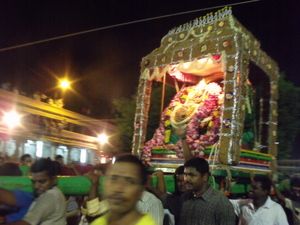
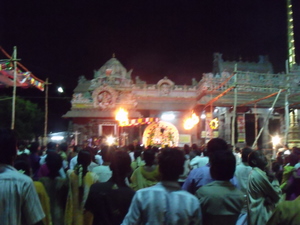
 The deity of this festival is Lord Somaskanda, a form of Shiva and Parvathi, usually found in a shrine on the south-western corner of the main temple of Lord Arunachala. From the first day of the festival upto the ninth, every night around 10 o clock, the gods are brought outside to the third courtyard of the temple, installed in a special palanquin
 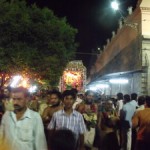 and there ensues an elaborate procession-celebration of the Gods in the form of ten splendid, event-filled tours around the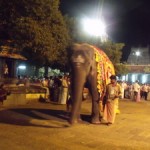
Makila trees lasting till well over midnight. The significance of the “Makila tree” (mimusops elangi) : the tamil verbe makil means to enjoy, to desire and the noun makilchi means joy, exultation or ecstasy. Makiltaran is one of the names of the god Kama. The word makila is often pronounced makuta meaning crown and refers to the coronation of Shiva as the sovereign of the universe.
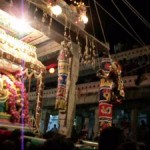
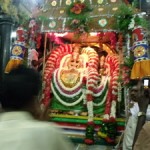 After coming out of his shrine, Somaskanda is installed on the first pandal just in front of the golden flag pole facing the main shrine. Here the Gods are placed under a lovely canopy of fragrant cooling roots called vilamichaiver vimanam (vilamichai root canopy) hand-made by artisans specially for this occasion, and worshipped with offerings of flowers, diparadhana (waving of lights) and karpuraratti (burning of camphor) with the accompaniment of the temple musicians on their mridangam and nathaswaram.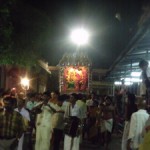
Next the Lord is brought to the second pandal, the
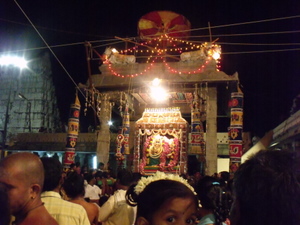
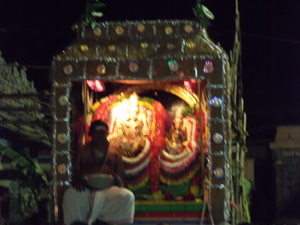
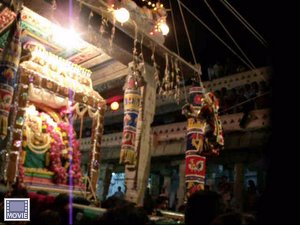
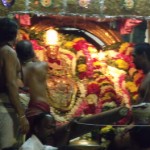
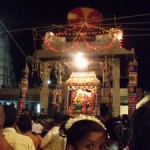 panneer mandapam, where he is greeted at first with the lovely fragrance of panneer (rose-water) which is sprinkled copiously from the top. An offering of diparadhana is made and the priest sthanikar climbs on the pedestal and sits at the feet of the Gods. Along with the kalasams Soma
 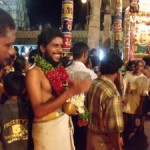 and Kama, the Gods are decorated with garlands. And then to the delight of the already excited spectators,
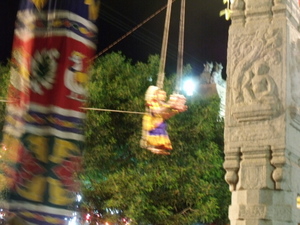
 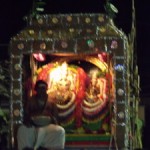 the Gods perform a frenzied ritual-dance in front of the mirror placed on the adjacent gallery, with the musicians playing accompaniment with great fervour. Now the Gods settle down under the panneer mandapam to witness a series of elaborate rituals whose significance should not be lost. The showering of flowers on the Gods by the Gandharva Kanni (the virgin-nymph) is
 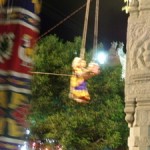 enacted by a puppet activated by strings attached from the adjacent gallery terrace. In a very beautiful show which is enthusiastically cheered by all the spectators both old and young, the lovely
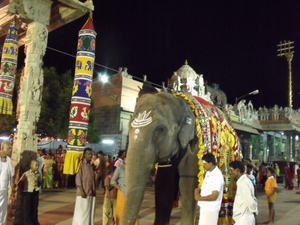
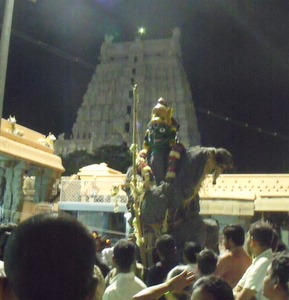
 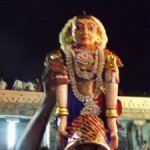 gandharva kanni puppet comes many times, seemingly out of thin air, and showers buckets of rose and jasmine flowers on the Gods. It is indeed a marvellous spectacle! Then a priest pours a pot of water with five vilva leaves in front of the deities and makes an offering of lights. During all this time, the stately temple elephant stands in attendance, donned in its festive robes. In the past it would gently fan the Gods with a venchamaram (sacred white fan made of peacock feathers and silk).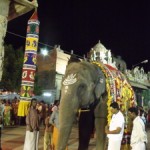
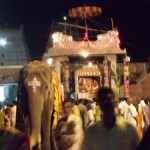
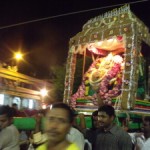
After these rituals, the ten processional rounds take place and the gods are borne on their palanquin ten times around the makila trees enclave led by the elephant and accompanied by the musicians and singers and followed by devotees. At the completion of each round, the gods dance in front of the mirror and then remain seated under the panneer mandapam where they receive two floral showers by the Gandharva kanni and diparadhana (light) offering.
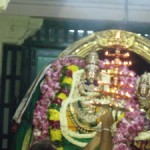
The significance of the Gandharva Kanni (celestial virgin nymph) : The Gandharvas are celestial beings and also musicians. They are the guardians of Soma, the divine nectar of immortality and divine teacher of the Moon who is also called Soma. They are the parents of the first human beings, the brother-sister couple Yama and Yami. The Gandharvas are attributed with a mystical power over women and the right to possess them. They are invoked in traditional hindu marriage ceremonies and in the brahmin tradition, the bride who is to be married is supposed to belong first to Soma, to Gandharva and to Agni before becoming the wife of a
 human being. A gandharva marriage is a marriage of love (not arranged). The chief of the Gandharvas is Chitraratha. The wives of the gandharva men are usually celestial damsels, apsaras. In the present festival, the appearance of the Gandharva kanni would mean to manifest, in a nubile form, the expression of desire and the virtue of union as well as the other elements which are associated here-in (flowers, fragrance, music).
 Special days of the festival: The special days are the 3rd, 5th, 8th and 10th days. On the 3rd day, the birth of Kama is supposed to happen, (this was enacted by a temple danseuse disguised as Kama in the olden days).
The 5th and 8th days: On the 5th day, during the 3rd round, Somaskanda makes a halt in front of the main Dakshinamurthi statue under the Makila trees and two priests perform simultaneously one puja to each of the deities with
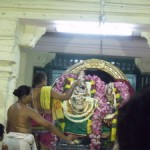 food and light offerings, the synchronisation of the pujas highlighting the unification of the two divine forms. After the 10th round, Somaskanda is taken inside the Kalyana mandapam where he is divested of silks and jewellery and re-adorned in a new alamkaram made entirely of flowers and green leaves (spring costume).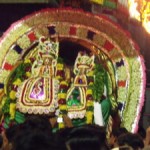
When the Gods come back outside, the entire lights of the temple are switched off and the Gods make a special tour of the 3rd courtyard with only the light of flaming torches made of rings of plaited straw thereby representing the olivu-vattam, circle of light which designates the moon
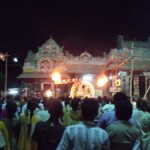 (Soma).
On the 8th day, Somaskanda is taken inside
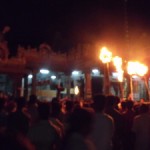
the Vasantha mandapam which is at present the temple
administration office and after changing to spring costume, brought outside and again all the lights are switched off and the same olivu vattam tour takes place but this time in the opposite or anti clock-wise direction (apradakshina). Thus the Gods arrive from the left side whereas his musicians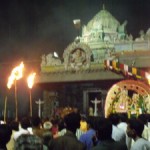
and singers come from the right and they meet in front of the main pandal. In the olden days, the devadasis danced the pinnal-kollattam and one of them, disguised as Kama, was bound in cords.
 The 10th and final day: Around 10 o clock in the morning, after the uchikala ritual, Somaskanda and the Goddess go outside the temple on procession in palanquins. They are accompanied by the Astra Deva and the Palikkai. The procession winds its
 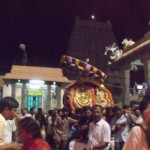 way up to the Ayyankulam, a sacred reservoir of water inside the temple of Arunagirinathar. Here the Teerthavari ritual takes place according to tradtion and the palikkai is thrown inside the water after the Astra deva,s holy dip in the water. The Gods return in procession to the big temple late in the evening. It is the full moon of Chitra. Somaskanda first performs a salutation dance in front of Sambanda Vinayaka while the Goddess is taken inside the shrine. Somaskanda is then borne to the Vasantha mandapam and installed on the front porch where he
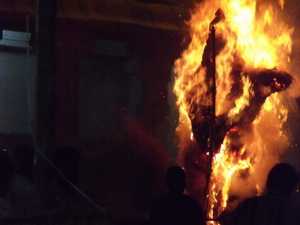
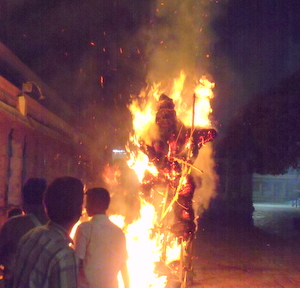
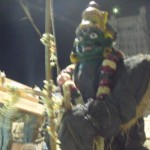 is worshipped with diparadhana and karpurarathi. And there he sits beaming benevolently at the crowds of devotees who are thronging at his feet. One would never imagine the terrible events that would follow. Lo and behold! Kama appears and starts to wield his bow and aim his flowery arrow at Shiva. Depicting this, a giant effigy of Kama made of straw holding a huge bow and arrow festooned in flowers is brought in on a wheeled contraption and placed facing Somaskanda. A string is tied connecting the two deities. Then with the help of the priests a fire cracker is lit at the hand of
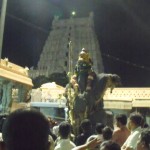 Somaskanda where it instantly takes off and whizzes down the string and reaches Kama and BOOM! Kama explodes into
 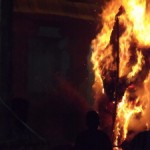 flames and is immediately wheeled back to the Makila trees enclave where he gets burnt up entirely. A magnificent display of fireworks then takes place in the temple courtyard, enthralling the crowds. After this Somaskanda is borne back into the temple and installed in his shrine.
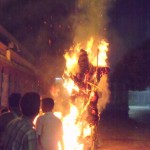 Thus Kama is destroyed by the wrath of Shiva in the festival. However, according to legend, Kama is later on resurrected out of the ashes after his consort Rathi appeals to Shiva and begs him to restore her husband. The death and resurrection of Kama represent the spiritual truth of how after the ego is destroyed, one is reborn as pure eternal Being. The fact that the flames from the third eye of Shiva burn Kama signifies that the third eye of Jnana (knowledge) in one’s heart must be opened in order for the ego (ignorance) to be destroyed for no darkness can prevail when the light of knowledge shines.