Girivalam shrines – Snake worship
-
Snake worship is an ancient and widespread religious practice in India. The
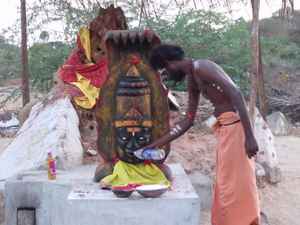 Cobra is associated with the Lingam, the emblem of Lord Shiva. The Nagarpanchami snake festival is celebrated by many Hindus. On this day, people worship snake gods with flowers, milk and eggs in front of their idols in temples. Innumerable shrines containing images of the snake king Vasuki bear eloquent testimony to the influence of the Serpent on the social and spiritual fabric of India.
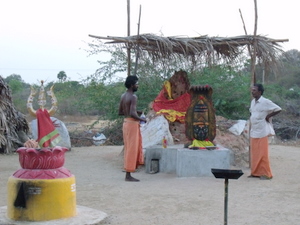 Here in Tiruvannamalai too, there are many termite mounds which are considered to be the dwelling place of serpents and hence venerated as snake temples. The most recent snake shrine is a huge termite hill on the left side of the outer Girivalam path a few metres after the Draupadi temple. Within a short time this temple has become quite popular and the resident serpent goddess has been christened “Nagathamman” (Naga means snake in Sanskrit).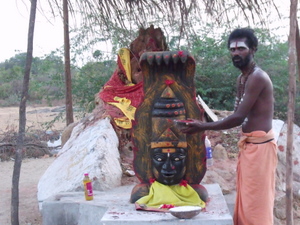
In Hindu mythology we come across several episodes involving serpents. When the ocean of milk was churned for the recovery of ambrosia, the snake king Vasuki served as a rope and was tied around Mehru mountain. The poison ‘HalaHala’ which emerged from the ocean prior to the arisal of the nectar, was in danger of engulfing the whole universe. But Lord Shiva bravely consumed the poison emitted by the serpent and thus saved the universe from destruction. Due to the effect of the poison his throat became dark blue in colour. For this reason, Shiva has the name of NeelaKantha (the Blue-throated One).