Last Posts
-
The Karthigai Brahmotsavam
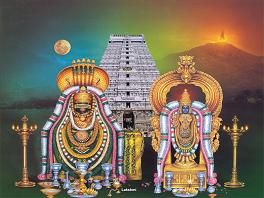 In India, all temple festivals are ‘Utsavams’ and the most important one is called ‘Brahmotsavam’. From the etymological point of view, the Sanskrit word ‘Utsava’ denotes an act of creation or re-creation. If we study the features of the Brahmotsavam, we will find that more than any other temple festival, the Brahmotsavam would essentially be a festival of re-creation.
The Karthigai Deepam Brahmotsavam holds a unique
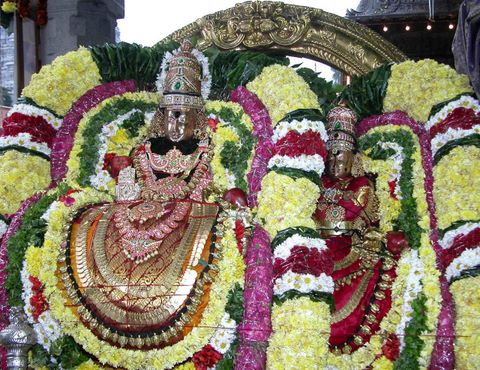 place in the world of temple festivals. Due to its ancient origins and deeply esoteric significance, it has withstood the ravages of time and modernization. Despite the decadence of the present age and all its evils, the beauty and wonder of the Deepam festival remain unchanged and unsullied. The true significance of all religious festivals is that the Supreme Being makes His presence felt strongly during that time. During Karthigai Deepam, Arunachala opens up the heart of His beloved ones and reveals Himself as the Supreme Being. Shining as ‘I’, ‘I’ the sole occupant seated in the centre of the Heart’s cave of His devotees, He is believed to guide and inspire the proceedings of the entire festival.
 On the first three days of the sixteen day festival, the various deities are propitiated, while the last three days form a sort of epilogue to the lighting of the Deepam on the Hill. Thus the main festival is only for ten days. The first day begins with the hoisting of the Flag which ceremoniously ushers in the ten days of the Brahmotsavam. Called Dwajaarohanam, it marks the beginning of any temple festival. The Dwajaarohanam of Karthigai this year took place at dawn on Friday 12th November and was attended by a fairly large crowd of devotees. The idol of the Lord was adorned
  beautifully with jewels and flowers and brought by the priests and placed in front of the dazzling golden flagpole in the first courtyard of the temple. At the appointed auspicious time, the flag was hoisted to the divine chanting sound of the Vedas accompanied by Nathaswaram music, drums and cymbals. The priests then invited all the sacred rivers, all the gods and goddesses and all the rishis and seers to come and witness and bless this occasion. After the ceremony was over, the Lord was taken around on procession and then installed in the vast hall (called the Kalyana Mandapam) on the southern side. Here he will stay for the next ten days, beaming graciously upon the multitude of devotees thronging at His feet for Darshan.
The special days before the actual Deepam day are the
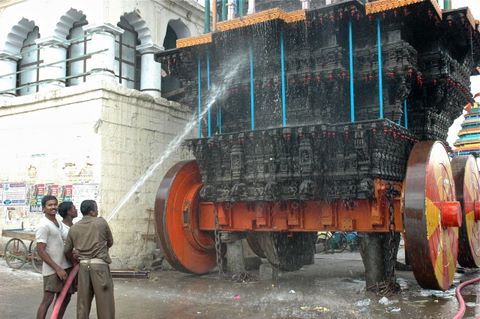
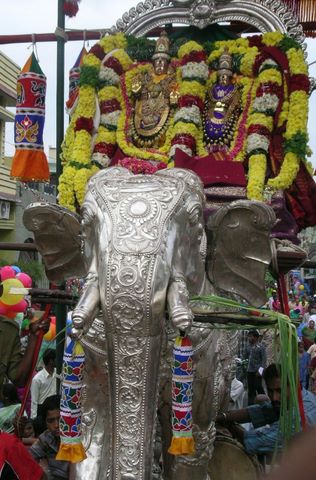 fifth and the seventh days. On the night of the fifth day, the Lord along with his consort is taken on His sacred Mount, the Rishaba (Bull) which is made of wrought silver in this case. The seventh day is the day of the Maha Ratham or the Great Chariot which is of spectacular proportions and the largest sacred chariot in India. This year it will take place on the 18th of November and millions of devotees braving the sun and rain will struggle to pull the chains of the chariot for it moves entirely by human force. The tenth Day is the most important one when the Maha Deepam will be lit on top
 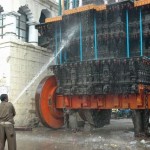 of the Hill at sunset and falls on the 21st of November this year. The Deepam burns for seven, nine, eleven or thirteen days and at about six every evening, the flame flares up and burns throughout the night. It is visible for miles around and thrills the heart of every being who has the good fortune to look upon it. Giri Pradakshina at this time is a very special experience and devotees come from far, distant lands to partake of this Grace. May the Karthigai Deepam this year light the flame of jnana in each of our Hearts!
continue reading
-
Skanda Sashti and Soora-Samharam
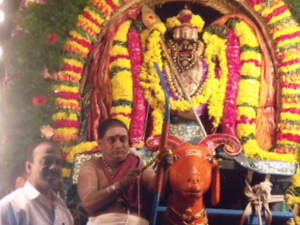 As the name indicates, this is a festival celebrating the prowess of Lord Muruga, the son of Lord Shiva, who is also called Skanda. It falls on Sashti, which is the sixth day of the lunar cycle after the New Moon day of Deepavali. Whereas Deepavali is when Lord Krishna the hero-god of the North slays the demon Narakaasura, Skanda Sashti is when Lord Muruga the Hero-God of the South slays the demon Soorapadman.
Here in Tiruvannamalai, the big temple of
 Arunachaleswara celebrates this festival in a very popular and dramatic manner. The Soorasamharam (destruction of Sooran) takes place at nightfall on the day of Skanda Sashti (this year it fell on Thursday 11th
  November). This time, Lord Muruga in the form of Arumugam or Shanmukham with six heads and twelve arms goes out in procession from the big temple after having, earlier, received the weapon (a bow and arrow) from his mother, the Goddess Unnamulaiyamman. After making a tour of the four
 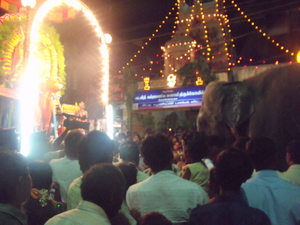 streets around the temple, He then wields his way in the northern direction preceded by the temple elephant and accompanied by his retinue of priests, musicians and devotees.
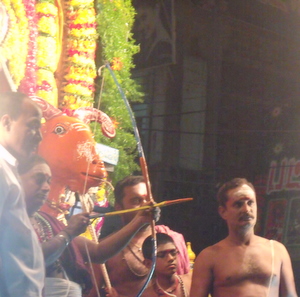 The procession passes in front of the Durga temple and then stops in front of the Vada Subramanya temple a few metres before the bus depot. Here Lord Muruga is assailed by the demon coming from the North (like all asuras). This is enacted in the form of a
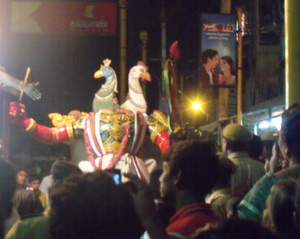
 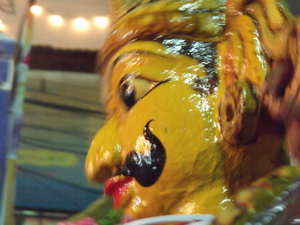 giant wooden doll placed on a cart with wheels which comes whizzing down the slope pushed by men from behind. The asura Sooran thus attacks Lord Muruga three times and the priest wields his bow and lets fly an arrow to strike him each time. After each hit, the head of the Asura changes successively.
  The last head is the Maamarasura with the head of a mango tree. At the end, the Asura undergoes a change of heart, repents his misdeeds and to signify this, his head is altered into a peacock and
 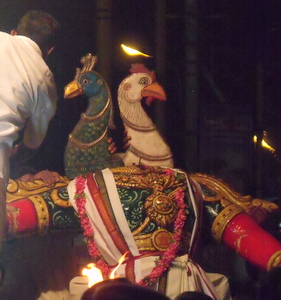 a rooster head, being the two mounts of Lord Muruga. The Asura Sooran then pays obeisance to the Lord and thus the festival ends after a grand display of fireworks.
continue reading
-
The Origin of Karthigai Deepam
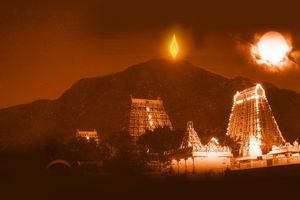 The festival of Karthigai Deepam which is approaching soon is the one of the oldest living festivals in India. It takes place in the Tamil month of Karthigai when the star Kirthiga is on the ascendant and usually occurs on a full moon day. In ancient tamil literature, the oldest available work Tolkappiyam which dates back to 2500 B.C. carries a marked reference to this festival. In another ancient Tamil classic, the Kalavazhi Naarpadu, dating back to the third Sangam period (around 1000 B.C.), the poet writes, “In the battle, the blood oozing out from the dead soldiers’ bodies is like the red coloured flame of the light lit on Karthigai Deepam”. Another song in Sambandar’s Thevaram says that the Lord is verily the Deepam (lit during the Karthigai festival).
Everyone knows that Karthigam Deepam is the lighting of the flame on the summit of Arunachala on Karthigai day but not many people know about
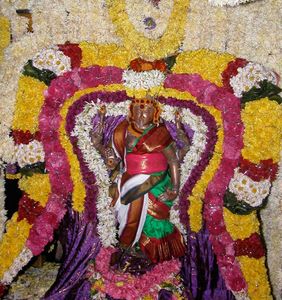 why this festival is celebrated. Readers may remember the legend of the Navaratri festival in earlier posts about how Goddess Parvathi having incurred the wrath of her husband, Lord Shiva, came to the holy hill of Arunachala to do Tapas and regain the favour of her Lord. And so, after a long period of arduous Tapas which the Goddess Parvathi performed with great devotion and strength, Lord Shiva’s wrath was appeased and He came down to Arunachala to take her back. When He arrived, Lord Shiva was so moved by the strength and force which emanated from the Goddess as a result of her Tapas that he decided that She was his equal in every way. Therefore he granted her half his body so that the Two would become totally united in One form. This was the birth of Ardhanareeswara. Physically It signifies the Divine Union of Shiva and Parvathi. Spiritually it signifies the absolute union of Advaita. Not two but One. Shiva and Parvathi are not two but One. Man and God are not two but One.
This momentous event is believed to have happened in the month of Karthigai on the day of Kirthiga Nakshatra and that is why till today the flame is lit on the summit of Arunachala in memory and honour of this wonderful Union which unite Man and God.
When Sri Muruganar asked Bhagavan Ramana about the significance of the
 Karthigai Deepam festival, Bhagavan composed a stanza of four lines in which He says, “The true significance of the Karthigai Deepam festival is to turn the intellect inwards and have it fixed in the Heart, thereby merging it with the indweller of the Heart”
continue reading
-
Deepavali
Deepavali is a festival of truimph of good over evil and the word literally means “row of lights”. Though it started as a north-indian vaishnavaite festival it is now celebrated all over India. The legend of Deepavali goes back to times of yore. There was an evil demon called Narakasura who was terrorising the world. People prayed to Lord Krishna to save them and so Krishna came down and slew the demon after a terrible battle. In his last breath, the demon repented his evil deeds and begged Krishna that his death day be celebrated as a festival and that people should wear new clothes, eat sweets and burst fire crackers on that day. Krishna granted the demon his dying wish.
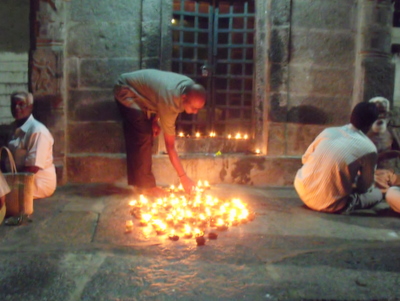 The battle between Krishna and Narakasura took place at night in the forest. After Krishna killed Narakasura, he smeared his forehead with the demon’s blood as a sign of victory and returned to the city at dawn. The women folk received him with joy and gave him a bath to wash the blood off after anointing his head with scented oils. In remembrance of this, on Deepavali, it is still a tradition among the people to wake up at dawn and take an oil bath, that is after applying oil on the head. And then of course the custom of wearing new clothes and gorging on delicious sweets and setting of a fantastic array of fireworks is practiced with great enthusiasm by one and all, especially the youngsters.
In Tiruvannamalai, at dawn, in the big temple of Lord
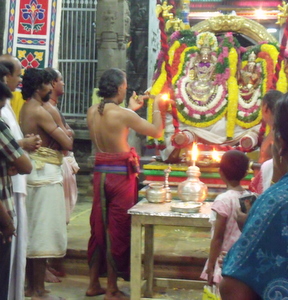 Arunachaleswara, all the different deities in every nook and corner of the temple, are given an oil abhishekam and then adorned with new clothes. Otherwise deepavali does not have any special significance here except that the textile shops in town do a brisk trade and go about even a week prior to the festival, in autorickshaws with blaring loudspeakers advertising their wares.
continue reading
-
Durgai Amman Kovil
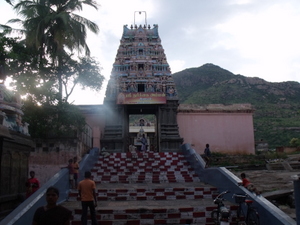 The Durgai Amman Kovil stands as a veritable landmark on the eastern portion of town. It is a fairly large temple dedicated to the Goddess Durga and is filled with women devotees almost every day. Durga is the Goddess of fertility and womanhood and She is revered as the female archetype. As one crosses the bus depot area and enters the temple quarter, one can find the entrance tower of this temple on the right and the street on which it stands is named after it – Durgai Amman kovil street.
The temple is situated in a vast area and has the
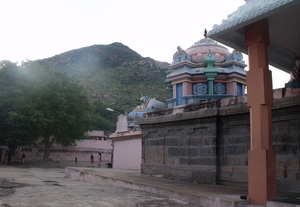 backdrop of the Mountain on three sides. There are two grand old peepul trees and one banyan tree around the courtyard. As well as the main shrine to the Goddess, there are many sub-shrines in honour of various forms of Shiva and Parvathi. The famous Kadga
 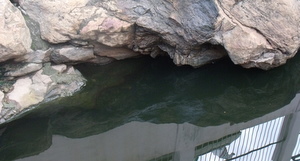 Theertham with its perennial waters fed by underground springs from the mountain is found here and serves for the abhishekams.
Apart from regular worship, there are three special cults which take place here. One is the Durga Rahu kala cult on Tuesdays and Fridays. During the inauspicious time of Rahu, many married women come here and burn oil lamps made of an inverted lemon peel and chant the Durga namavali and other
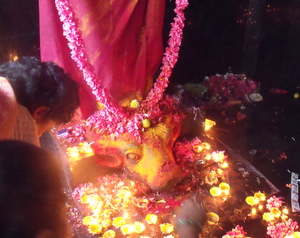 hymns in praise of Her. They believe that this will keep their husbands in well-being and long life and also protect them from the evil effects of the demon Rahu. It is a touching sight to see the devotion of these Sumangali women who queue up in large numbers to perform this ritual.
The second is the Sri Chakra cult where-in Sri Chakra puja is performed on certain auspicious days. Inside the temple precints, there is a beautiful stone-carved Sri Chakra Mehru installed in a special
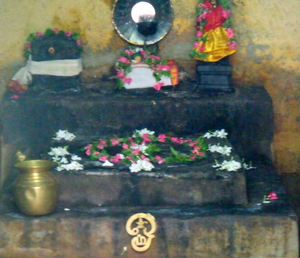 shrine. This Sri Chakra was consecrated by Bhagavan Sri Ramana himself and seems to emanate a very deep energy. Devotees are fortunate because this Sri Chakra can be seen and approached very close, unlike the one in Ramanashram which is deep inside the sanctum and can only be seen and approached by the priests.
The third cult is one of snake worship. In the temple
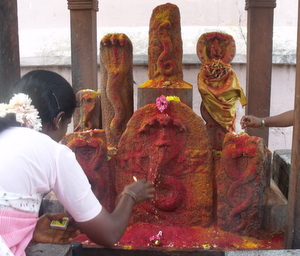 courtyard is an altar with a series of snake idols and women congregate here and perform puja with turmeric and vermillon to these idols, with their own hands. There is no intermediary of a priest in this case and this also speaks of the strong feminine aspect of this temple.
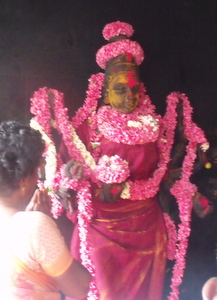 What is remarkable here is that in spite of the crowds that throng here all the time, the temple always has a tranquil and serene aura to it. This must probably be because the majority of the devotees here are usually women who come demurely and attend to their worship and other feminine rituals with quiet piety and grace.
continue reading
-
Ashtalingams – North – Kubera Lingam
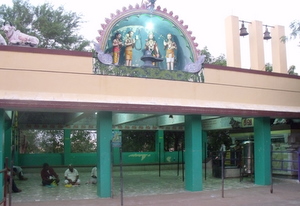 Kubera is the Hindu God of money, wealth and material possessions. Kubera does not create wealth but he is believed to be the one who distributes wealth wisely among deserving devotees.
In Hindu Scriptures, Kubera is the chief of the Yakshas and an ardent devotee of Lord Shiva. Once he performed penance for several years and Lord Shiva along with his consort Goddess Parvathi gave dharshan to Kubera. Kubera had not seen Goddess Parvati before and was astounded by the splendor and beauty of Goddess Parvathi who was bedecked with jewels. Goddess Parvati mistook Kubera’s staring for lust and she cursed him that one of his eyes should explode.
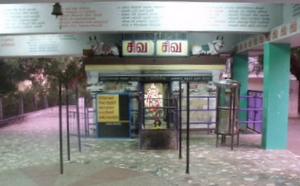
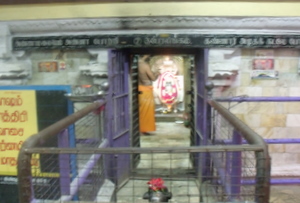 Poor Kubera was now left with only one eye and he then explained that he had no bad or lustful intention and that he had stared because he was dazzled by such beautiful gold ornaments the like of which he had never seen before. Goddess Parvati realized her mistake and immediately the one eye that Kubera had lost grew back but remained smaller than the other one. Shiva also made Kubera one of the Ashta Dikpalakas (the cardinal deities of the eight directions) and he thus governs the Northern direction. Goddess Parvati made him the god of wealth and material possessions as atonement for her curse.
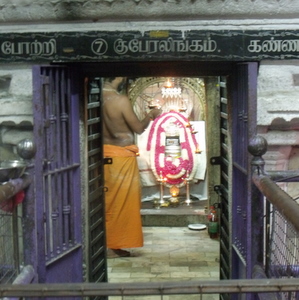 There is another legend which says that Kubera is the grandson of Brahma. He is also believed to be Vaisharavana who was the brother of Ravana. But Ravana defeated him and took his Pushpak chariot and exiled him to Kailash. It is here that he did penance and received the blessings of Shiva.
Kubera is often portrayed with a vessel studded with Navratnas (nine gems). He is also shown as showering gold. There are numerous legends associated with Kubera and the most popular one is associated with Lord Balaji or Venkateswara. It is said that Lord Balaji took a loan from Kubera to marry Goddess Lakshmi on earth. But the condition set was that Lord Balaji could not leave the earth until he paid back the debt. It is believed that till today Lord Balaji is paying interest on that loan to Kubera. And devotees donate liberally to help Lord Balaji repay his debt.
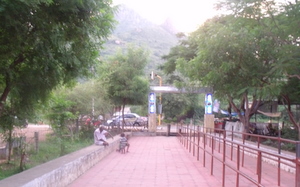 Kubera lingam shrine on the Arunachala Girivalam can be found about a few hundred metres before the Panchamukham. It is believed that Lord Kubera himself came here and worshipped Arunachala in order to maintain his wealth and prosperity. Hence a Shiva lingam was installed and consecrated here at this point which is situated exactly north from the mountain. Many devotees throng here
 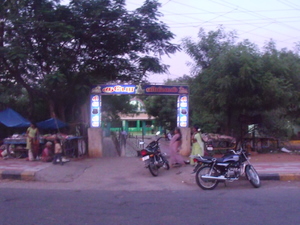 with the hope that they become rich like Kubera, not understanding the true spiritual significance of wealth.
continue reading
-
Ayudha puja, Saraswathi puja & Vijaya Dasami
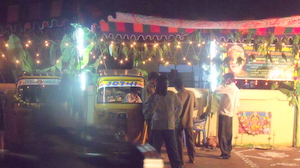
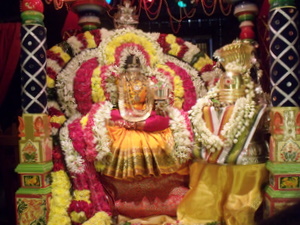 The ninth day of Navarathri is celebrated as Ayudha puja and Saraswathi puja. Ayudha means weapon or tool and on this day every tool or instrument which serves us in daily life is honoured in a special way. Even transport vehicles are included and the auto stand in front of Ramanashram bore a festive look as all the autorickshaws had been cleaned and decorated and a puja was performed there by the drivers in the evening.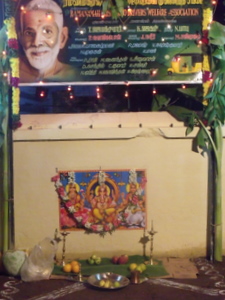
Saraswathi puja is celebrated in the houses of artists and scholars and on this day they honour their musical instruments, books of learning and other articles of study which are believed to be the abode of
 Saraswathi, the Goddess of wisdom. The Ramanashram book shop celebrated Saraswathi puja and the whole place was cleaned and decorated. Sandal paste and vermillon were applied everywhere and flower garlands festooned the entrance. After the puja, pufffed rice and sugar candy are distributed to one and all as prasad.
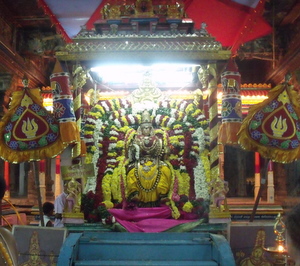 Vijaya Dasami is the tenth day after the nine nights of Navaratri and signifies the victory of the Goddess Durga over the powers of darkness. While performing the tapas of atonement, Parvathi was assailed by the evil demon Mahishasura who tried to seduce her. When She refused to fall to his wicked wiles, the demon tried to fight Her and win Her by force, right there on the slopes of Arunachala. Undaunted, the brave Parvathi took the form of Durga, the
 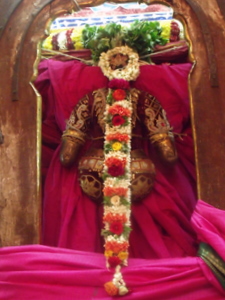 fierce Shakthi and screamed at Mahishasura, “This is a sacred place where only sages and devotees of Arunachala can reside, therefore do not incur the wrath of my Lord and be burnt by Him. It is ordained that I should fight and kill you.”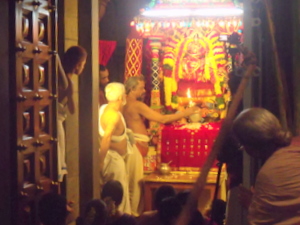
Hence She took him outside the borders of Tiruvannamalai. After a nine day battle She slayed him and returned to Tiruvannamalai truimphantly, where She continued her tapas on the slopes of the holy mountain. Thus the Navaratri festival although celebrated all over
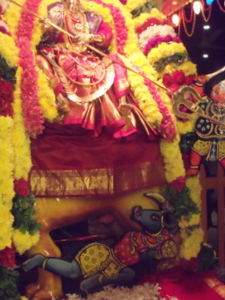 India, has the greatest significance in Tiruvannamalai.
continue reading
-
Navaratri
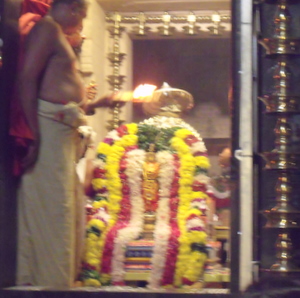 Navaratri is a festival of nine nights dedicated to the Goddess Shakthi (Parvathi or Amba) in her different manifestations. The legend of Navarathri starts with the penance of the Goddess on the slopes of Arunachala. Separated from her Lord (due to having playfully closed his eyes with her hands), the Goddess yearns to be reunited with Him. The great sage Guatama advises her to perform penance on the slopes of the holy Hill Arunachala and accordingly she comes here and sits in Tapas (penance). She follows the various scriptural injunctions and exhibits her devotion to the Lord in various ways. During the nine days of penance she manifests herself each day in one of her different forms.
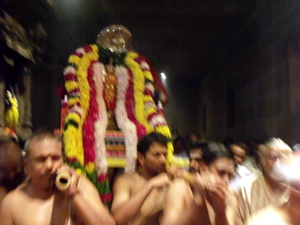 In Ramanashram, the Navaratri festival is celebrated in a grand way. On the night of Mahavalya Amavasya, the goddess Yogambika is brought out of her niche in the Mother’s shrine and taken on procession around the Samadhi of Ramana. After this, she is installed in a beautiful decorated pedestal behind the Nandi of the Mother’s shrine. Every night for nine days, the goddess is decorated splendidly in silk attire, gold jewels and flowers, depicting each day a different aspect. After the Alamkaram, arathi
 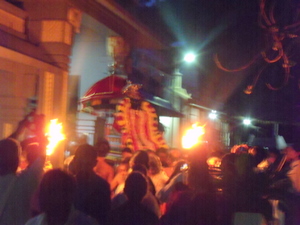 puja is performed by the priests in an elaborate manner. Hundreds of devotees from all over throng the new hall every evening to witness this spectacle.
It will be interesting to see what Bhagavan Sri Ramana had to say about this celebration. In Letters from Ramanasramam, Suri Nagamma recounts to her brother in a letter dated 27th January 1946. “You have seen the decorations made in the shrine of Mathrabhutheswara on the first day of Navarathri festival last year. There was a different type of decoration every day in accordance with the puranic story that Amba went out to do Tapas as she could not bear the separation from the Shiva. So the idol of Amba was
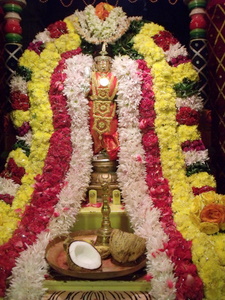 decorated suitably and was put in the shade of a tree. After the night meal was over that day, Bhagavan was taken to that place and was shown that idol. Next morning in the hall, while talking about the ornamentation in the temple and in this shrine, Bhagavan said, “Yesterday’s ornamentation was intended to show that Amba was doing Tapas. Unable to bear the separation, she goes out to do Tapas (penance) here. But Parvathi is depicted as sitting in a stylish pose under a tree to do Tapas, wearing a silk sari, gold jewels and flower garlands! What our people do is always like this. Tapas means meditation connected with the practice of self-denial or bodily mortification, does it not? Amba is reported to have closed the eyes of Shiva with both her hands for fun and to expiate that sin, Parameswara asked her
  to perform penance, and so she left her husband, went to a lonely place, and in self-mortification, forgot about her body, became weak and with great austerity, performed Tapas. But see the way Amba is now decorated to depict that story. She is dressed like a Maharani with diamonds and emeralds and gold ornaments and wearing a silk sari and flower garlands !”
continue reading
-
Ashtalingams – Vayu Lingam – North-West
Vayu is the Hindu god of wind and he is often associated with Indra. His other names are Pavana, the Purifier, Gandha-Vaha bringer of perfumes and Satata-Ga the Ever-moving one. He is a fierce god and drives his horses furiously. He is considered to be the god of rapid motion and therefore the father of the fleet-footed.
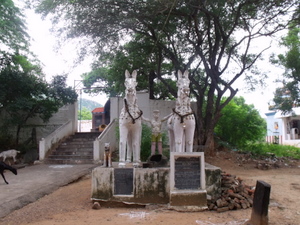
Vayu is believed to be the father of Hanuman who could move with the speed of wind and of Bhima, brother of Arjuna, who was called the Swift. The storm-gods, the Maruts, are his children, born from a daughter of Tvashtri, the divine carpenter. Many hymns have been written to him. One legend says that Narada the sage asked him to blow strongly enough to break off the top of Mount Mehru, the holy mountain. Vayu blew and blew, but in vain, for Garuda, the vehicle of Vishnu, spread his wings over the summit to shelter it and even the most terrific storm failed to move it.Then Narada told him to watch Garuda, and if for a moment the great bird lifted his wings, he could try again to break the summit away. Such a moment came and Vayu blew the top of the mountain off and it landed in the ocean where it now rests as Lanka or Ceylon.
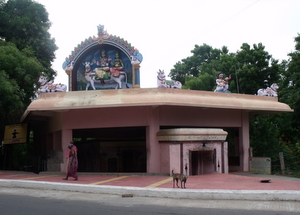 The Vayu Lingam shrine is found on the left side of the outer girivalam road about one kilometer after the village of Adi Annamalai. Though it now presents itself as an ordinary modern concrete structure, the remarkable feature of this shrine still remains from the olden days. At any time of the day when one enters the shrine one is always greeted by a gust of wind and this happens even on the stillest, warmest day!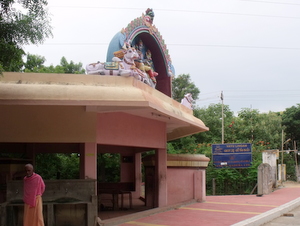
continue reading
-
Arunachala Panchamukham
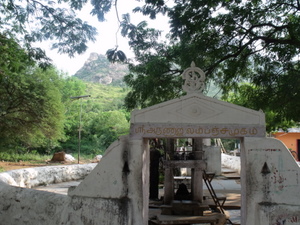 When one walks along the outer giripradakshina path, about a hundred metres after the Kubera Lingam shrine, one can see on the right a curious shrine with five small Shiva Lingams on a raised pedestal circumscribed by a round stone platform. It is titled Arunachala Panchamukham in tamil old-fashioned script. If one looks at the mountain from this point there are distinctly five peaks visible with very beautiful contours. This is called Panchamukham – the five faces. The five peaks here represent the five aspects of Lord Shiva viz., Satyajotam, Vamadevam, Tatpurusham, Eesanyam and Aghoram. And a giripradakshina cannot be complete unless one has taken dharshan of the Panchamukham.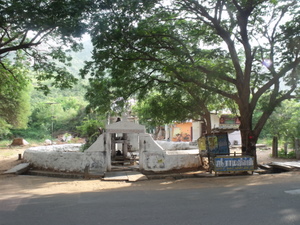
A devotee recalls, “Near the Panchamukham, at sunrise or sunset, especially during the winter months, the sun’s rays pierce the mist and spotlight the peaks. The interplay of light and shade creates patterns, highlighting the transcendental beauty of the outline of the hill. The successive peaks split the light into ribbons that trail off. The interspersing light re-emerges, exhibiting the majestic and imposing
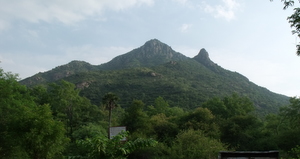 splendour of the Lord in all His glory…”
Today, unfortunately the view of the Panchamukham is marrred by the construction of an ugly modern concrete structure, supposedly a shrine for Goddess Durga. One wonders if She would at all be
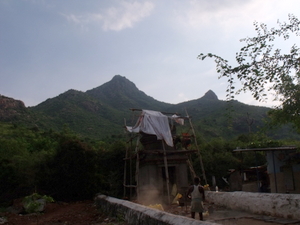 happy to have a temple that actually spoils the sacred beauty of this revered spot!
continue reading