Festivals
-
Ganesha Chathurthi
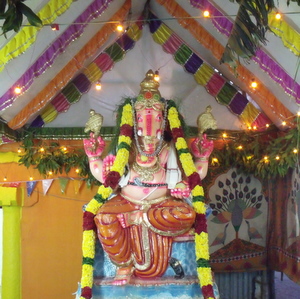 Hindus believe that Lord Ganesha is the God who has the power of removing all obstacles and making one’s path clear whether it be worldly or spiritual. Any new undertaking, either at one’s place of work or at home, always starts by reciting a mantra invoking his blessings. He is also known as the God of good luck and prosperity. Ganesha Chathurthi, which is the birth anniversary of Lord Ganesha, is celebrated in a grand manner all over India and in Tiruvannamalai too. This year, Ganesha Chathurthi fell on the 11th of September and in the Sadhu Mandapam opposite Agni Theertham, a spectacular Ganesha of giant proportions was installed and worshipped with great pomp and splendour.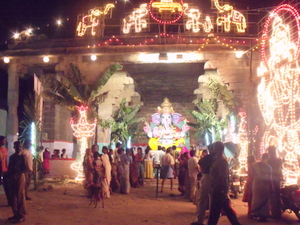
The most popular legend associated with Lord Ganesha can be found in the Shiva Puranam. Here it says that Lord Ganapati was created out of the dough that Goddess Parvati used for her bath. The Goddess wanted a gate-keeper, to keep visitors away while she took her bath. So She created a male doll from the dough and breathed life into it. The day she did this came to be known as the birthday of Lord Ganesha, which we celebrate today as Ganesh Chathurthi.
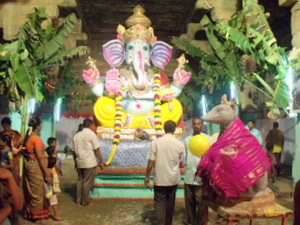 One day while Goddess Parvati was taking her bath, Lord Shiva came to visit her. Ganesha did not know him, so he did not allow the Lord to enter the house. This made Lord Shiva angry and he cut off poor Ganesha’s head. Later, when he came to know the truth, he replaced Ganesha’s head with the head of an elephant. After this, the appearance of Lord Ganesha changed and he became the elephant-headed god.
There is yet another popular legend associated with Ganesha Chaturthi, from Skanda Puranam. Here it says that once Ganesha was invited for a feast in Chandraloka (the Moon’s abode). Our Ganesha being quite fond of sweets, ate Laddoos till his stomach bloated, so much so that as he got up to walk after the meal, he could not balance himself because of his huge stomach and he slipped and fell. His stomach burst and all the laddoos came rolling out. Seeing this, the Moon was highly amused and burst out laughing. Ganesha got angry and cursed the Moon that it would vanish from the universe.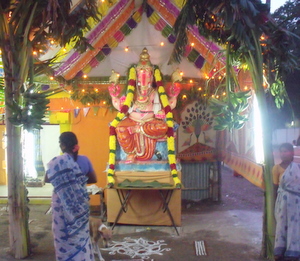
Because of the Moon’s disappearance, the whole world began to wane. The gods asked Lord Shiva to get Ganesha to revoke his curse. The Moon also apologized for his misbehavior. Finally, Ganesha modified his curse saying that the Moon would be invisible only on one day of the month and would be partially seen on Ganesha Chaturthi. He also added that anyone who looked at the moon on Ganesha Chaturthi would face a
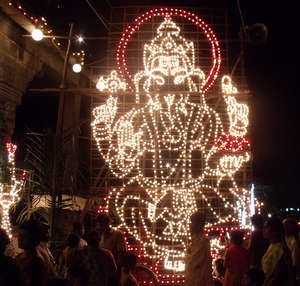 false charge. This is the reason why, even today, it is considered inauspicious to look at the moon on Ganesha Chathurthi.
continue reading
-
Aadi Puram
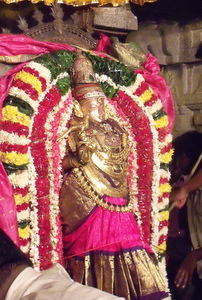 The tamil month of Aadi (sanskrit = Aashaada) has drawn to an end and the Goddess Shakthi to whom the whole month is dedicated is probably taking a much-needed rest after the frenzied rituals and celebrations with which she has been bombarded during all this month.
The culminating festival in her honour is the feast of Aadi Puram which falls on the Puram constellation. This year it was celebrated on August 12th and in the big temple of Arunachaleswara, there took place a grand religious and devotional extravaganza on this day.
In the evening, the Goddess Parashakthi is brought to the valaiyal kappu mandapam in the 5th courtyard. Here first the Goddess is worshipped with a grand abhishekam. Then She is beautifully adorned in a silk sari and decked with golden ornaments and flowers. After this a long queue of women devotees offer bracelets and bangles (valaiyal) to the Goddess. The priest places the bracelets on Her arms and then returns them to the women as prasad. Rudram is chanted by the Vaidikas all the while.
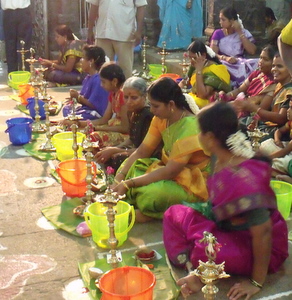
This Valaiyal kappu (protection with bracelets) ceremony is traditionally performed for preganant women in their 8th or 9th month. On Aadi Puram, this ceremony is performed to the Goddess as it is a general belief that She is at this time expecting the birth of Muruga or Subramanya, the second son of Shiva and Parvathi.
However the logic which underlies the sequence of the rituals of Aadi Puram is quite enigmatic. Whereas the the ritual of valaiyal kappu is especially to protect the woman who is in an advanced stage of pregnancy, in the next ceremony after this, the Goddess is treated as a young virgin woman about to get married and receives the
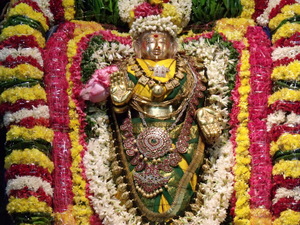 offering of a Thali, the traditional ornament of marriage. There seems to be in the celebration of Aadi Puram, an effect of condensation of all that the Goddess represents. This is amplified by the local cults of the Aadi month and the connection to Durga and is completed in the ensuing months with the Navaratri festival in autumn and the Karthikai festival in winter.
continue reading
-
Amman Kooluthal festival
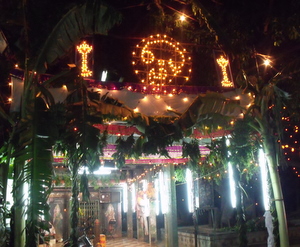 In the month of Aadi (July-August), which is devoted to the Mother Goddess (Amman), there is a popular rural celebration in Tamil Nadu called the Kooluthal festival. Kool is a type of gruel made of fermented ragi batter and at this time, each family prepares a pot of Kool and offers it at the local Amman temple where it is poured into a huge cauldron and offered to the
 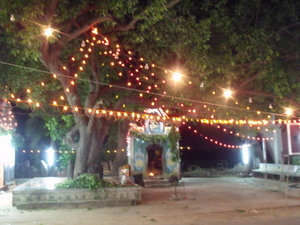 resident Goddess (usually MariAmman, a rural form of Parvathi). This is then distributed to one and all as Prasad. During the festival, the whole main street from the temple is
 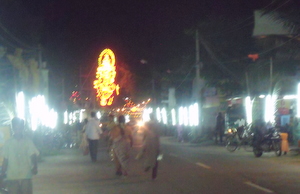 decorated with banana and palm fronds and shiny coloured lights are strung everywhere. There are also enormous lighted cut-outs depicting the Goddess which blaze at night and strike the attention of every passer-by.
This week in the village of Adi Annamalai, the Kooluthal festival was celebrated on a
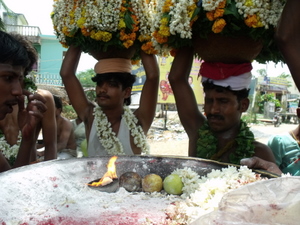
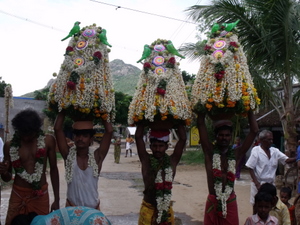 grand scale. The morning after the distribution of the Kool, the ritual with the karagam dancers was performed. This involves a group of male dancers, some with flower-decorated pots balanced on their heads, musicians of three sorts, a few with drums, some others with waving cymbals and more others with
 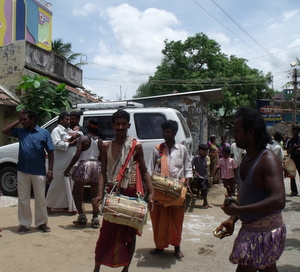 bells tied around their feet and brass rings in their hands. This group makes a tour of all the streets in the village. The ones with the pots on their heads are considered to be embodiments of the Goddess and are worshipped by each family with women washing their feet with pots of water, applying turmeric and vermilion on their feet and then prostrating on the ground in front of them.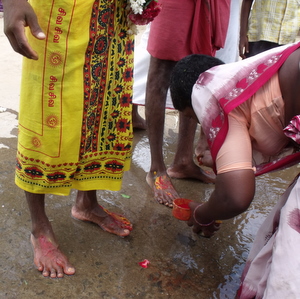
In the evening, the Goddess is brought out in procession and fireworks are set off. Later that night there is much fun and merry-making among all the people. Film shows, dramas and other entertainment shows take place in the ground outside the temple and the rural folk relax and enjoy themselves.
This is the time of year when summer is drawing to an end and the first rains have arrived. People are relieved that the great heat
 is over and that they can start the next season of cultivation soon. It is a time of hope. The Goddess is propitiated with the belief that the rains will be bountiful and that they would reap a good harvest and have prosperity in their lives with Her blessings.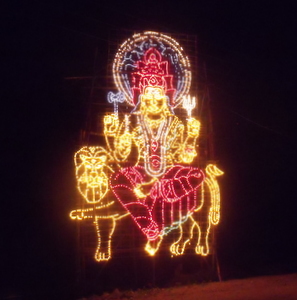
continue reading
-
Guru Purnima
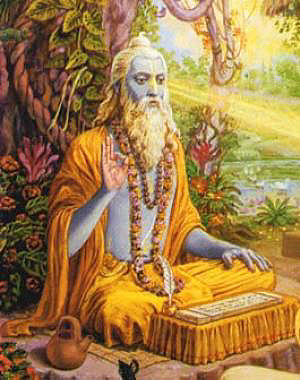
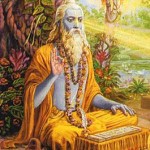 The full moon which appears in the Hindu month of Aadi (Aashada) (July-August) is observed as the auspicious day of Guru Purnima, a day sacred to the memory of the great sage, Vyasa. Indeed, we are all indebted to this ancient saint who edited the four Vedas, wrote the 18 Puranas, the Mahabharata and the Srimad Bhagavata.
On this day, all spiritual aspirants and devotees worship their guru and all disciples perform a ‘puja’ to their respective spiritual preceptor or ‘Gurudeva’.
Moreover, this day is of great importance to the farmers, for it heralds the setting in of the much-needed monsoon rains, as the drenching of the cool rain on the earth after the hot summer makes everything grow and become green and lush again. It is also considered as a very beneficial time for all spiritual practices. Traditionally, spiritual seekers are taught to intensify and take seriously their spiritual ‘sadhana’ from this day.
 The period ‘Chaturmas’ (“four months”) starts on this day. In puranic times, this was the period when wandering spiritual masters and their disciples used to settle down at a place to study and discourse on the Brahma Sutras composed by Vyasa, and engage themselves in Vedantic discussions.
In Tiruvannamalai, the spiritual centre of the universe, millions perform giri pradakshina and walk around the holy mountain Arunachala with the earnest hope of gaining spiritual wealth from the Guru of Gurus, the timeless embodiment of the Self in the form of an earthly mountain. May we all surrender to his Holy Feet on this Guru Purnima and realize the true Arunachala who shines in the depth of every heart!
continue reading
-
Dakshinayanam
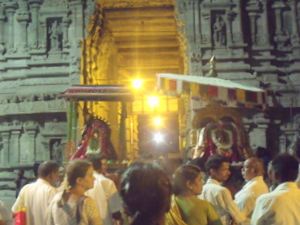 The term Dakshinayanam literally means southern journey. Here it refers to the Indian Summer solistice, for in hindu puranic yore the Sun is believed to move towards the South at this time. It seems to accentuate the idea that we are entering the darker part of the year – less sun, more rain, longer nights…
As Arunachala is also revered as the Sun mountain, events involving the Sun are always celebrated here as a festival.
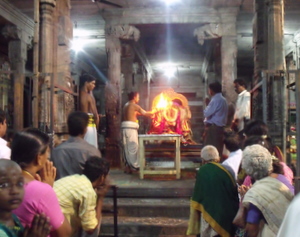
The Dakshinayanam festival begins in the big temple exactly 10 days before the summer
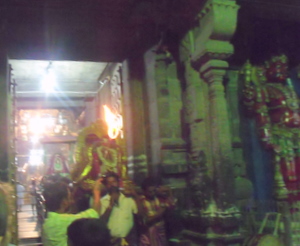 solistice which, in India, falls around the 17th of July. It takes place on the usual course of an Utsavam (temple festival). Even though the meaning of the festival is not very explicit, one can eventually glean the cosmic dimension in it, for, at this time of year such a festival seeks to define the auspicious period in which the idea of death leading to ascension is highlighted in a most subtle way.
Each day in the morning around sunrise and in the evening around sunset the different gods of the hindu pantheon are taken out on procession. The yagasala is opened since the first day and two kalasams representing the Sun
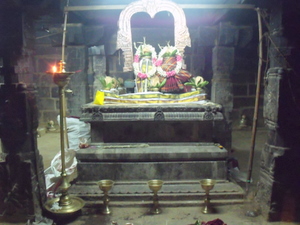 (Surya) and his wife, Chaya (the Shadow) are venerated according to vedic rituals for the first 9 days. On the 10th day, at the culmination of the festival, the kalasams are brought outside on procession with the gods and taken inside the main shrine for bathing the deities.
The main difference between the Dakshinayanam and the Uttarayanam (Northern Journey – winter solisice festival) is the place accorded to the Tiruvoodal (divine quarrel). Whereas it stays as a private affair now and is only performed within the walls of the
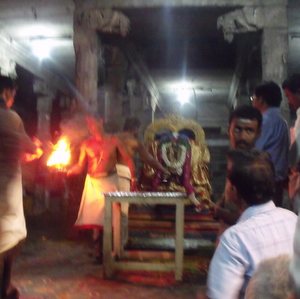 temple shrine, at Uttarayanam, the Tiruvoodal is a public affair and taken right to the streets and enacted in the view of the public. One wonders why and the answer is “even the Gods like to keep their affairs in the dark at this time!”
continue reading
-
Chitra Pournami
 This is the full moon in the month of Chithirai in conjunction with the Chaitra or Chitra constellation. It is a one of the special full moons of the year and the word chitra means brilliant or colourful from which the term chitrakar is derived meaning painter-artist or magician.
On this full moon night, the legend of Chitragupta is narrated among families.
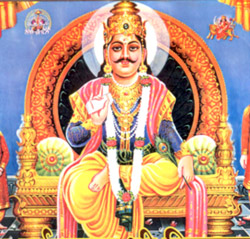
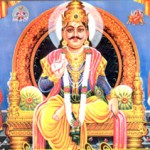
Chitragupta is the Hindu god, who is assigned with the task of keeping a complete record of the good and bad deeds of human beings and after their death, judge them whether they should go to hell or heaven, depending on their actions on the earth. In some beliefs, Chitragupta is the creation of Lord Brahma and the younger brother of the god of death, Yama. According to Hindu mythology, Brahma is the creator of the whole world. He first created sixteen sons from different parts of his body. Then lord Brahma created his seventeenth son Chitragupta from his belly. Chitragupta is also called `Kayastha` as he was created from the Kaya(body) of Lord Brahma. He is a divine incarnation in human form. Chitragupta has eight sons namely Gorh, Mathur,Bhatnagar, Saxena, Asthana, Srivastava, Ambastha and Karn. The Hindu religion believes in the cycle of life, death and rebirth. It is believed that those who have done misdeeds in life have to take rebirth after a punishment period in hell to complete their life cycle. The primary duty of Chitragupta is to create a log of the lives of all human beings. After the death of each creature, Chitragupta judges and decides whether they will attain ‘Moksha’ or go to heaven for their good-deeds and get redemption from all worldly troubles or receive punishment for their sins in another life form or in hell.
It is a general belief that on this night, any religious act of absolution like bathing in sacred waters or pradakshina around a holy mountain will propitiate Chitragupta who may
 obliterate the records of one’s bad deeds as a result. Hence millions come to Tiruvannamalai on this night to do giri pradakshina.
Interestingly, the nakshatra Chitra is placed under the protection of Tvastr, the divine carpenter of hindu mythology who supposedly crafted the living creatures, It is believed that he is also associated with the fire and lightning bolt of Indra as well as serving as priest to the Asuras.
continue reading
-
Vasantha Utsavam – Part II – the celebrations
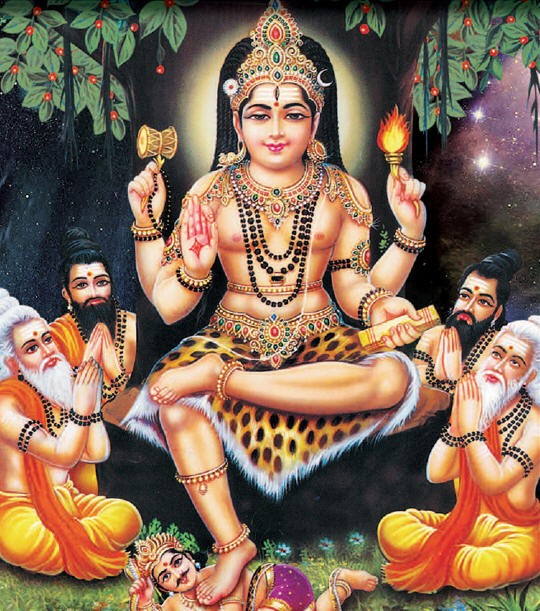
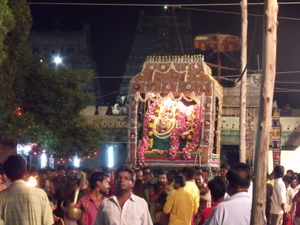
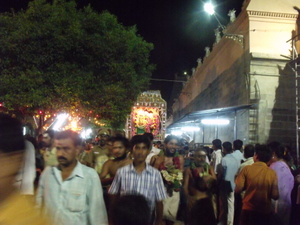
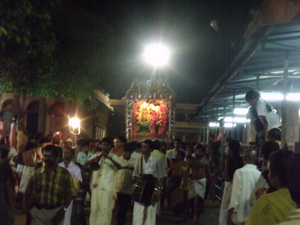
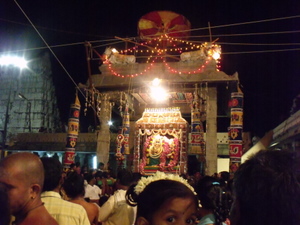
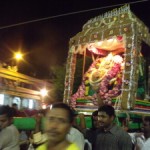
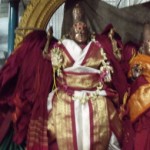
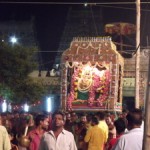 The deity of this festival is Lord Somaskanda, a form of Shiva and Parvathi, usually found in a shrine on the south-western corner of the main temple of Lord Arunachala. From the first day of the festival upto the ninth, every night around 10 o clock, the gods are brought outside to the third courtyard of the temple, installed in a special palanquin
 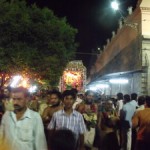 and there ensues an elaborate procession-celebration of the Gods in the form of ten splendid, event-filled tours around the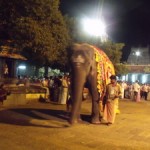
Makila trees lasting till well over midnight. The significance of the “Makila tree” (mimusops elangi) : the tamil verbe makil means to enjoy, to desire and the noun makilchi means joy, exultation or ecstasy. Makiltaran is one of the names of the god Kama. The word makila is often pronounced makuta meaning crown and refers to the coronation of Shiva as the sovereign of the universe.
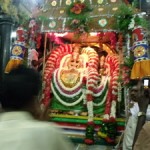 After coming out of his shrine, Somaskanda is installed on the first pandal just in front of the golden flag pole facing the main shrine. Here the Gods are placed under a lovely canopy of fragrant cooling roots called vilamichaiver vimanam (vilamichai root canopy) hand-made by artisans specially for this occasion, and worshipped with offerings of flowers, diparadhana (waving of lights) and karpuraratti (burning of camphor) with the accompaniment of the temple musicians on their mridangam and nathaswaram.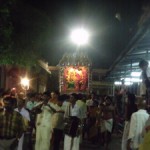
Next the Lord is brought to the second pandal, the
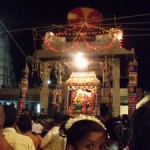 panneer mandapam, where he is greeted at first with the lovely fragrance of panneer (rose-water) which is sprinkled copiously from the top. An offering of diparadhana is made and the priest sthanikar climbs on the pedestal and sits at the feet of the Gods. Along with the kalasams Soma
 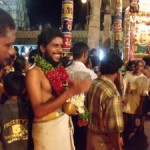 and Kama, the Gods are decorated with garlands. And then to the delight of the already excited spectators,
 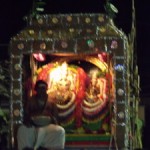 the Gods perform a frenzied ritual-dance in front of the mirror placed on the adjacent gallery, with the musicians playing accompaniment with great fervour. Now the Gods settle down under the panneer mandapam to witness a series of elaborate rituals whose significance should not be lost. The showering of flowers on the Gods by the Gandharva Kanni (the virgin-nymph) is
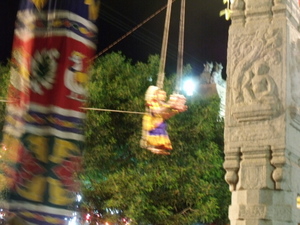
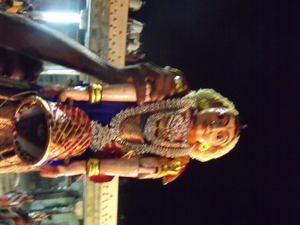
 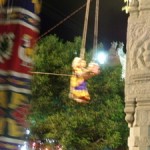 enacted by a puppet activated by strings attached from the adjacent gallery terrace. In a very beautiful show which is enthusiastically cheered by all the spectators both old and young, the lovely
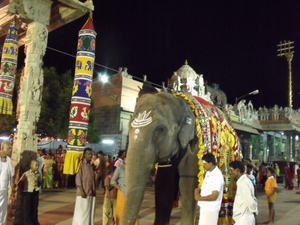
 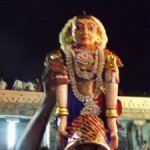 gandharva kanni puppet comes many times, seemingly out of thin air, and showers buckets of rose and jasmine flowers on the Gods. It is indeed a marvellous spectacle! Then a priest pours a pot of water with five vilva leaves in front of the deities and makes an offering of lights. During all this time, the stately temple elephant stands in attendance, donned in its festive robes. In the past it would gently fan the Gods with a venchamaram (sacred white fan made of peacock feathers and silk).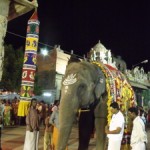
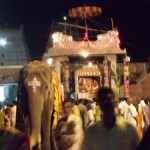
After these rituals, the ten processional rounds take place and the gods are borne on their palanquin ten times around the makila trees enclave led by the elephant and accompanied by the musicians and singers and followed by devotees. At the completion of each round, the gods dance in front of the mirror and then remain seated under the panneer mandapam where they receive two floral showers by the Gandharva kanni and diparadhana (light) offering.
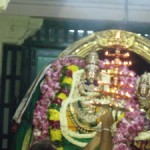
The significance of the Gandharva Kanni (celestial virgin nymph) : The Gandharvas are celestial beings and also musicians. They are the guardians of Soma, the divine nectar of immortality and divine teacher of the Moon who is also called Soma. They are the parents of the first human beings, the brother-sister couple Yama and Yami. The Gandharvas are attributed with a mystical power over women and the right to possess them. They are invoked in traditional hindu marriage ceremonies and in the brahmin tradition, the bride who is to be married is supposed to belong first to Soma, to Gandharva and to Agni before becoming the wife of a
 human being. A gandharva marriage is a marriage of love (not arranged). The chief of the Gandharvas is Chitraratha. The wives of the gandharva men are usually celestial damsels, apsaras. In the present festival, the appearance of the Gandharva kanni would mean to manifest, in a nubile form, the expression of desire and the virtue of union as well as the other elements which are associated here-in (flowers, fragrance, music).
 Special days of the festival: The special days are the 3rd, 5th, 8th and 10th days. On the 3rd day, the birth of Kama is supposed to happen, (this was enacted by a temple danseuse disguised as Kama in the olden days).
The 5th and 8th days: On the 5th day, during the 3rd round, Somaskanda makes a halt in front of the main Dakshinamurthi statue under the Makila trees and two priests perform simultaneously one puja to each of the deities with
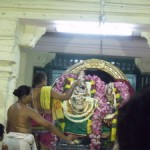 food and light offerings, the synchronisation of the pujas highlighting the unification of the two divine forms. After the 10th round, Somaskanda is taken inside the Kalyana mandapam where he is divested of silks and jewellery and re-adorned in a new alamkaram made entirely of flowers and green leaves (spring costume).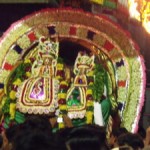
When the Gods come back outside, the entire lights of the temple are switched off and the Gods make a special tour of the 3rd courtyard with only the light of flaming torches made of rings of plaited straw thereby representing the olivu-vattam, circle of light which designates the moon
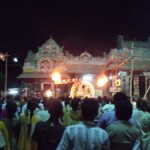 (Soma).
On the 8th day, Somaskanda is taken inside
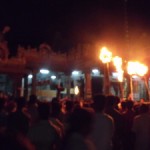
the Vasantha mandapam which is at present the temple
administration office and after changing to spring costume, brought outside and again all the lights are switched off and the same olivu vattam tour takes place but this time in the opposite or anti clock-wise direction (apradakshina). Thus the Gods arrive from the left side whereas his musicians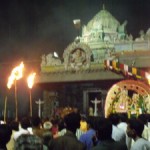
and singers come from the right and they meet in front of the main pandal. In the olden days, the devadasis danced the pinnal-kollattam and one of them, disguised as Kama, was bound in cords.
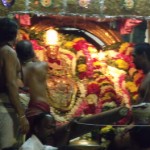 The 10th and final day: Around 10 o clock in the morning, after the uchikala ritual, Somaskanda and the Goddess go outside the temple on procession in palanquins. They are accompanied by the Astra Deva and the Palikkai. The procession winds its
 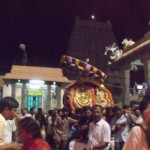 way up to the Ayyankulam, a sacred reservoir of water inside the temple of Arunagirinathar. Here the Teerthavari ritual takes place according to tradtion and the palikkai is thrown inside the water after the Astra deva,s holy dip in the water. The Gods return in procession to the big temple late in the evening. It is the full moon of Chitra. Somaskanda first performs a salutation dance in front of Sambanda Vinayaka while the Goddess is taken inside the shrine. Somaskanda is then borne to the Vasantha mandapam and installed on the front porch where he
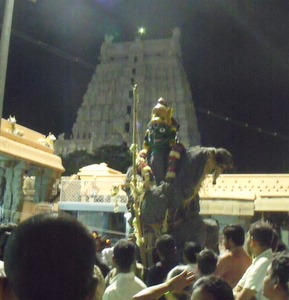
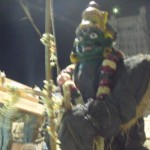 is worshipped with diparadhana and karpurarathi. And there he sits beaming benevolently at the crowds of devotees who are thronging at his feet. One would never imagine the terrible events that would follow. Lo and behold! Kama appears and starts to wield his bow and aim his flowery arrow at Shiva. Depicting this, a giant effigy of Kama made of straw holding a huge bow and arrow festooned in flowers is brought in on a wheeled contraption and placed facing Somaskanda. A string is tied connecting the two deities. Then with the help of the priests a fire cracker is lit at the hand of
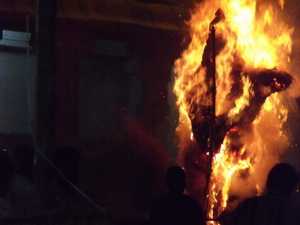
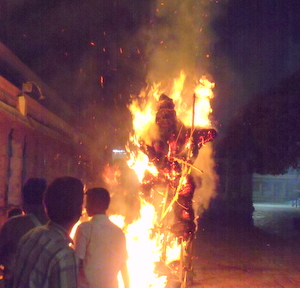
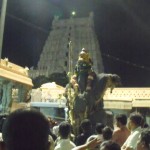 Somaskanda where it instantly takes off and whizzes down the string and reaches Kama and BOOM! Kama explodes into
 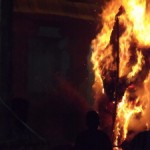 flames and is immediately wheeled back to the Makila trees enclave where he gets burnt up entirely. A magnificent display of fireworks then takes place in the temple courtyard, enthralling the crowds. After this Somaskanda is borne back into the temple and installed in his shrine.
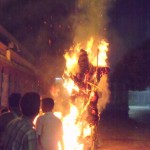 Thus Kama is destroyed by the wrath of Shiva in the festival. However, according to legend, Kama is later on resurrected out of the ashes after his consort Rathi appeals to Shiva and begs him to restore her husband. The death and resurrection of Kama represent the spiritual truth of how after the ego is destroyed, one is reborn as pure eternal Being. The fact that the flames from the third eye of Shiva burn Kama signifies that the third eye of Jnana (knowledge) in one’s heart must be opened in order for the ego (ignorance) to be destroyed for no darkness can prevail when the light of knowledge shines.
continue reading
-
Vasantha Utsavam, the Spring festival – Part I – a curtain raiser
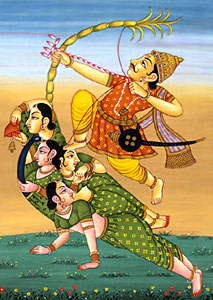
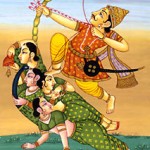 In Tiruvannamalai, the Vasantha Utsavam is celebrated to commemorate the momentous events that took place one fateful spring morning thousands of years ago, when Kama, the God of Love, decided to wield his Cupid´s bow and fire a flowery arrow into the heart of Lord Shiva himself who sat in deep meditation. Shiva, thus aroused, becomes furious and burns poor Kama to ashes with the flames of wrath leaping out of his third eye. Much later, Rathi the celestial consort of Kama appeals to Shiva in tearful agony and Shiva moved by her distress resurrects Kama out of the ashes.
This festival is celebrated alternately in the popular quarters of the town of Tiruvannamalai and inside the big temple of Arunachaleswara under the auspices of an Utsavam. In the town it is celebrated in 5 or 6 minor shrines dedicated to Devi or Subramanya. About two months prior to this, on the day of Masi Magam, a staff with a green standard is planted in the earth near the temple. To the bottom end of the staff is attached a pat of dried cow dung which bears the vaishnavite symbol of Kama. Although it is not used otherwise than in this ceremony, the pat of cow dung is the symbol representing the burning of Kama to ashes by the fire of Shiva. Following this incident, 10 days before the full moon of Chithirai, a little group of devotees from each temple march across the town in the evening bearing a tambour and a flag depicting Kama in the process of striking his arrows. They go from street to street singing the mournful strains of the Oppari (funeral) chant. Moreover, interspersed with the chanting, they recite the amorous exploits of Kama in coarse dialect. On the 10th day which is the full moon, an effigy of Kama made of lemon grass is dragged on the streets and burnt early in the morning in the presence of a character dressed up as Rathi and another dressed up as Shiva in meditation under the trees.
However, in the temple celebration, Kama is always resurrected, 3 or 5 days after his death. And with this idea, the ashes are collected in a little mound and in the midst of chanting Rathi pours milk on them as is wont in funerals. In some cases Shiva also gives a stick to Rathi with which to beat on the ashes thus showing that the Lord has accepted the appeal of the wife and that it is He who thus accords to Kama the right to live again.
In the temple also the festival is celebrated just after the vernal equinox which corresponds to midday of the gods day. It is notable that the 10th and final day of the festival coincides with the full moon of Chithirai in conjunction with the Chaithra constellation.
The preparations for the festival in the big temple consist of the following ceremonies:
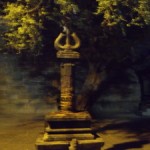
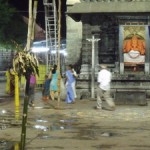 – the pandalkal muhurtam or the auspicious moment for defining the sacred space of the festival by the ritual of erecting the pandalkal or pandal pole. This is done in front of the shrine of the Sambandha Vinayagar who is freshly anointed with vermillion and showered with abhishekas for the occasion. Here on the ground the pandalkal decorated with mango leaves and flower garlands is firmly planted inside a pit which has been dug and consecrated earlier with bhumi puja ritual. After the pole is erected, diparadhana and arathi are performed.
– the Yagasalai or hall of sacrifice is opened on the first day in the evening after the sayarakshai ritual.
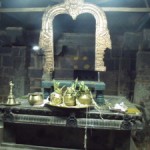
Here on the central platform, two kalasams, one representing Soma and the other Kama, have been placed on a mound of rice. The kalasams in this case are bronze pots filled with turmeric water and a coin, they are closed with a coconut surrounded by mango leaves crested by a knot of Dharba grass and decorated with a flower garland. Around the kalasam representing Soma, there are five palikai, little earthen pots in which the Navadhanya or the nine classic food grains have been germinated.
 The soil in the pots comes from the ground beneath the Vilva tree which grows near the shrine of Goddess Pidari amman. Puja is performed to the kalasams twice daily during the 10 day period of the festival.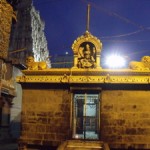
– A Kappu or protection bracelet is tied around the arm of god Somaskanda just after the first ritual in the yagasala.
The specific rituals of the Vasantha festival: They are connected to the Southern area of the 3rd courtyard of the temple where there are the three Makila (mimusops elangi) trees, (the sthala viruksha or sacred/special tree of Arunachala), as well as to the divine marriage hall or kalyana mandapam.
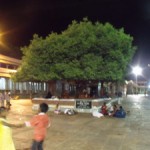
– the deities who are installed in shrines under the trees receive abhishekam and karpuratti puja daily twice during the 10 days.
 – inside the marriage hall right at the back, the Bhimaswera lingam is also venerated with abhishekam and puja during all the 10 days whereas this lingam is never venerated at any
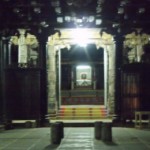 other time of the year. Interestingly the name of this lingam, Lord Bhima refers to the third brother of the Pandavas in the epic of Mahabharatham and it is he who gives Kama, the desire, the precedence over the three other goals of man (purusharthas)
 The principal and most attractive feature of the festival are the 10 splendid nightly tours of the god Somaskanda around the Makila trees with music and dance accompaniements and fanfare for the first 9 days of the festival. On the 10th day which falls on the full moon, the gods will go on a tirthavari procession to Ayyamkulam (ritual of the gods taking holy dip in a sacred pool) and on their return will take place the burning of Kama enacted in the form of an elaborate divine charade.
The celebration of the Vasantha festival dates back to very ancient times as learnt from the Bhavisyottara purana. Our next post will describe the actual proceedings of the festival with photos.
continue reading
-
Tamil New Year
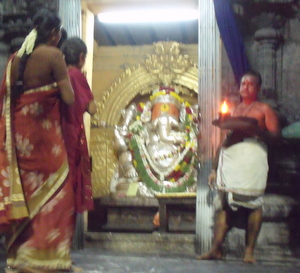 Tamil Nadu and Kerala are the only regions in India which follow the lunar calendar year (Chandra varusham) unlike the other regions which mostly follow the solar calendar year (Ravi varusham). The Tamil New year is born in the middle of April which is the first day of the month of Chithirai according to the Tamil calendar and it always begins on the new moon (Amavasya). People celebrate the new year like a religious festival and in Tiruvannamalai too, on this day they do giri pradakshina, perform pujas and religious ceremonies in their homes and then go to temples to worship the Lord.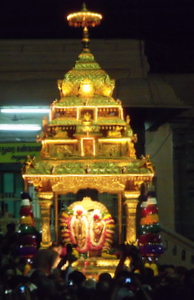
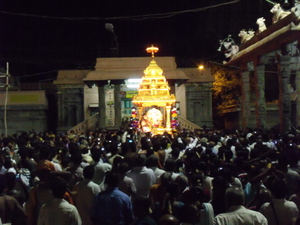
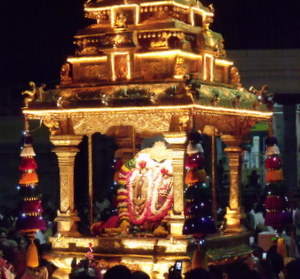
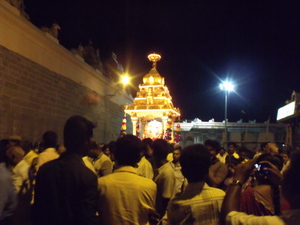
In the big temple of Lord Arunachaleswara, the beautiful golden chariot is taken out in honour of this day and the God and Goddess ride out on procession in all their magnificence and splendour. It is indeed a wondrous sight to see the Gods bedecked with jewels and flowers, seated majestically inside the chariot of pure gold and the air is rent with loud exclamations of wonder and piety as the chariot makes its way, around the vast courtyard of the temple, pulled by hundreds of earnest hands.
Earlier, the chief priest of the temple has read out the ‘Panchangam’ (traditional tamil almanac) with various predictions and auspicious interventions. The year born today is called ‘Vikruthi’. During the course of the month, the Nakshatra (constellation) Tiruvonam will be consecrated to Lord Nataraja and that of Satayam to the tamil saivaite saint Appar. But the main festival of the month is of course Vasantha, the spring festival which is dedicated to the death and resurrection of Sri Kama deva, god of desire. The spiritual significance of this is the destruction of worldly desire in order to give rise to the pure desireless being.

continue reading
-
Mahashivaratri
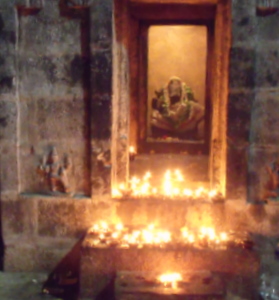 This year saw an unusual tilt to the annual Mahashivatri festival in Tamil Nadu for it was celebrated on two days due to a difference between the dravidian (lunar) and aryan (solar) calendars. So, after it was celebrated all over India in February, it was celebrated in March in some parts of TamilNadu notably in Tiruvannamalai.
At the big temple of Arunachala there were awesome kolams drawn on the floors representing Lord Shiva and his consort Parvathi. There was also an incredible array of oil lamps (more than 100000) burning everywhere, lit by devotees and creating an ambience of sacredness and piety.
 Giri Pradakshina was performed all through the night by hundreds well into the wee hours of the morning. Prasad was distributed at many of the lingam shrines on the path and the big temple hosted a live concert of Shivamani and his troupe which enthralled all the pilgrims and kept them awake, for the importance of this night is not to fall asleep.
continue reading